On this page
How to identify it
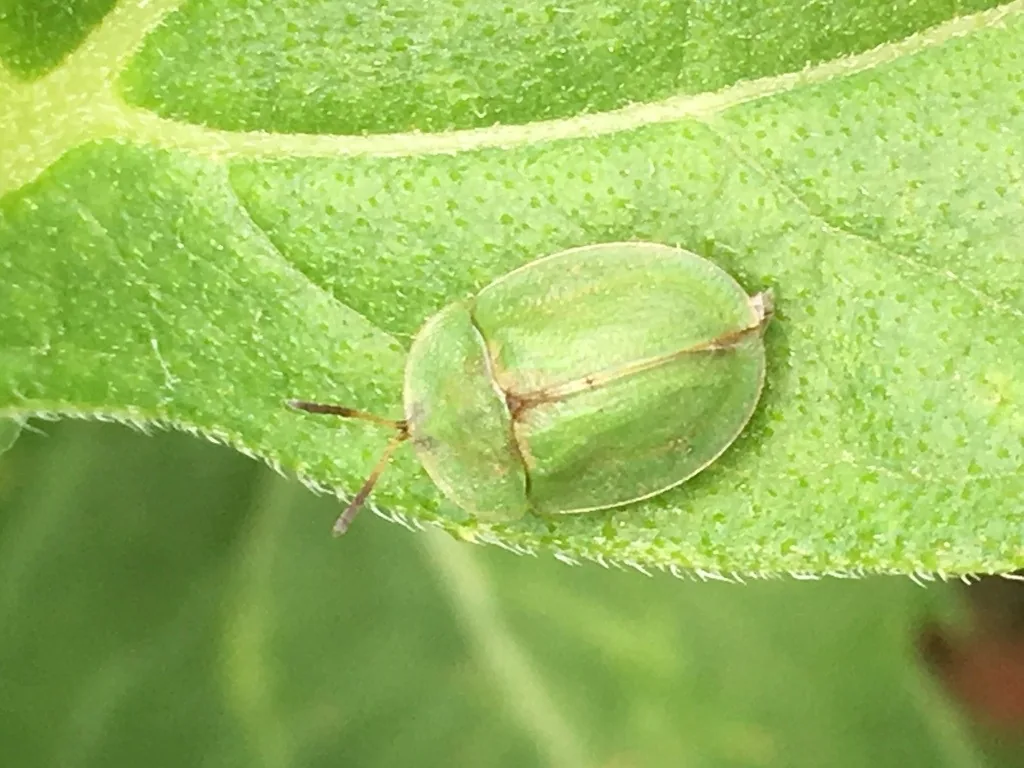
- A medium-sized tortoise beetle, 6 to 8 mm long (about 1/4 to 5/16 inch). Like other tortoise beetles, it is recognized by the flattened, outspread edges of its pronotum and wing covers.[1]
- The larva carries a shield on its back. It keeps each shed skin on a pair of tail prongs and also deposits its droppings there, building a large shield of droppings and old skins that it usually drops before it pupates.[1]
- Eggs are laid on the undersides of leaves, singly or in small groups, under a protective covering.[1]
Where it lives
Native across the Palearctic, from Great Britain and the Mediterranean through Siberia, Kazakhstan and Mongolia to the Kuril Islands and Japan. It was accidentally introduced to North America, where it quickly naturalized and spread, and it was deliberately released in New Zealand in 2007 against Canada thistle.[1][2]
Biology and life cycle
It specializes on the thistle tribe (Cardueae), the thistles and knapweeds. At least 21 host species have been recorded in its native range, mostly true thistles, but it strongly prefers Canada thistle, on which it is one of the most common plant-feeding insects in its native range.[2]
Besides Carduus and Cirsium thistles, larvae and adults feed on other plants of the thistle tribe, such as burdock (Arctium), milk thistle (Silybum) and Cynara, the genus of artichoke and cardoon.[1]
The whole life cycle, egg, five larval stages, pupa and adult, takes place on the host plant's foliage, and both adults and larvae eat leaves. The larvae stay on the plant where the eggs were laid, or on shoots touching it, because they cannot travel far over the ground.[2]
It has one generation a year and spends the winter as an adult, under leaf litter in hedgerows or at forest edges. Adults come out in spring to feed on young foliage and mate; the new generation of adults appears in summer and, after feeding, moves to its winter shelter. Adults are long-lived and can overwinter as many as three times.[1][2]
Adults pick host plants partly by smell. In tests, their attraction to the odors of different thistles and knapweeds, and their choice of plants to feed and lay eggs on, followed how closely each plant was related to Canada thistle. In New Zealand, researchers expect it to stay mostly on Cirsium and Carduus thistles.[3]
Damage and signs
- Its feeding is aimed mostly at weeds: it is one of the most common insects on Canada thistle in its native range, people helped spread it in North America as a possible control for invasive thistles, and New Zealand released it on purpose against Canada thistle.[2][1]
- Its host list does include cultivated members of the thistle tribe: larvae and adults also feed on Cynara species, the genus of artichoke and cardoon.[1]
Health risk
It is a leaf-feeding beetle of thistles, and none of these studies describes any risk to people.[1][2]
Control
Prevention
No control is needed where it feeds on thistles. People helped spread it in North America as a possible biological control for invasive thistles, and New Zealand released it on purpose against Canada thistle.[1][2]
Common questions
- Why does the larva carry a pile of debris on its back?
- It is a shield made of the larva's own shed skins and droppings, held up on a pair of tail prongs. The larva usually drops it before pupating.[1]
- What plants does the thistle tortoise beetle eat?
- Only plants of the thistle tribe. Canada thistle is its favorite, and other recorded hosts include Carduus thistles, burdock, milk thistle and Cynara, the genus of artichoke and cardoon.[2][1]
- Is it a biological control agent?
- Yes. New Zealand released it on purpose in 2007 against Canada thistle. In North America it arrived by accident, and people helped spread it as a potential control for invasive thistles.[2][1]
Sources
- Scientific Reports (Nature Portfolio), full text in PubMed Central (PMC6624315), “Kutcherov, Lopatina and Yermakov. Effects of Temperature and Photoperiod on the Immature Development in Cassida rubiginosa Mull. and C. stigmatica Sffr. (Coleoptera: Chrysomelidae). Scientific Reports 9: 10047 (2019), doi:10.1038/s41598-019-46421-3.” doi.org/10.1038/s41598-019-46421-3 (accessed 2026-11-09)
- Frontiers in Plant Science (Frontiers Media), full text in PubMed Central (PMC4994537), “Cripps, Jackman, Roquet, van Koten, Rostas, Bourdot and Susanna. Evolution of Specialization of Cassida rubiginosa on Cirsium arvense (Compositae, Cardueae). Frontiers in Plant Science 7: 1261 (2016), doi:10.3389/fpls.2016.01261.” doi.org/10.3389/fpls.2016.01261 (accessed 2026-11-09)
- Pest Management Science (Wiley, for the Society of Chemical Industry), indexed in PubMed (PMID 37450765), “Hettiarachchi, Rostas, Sullivan, Jackman, van Koten and Cripps. Plant phylogeny determines host selection and acceptance of the oligophagous leaf beetle Cassida rubiginosa. Pest Management Science 79: 4694-4703 (2023), doi:10.1002/ps.7669 (abstract).” doi.org/10.1002/ps.7669 (accessed 2026-11-09)
- iNaturalist, “Cassida rubiginosa taxon page (order and family).” www.inaturalist.org/taxa/216166 (accessed 2026-11-09)