On this page
How to identify it
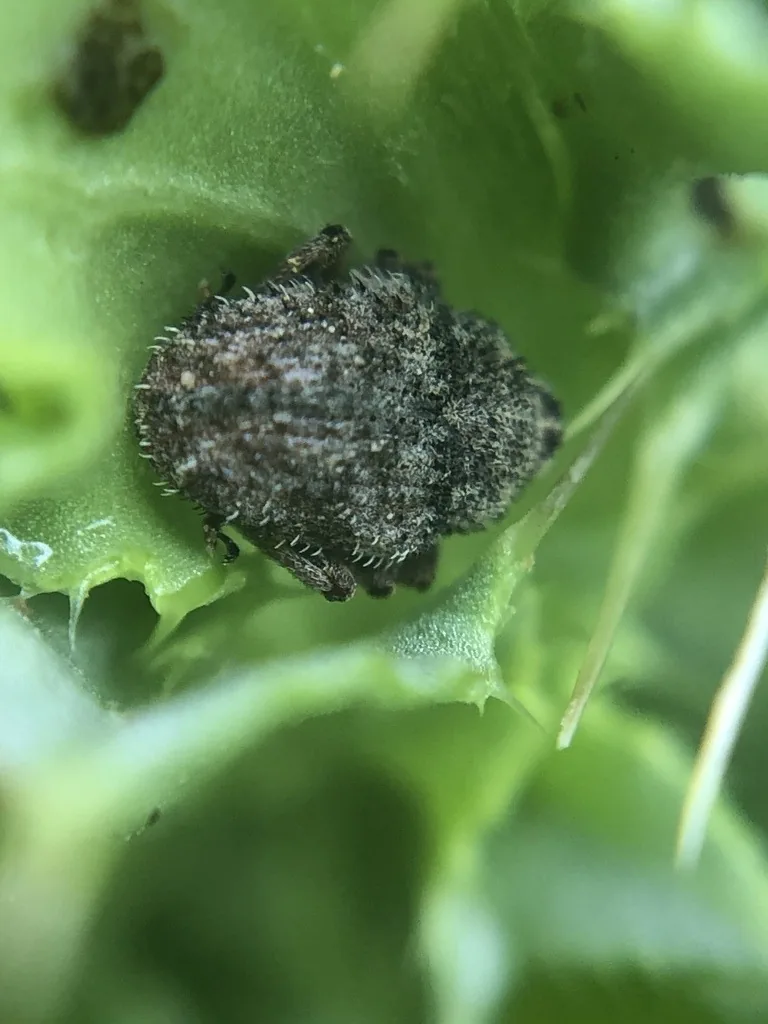
- Adults are about 4 mm long, round-bodied, brown with white mottling, with obvious spines on the thorax and a long snout.[1]
- Larvae are white with a dark brown head and reach about 3 mm. They feed hidden at the root-stem junction, so early mining shows only if the crown is cut open.[1]
- Later in the season the sign is a thistle whose central stem has died at the crown and that has pushed up secondary stems instead.[1]
Look-alikes
| Look-alike | How to tell them apart |
|---|---|
| Thistle seedhead weevil (Rhinocyllus conicus) | The other weevil released against musk thistle is larger (up to 6 mm), dark brown with mottled yellow hairs that may rub off, and has a short snout. It lays eggs on the flower heads and its larvae eat the seed, whereas the crown weevil's larvae work at the base of the plant.[1] |
| Canada thistle stem weevil (Hadroplontus litura) | Also about 4 mm with a long curved snout, but mottled black and white with a T-shaped mark on the back, and its larvae mine the leaf veins and stems of Canada thistle.[1] |
Where it lives
Native to Europe. Weevils from Italy were released on musk and plumeless thistle across the United States beginning in 1974 and have since spread on their own to bull and slenderflower thistle; a 1994 attempt to move them onto Scotch thistle failed. In Canada, German stock was released from 1975. The weevil is now widely distributed through parts of North America, doing best in open thistle stands and along their edges, and less well at high elevations or in marshy ground. Genetic work has confirmed that the species established in Canada and the United States is T. horridus itself, after a 2002 split of the name into three species was reduced to two.[1][4]
Biology and life cycle
Adults that overwintered in plant litter come out in spring and feed on the thistle rosettes. The eggs go on the undersides of the leaves of young plants, along the midrib and main veins.[1]
The hatching larvae move down the plant and feed on tissue where the root meets the stem, passing through three stages. They pupate in the soil in early summer.[1]
New adults emerge over the summer but stay inactive until fall, when they feed lightly on the foliage before overwintering in litter. Overwintered adults often live until the next generation starts to emerge. There is one generation a year.[1]
Its hosts in North America are musk, plumeless, Italian, slenderflower and bull thistle, with musk preferred, and it has been collected from Carduus, Cirsium and Onopordum thistles.[1][4]
Damage and signs
- Spring feeding by the adults is superficial and does little. The larvae are what count: their mining of the root crown can kill the developing stems. The plant often sends up secondary stems later, but flowering is delayed and seed production may fall.[1]
- On musk and plumeless thistle the weevil can be effective in combination with plant competition and the other biocontrol agents, but alone it is often ineffective. It does less on Italian and slenderflower thistle and very little on bull thistle. In Canada its impact is limited, and large rosettes that are attacked frequently survive to set seed.[1]
- The weevil has been found feeding on native North American thistles. In tallgrass prairie, infestation rates and numbers of adults were at least as high, and sometimes higher, on the native tall thistle as on the exotic bull thistle growing beside it, and the researchers urged that new releases wait for more study. A Tennessee study, by contrast, found the weevils associated with sites holding musk and bull thistle rather than two native species.[2][3]
Health risk
A plant-feeding weevil; none of these sources describes any risk to people.[1][2]
Control
Prevention
Do not move this weevil across state lines: because of its attacks on native thistles, interstate transport is no longer permitted in the United States, and some states also prohibit moving it within their borders. Where redistribution is still allowed, do not release it where related or susceptible native thistles grow.[1]
Biological control
Where it is already established on musk or plumeless thistle it is a biocontrol agent and needs no control. It works best alongside dense competing vegetation and the other thistle agents. Populations suspected of carrying Nosema pathogens should not be used for redistribution.[1]
Common questions
- What is eating my musk thistle at the base so the stem dies?
- Larvae of the musk thistle crown weevil feed at the root-stem junction and can kill the developing central stem. The plant usually pushes up secondary stems, flowers late and may set less seed.[1]
- Can I collect crown weevils and move them to another thistle patch?
- Not across state lines. Interstate transport was halted in the United States because the weevil also feeds on native thistles, and some states forbid moving it at all. Check with your state before any redistribution.[1]
- Does the weevil control thistles by itself?
- Rarely. It is effective on musk and plumeless thistle only in combination with competing plants and other biocontrol agents, and it does little to bull thistle.[1]
Sources
- North American Invasive Species Management Association (PDF hosted on Bugwood), “Introduced Thistle Biocontrol Agents: History and Ecology in North America. In: Winston, ed., Biological Control of Weeds in North America, NAISMA-BCW-2024-8-INTRODUCED THISTLES-A (2024).” bugwoodcloud.org/resource/files/29169.pdf (accessed 2026-11-10)
- Environmental Entomology (Entomological Society of America), “Takahashi, Louda, Miller and O'Brien (University of Nebraska). Occurrence of Trichosirocalus horridus (Coleoptera: Curculionidae) on native Cirsium altissimum versus exotic C. vulgare in North American tallgrass prairie. Environmental Entomology 38: 731-740 (2009), doi:10.1603/022.038.0325.” doi.org/10.1603/022.038.0325 (accessed 2026-11-10)
- Environmental Entomology (Entomological Society of America), “Wiggins, Grant, Lambdin, Ranney, Wilkerson and van Manen (University of Tennessee). Spatial prediction of habitat overlap of introduced and native thistles to identify potential areas of nontarget activity of biological control agents. Environmental Entomology 39: 1866-1877 (2010), doi:10.1603/EN10112.” doi.org/10.1603/EN10112 (accessed 2026-11-10)
- Bulletin of Entomological Research (Cambridge University Press), “De Biase, Colonnelli, Belvedere, La Marca, Cristofaro and Smith (USDA-ARS). Genetic and morphological studies of Trichosirocalus species introduced to North America, Australia and New Zealand for the biological control of thistles. Bulletin of Entomological Research 106: 99-113 (2016), doi:10.1017/S000748531500084X.” doi.org/10.1017/S000748531500084X (accessed 2026-11-10)
- iNaturalist, “Trichosirocalus horridus taxon page (order and family).” www.inaturalist.org/taxa/456106 (accessed 2026-11-10)