On this page
How to identify it
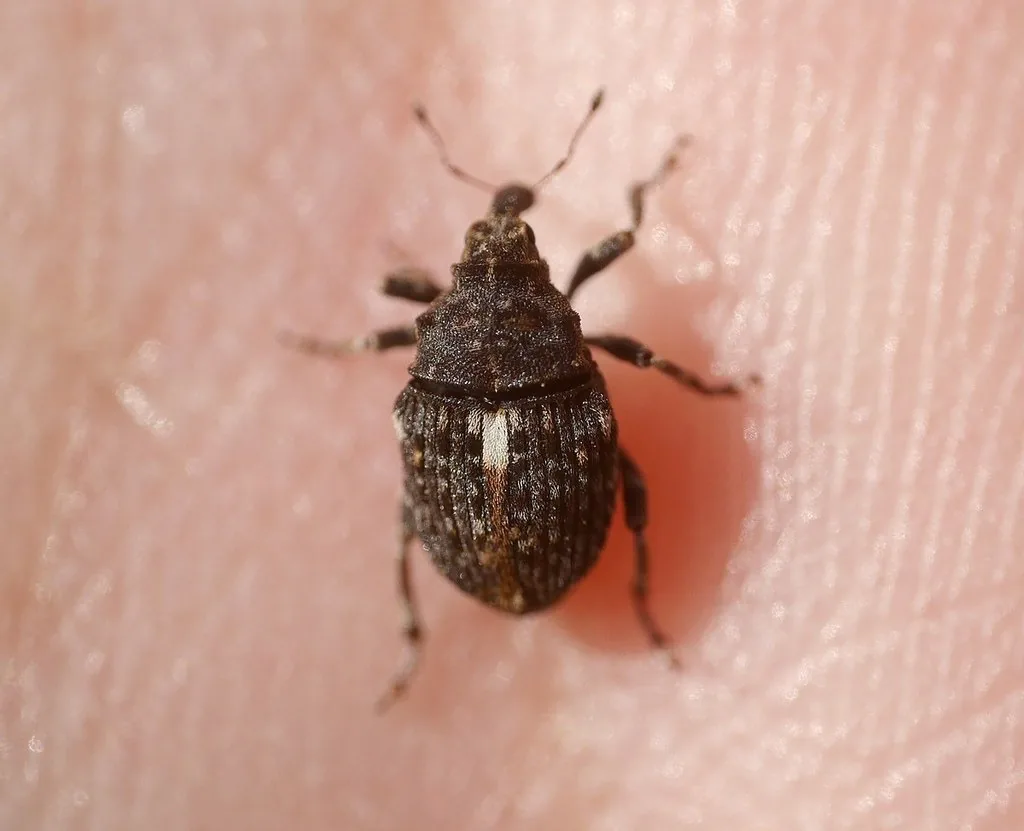
- Adults are 4 to 5 mm long, mottled dark brown with a white T on the wing covers, a long curved snout and elbowed antennae. They are easiest to find in fall and spring feeding on rosette leaves; when disturbed they drop from the plant and their soil-colored markings hide them. UC IPM adds that they make a chirping sound when disturbed.[1][2]
- Eggs are white and oval, laid on the undersides of rosette leaves and leaf stalks from fall through spring; UC IPM notes they are covered with a protective layer of frass. Larvae are white, brown-headed, C-shaped grubs 1 to 4 mm long, feeding inside the leaf stalks and root crown, so a stalk or crown has to be cut open to find them.[1][2]
- Leaves fed on by adults between the veins take on a skeletonized look, and the small egg-laying scars on the leaf stalks are a second sign that the weevil is present.[1]
Look-alikes
| Look-alike | How to tell them apart |
|---|---|
| Phrydiuchus spilmani | A sister species released in Oregon in 1969 and 1970 that never established. It is slightly lighter mottled brown and its white mark is more like a lower-case t.[1] |
Where it lives
Native to southern Eurasia. A Serbian population was released in Oregon from 1971 to 1973 and, once established, redistributed to California beginning in 1976, Idaho in 1979 and Colorado in 1992. As of 2022 it was confirmed established in California, Colorado, Idaho, Oregon and Washington. The Washington weed board notes the weevil is used in Idaho and Montana. It does well on warm, dry, south-facing slopes and poorly at higher elevations where snow arrives by early November.[1][3]
Biology and life cycle
Adults become active with the fall rains, feed on rosette leaves, mate and lay eggs on the undersides of leaf stalks and rosette leaves. The hatching larvae mine the stalks and leaf midribs, then tunnel into the crown, where most of their feeding takes place in cavities in the root crown through three larval stages. The weevil can overwinter as an egg, a larva or an adult, so every stage may be present on a plant in winter.[1][2]
Larvae finish development in late spring and leave the plant to pupate in the soil, where UC IPM notes ants take some of them. New adults appear in late spring or early summer, feed briefly on foliage and flower stalks, then spend the summer dormant under rocks, in soil or in other cool, moist hiding places until the fall rains start the cycle again. One generation a year.[1][2]
Damage and signs
- Larval feeding in the root crown is the damaging stage: it can kill small plants outright or reduce or prevent bolting, and several larvae often share one crown. UC IPM notes larger plants tend to be attacked more than small ones. Adult feeding skeletonizes leaves but has limited effect in summer, although fall feeding may add to winter mortality.[1][2]
- Results have varied. High weevil densities have been linked to falling Mediterranean sage densities where perennial grasses compete with the weed, and in California, where CDFA released 2,600 weevils at ten Modoc County sites from 1976 to 1980 and 1,500 more at two sites from 2002 to 2005, surveys in 2005 and 2006 found low sage densities at former high-density release sites. In salt desert scrub and in annual-grass or heavily grazed sites there has been little change in the weed despite good weevil numbers, and NAISMA recommends other methods there. Wildfire knocks the weevil back, but populations recover in later years.[1][2]
- Clary sage (Salvia sclarea) is a known alternative host, and adults can feed on it and on Salvia verbenacea, but larvae are known to complete development only on Mediterranean sage and no nontarget attack has been recorded in North America.[1][2]
Health risk
A root weevil of Mediterranean sage; none of the sources describes any risk to people.[1][2][3]
Control
Prevention
In Washington, Mediterranean sage is on the state quarantine list and eradication is required, so the weed board says biological control is generally not a good management option there.[3]
Biological control
The weevil is a weed-control agent and needs no control. In California, adults can be collected by sweep net or by hand, in fall and spring when they are out on the rosettes, and may also be available from the county Agricultural Commissioner. UC IPM's advice is to treat the edges of an infestation and let the weevils build up in the center, and to avoid wild swings in the weed population that would crash the weevil.[2][1]
Pesticides
Herbicide timing matters: spraying that kills the sage in winter or early spring, before the larvae have emerged, reduces the weevil population and disrupts biological control, and regularly sprayed ground such as road shoulders appears to prevent the weevil from establishing at all. The adults are inactive for most of summer and fall, which UC IPM suggests is the time for other control methods.[2]
Common questions
- How do I know the weevil is already in my Mediterranean sage?
- Look for ragged, skeletonized feeding between the leaf veins in fall and winter or late spring and early summer, egg-laying scars on the leaf stalks, and the small T-marked adults on rosette leaves; in winter and early spring, cutting open a leaf stalk or the upper root shows the white grubs and their feeding cavities.[1][2]
- Why hasn't it cleaned up my site?
- NAISMA reports little change in Mediterranean sage in salt desert scrub, annual-grass range and heavily grazed areas even with good weevil numbers; the weevil has done best where perennial grasses compete with the weed, on warm, dry, south-facing slopes, and not at higher sites with early snow.[1]
- Will it attack my garden sages?
- Adults can nibble clary sage and Salvia verbenacea, but larvae are known to develop only on Mediterranean sage, and there are no records of nontarget attack in North America.[1][2]
Sources
- North American Invasive Species Management Association (PDF hosted on Bugwood), “Andreas (Washington State University Extension), Price and Coombs (Oregon Department of Agriculture). Mediterranean Sage Biocontrol Agents: History and Ecology in North America. In: Winston, ed., Biological Control of Weeds in North America, NAISMA-BCW-2022-5-MEDITERRANEAN SAGE-A (2022).” bugwoodcloud.org/resource/files/23225.pdf (accessed 2026-11-10)
- University of California Statewide IPM Program, “Weed Control User Tool (WeedCUT): Biological Control of Mediterranean Sage (Pitcairn, California Department of Food and Agriculture, and Smith, USDA).” weedcut.ipm.ucanr.edu/biological-control/mediterranean-sage/ (accessed 2026-11-10)
- Washington State Noxious Weed Control Board, “Mediterranean sage (Salvia aethiopis).” www.nwcb.wa.gov/weeds/mediterranean-sage (accessed 2026-11-10)
- iNaturalist, “Phrydiuchus tau taxon page (order and family).” www.inaturalist.org/taxa/1085167 (accessed 2026-11-10)