On this page
How to identify it
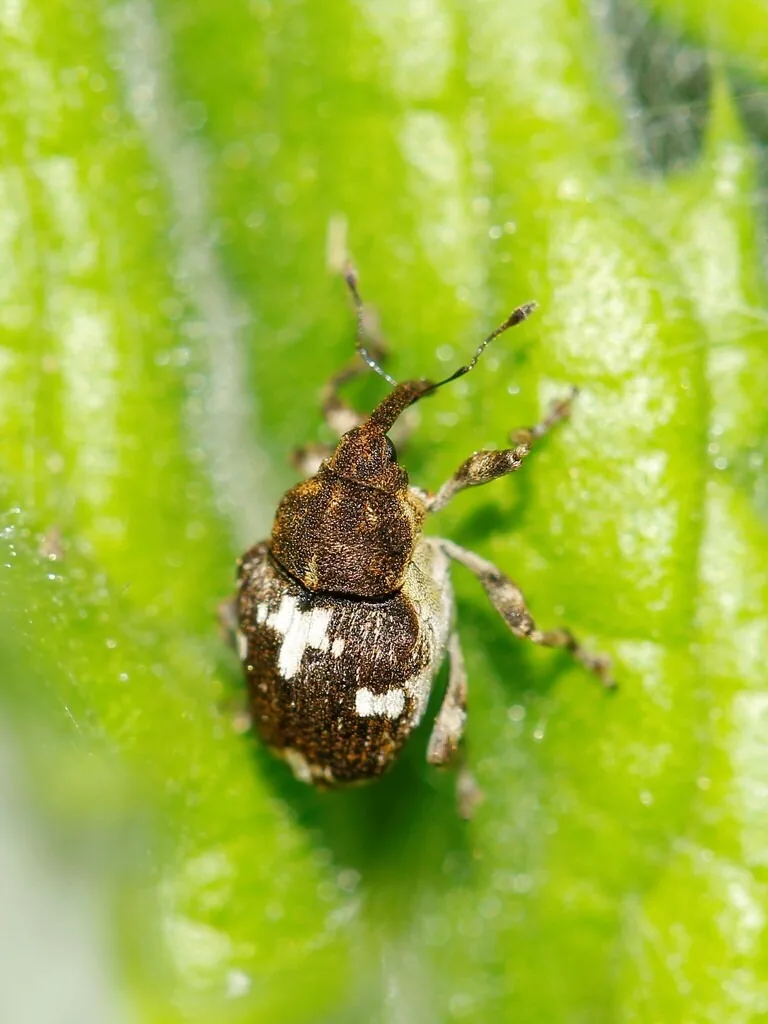
- Adults are 2 to 3 mm long, mottled dull brown with a white cross pattern on the wing covers, with a long snout and elbowed antennae. They hide deep among the leaf stalks or in the flower buds and bracts, drop and play dead when disturbed, and their soil-colored markings make them hard to find.[1]
- Larvae are white, C-shaped grubs 1 to 4 mm long with a brown head, feeding inside the roots, which must be dissected to find them. Eggs are white turning yellow-orange and sit at the very base of the leaf stalks in late spring and sometimes early fall.[1]
- Adult feeding holes, circular and oval, over the leaf and stalk resemble those of other houndstongue insects and prove nothing, but perfectly round, smooth-edged feeding and egg-laying scars at the very base of the leaf stalks are a good indicator of this weevil.[1]
Look-alikes
| Look-alike | How to tell them apart |
|---|---|
| Houndstongue flea beetle (Longitarsus quadriguttatus) | The other agent released in Canada, now scarce. Its larvae are also small and white in the roots, but less C-shaped; its adults are shiny black with reddish-copper marks, big hind thighs and no long snout, and their feeding is a uniform shot-hole pattern across the leaf blade.[1] |
Where it lives
Native to Europe. A mixed population from Hungary and Serbia was released in British Columbia in 1997 to 1999 and Alberta in 1998 to 1999, then redistributed many times from field colonies; it has done well at every release site. The United States denied release approval over nontarget feeding, but as Canadian populations grew the weevils crossed the border naturally, turning up first in Washington and since in Idaho and Montana. Overall US populations are still low, but they are very high near the border and spreading south through a range of habitats.[1]
Biology and life cycle
Adults emerge in spring from the soil litter, feed on the rosette leaves, mate and lay eggs from April to June at the base of the leaf stalks, with some eggs in bolting stems and root crowns.[1]
The larvae feed in the roots through three stages, then leave to pupate in the soil in oval silk cocoons coated with soil. New adults emerge in late summer and early fall, feed, mate and lay a much smaller batch of eggs.[1]
Adults live one to two years, so generations overlap and larvae can be found in roots in any month. The weevil overwinters in three forms: adults in the soil, pupae and new adults in their cocoons, or larvae in the roots.[1]
Canadian field work shows how it treats native relatives of houndstongue. After houndstongue its strongest preference is for Hackelia species, yet weevils released among the native Hackelia micrantha with little or no houndstongue present could not be found two years later, and feeding on the native plant was limited to rare, low-level spillover. Adult feeding scars went with egg laying on 90 percent of houndstongue plants but only 30 percent of the natives.[2]
In release experiments, 95 percent of feeding on the native Hackelia occurred within 4.25 metres of the release point whatever the houndstongue density, while feeding on houndstongue extended across the whole 14 metre study radius; marked weevils were recaptured on houndstongue more often than chance but not on Hackelia. The weevil simply does not seek out the native plant, which leaves it refuges a few metres from any concentration of weevils.[3]
Damage and signs
- Adult feeding on the foliage gives little control. The larvae are what matter: by eating the roots they can kill plants outright, stop rosettes from flowering, or cut the seed output of plants that do bolt.[1]
- In Canada the weevil has significantly reduced houndstongue wherever it is present, the program is considered a great success, and no further management is required. Where populations are high in the United States, houndstongue infestations have been completely destroyed.[1]
- The weevil has been recorded in North America attacking native Hackelia ciliata, H. floribunda and H. micrantha, Lithospermum ruderale, an Oreocarya species and Amsinckia species, plus the exotic Buglossoides arvensis. As of 2022 this attack appears to be minor, temporary spillover that happens only when weevils are very numerous and houndstongue is scarce; once houndstongue is controlled the weevil population crashes and the nontarget damage stops. Studies continue, and the researchers describe this weevil as among the least host-specific of modern weed agents.[1][2]
Health risk
A root-feeding weevil of houndstongue; none of these sources describes any risk to people.[1][2]
Control
Prevention
In the United States it is illegal to possess or transport this weevil, which has never been approved or intentionally released there. Do not collect it or move it to new houndstongue patches, even where it has arrived on its own.[1]
Biological control
Where it is present it needs no control. Canadian researchers recommend protecting valued native relatives of houndstongue by removing the houndstongue growing around them, since the weevil's spillover feeding stays within a few metres of dense weevil populations.[2][3]
Common questions
- Can I move houndstongue root weevils onto my pasture in Montana?
- No. The weevil was denied release approval in the United States over nontarget feeding, and as of 2022 it is illegal to possess and transport it there, even though it has spread south from Canada on its own.[1]
- How do I know this weevil is in my houndstongue?
- Look for perfectly round, smooth-edged scars at the very base of the leaf stalks and for eggs there in late spring; dig and split roots for the white C-shaped grubs. The adults are tiny, soil-colored and play dead when disturbed.[1]
- Does it harm native plants?
- It can feed on native Hackelia, Lithospermum, Oreocarya and Amsinckia, but the recorded damage has been minor spillover near very dense weevil populations, and field experiments show the weevil cannot sustain itself on the natives without houndstongue nearby.[1][2]
Sources
- North American Invasive Species Management Association (PDF hosted on Bugwood), “Andreas (Washington State University Extension), De Clerck-Floate (Agriculture and Agri-Food Canada) and Maggio (Montana Biocontrol Coordination Project). Houndstongue Biocontrol Agents: History and Ecology in North America. In: Winston, ed., Biological Control of Weeds in North America, NAISMA-BCW-2022-4-HOUNDSTONGUE-A (2022).” bugwoodcloud.org/resource/files/27416.pdf (accessed 2026-11-10)
- Ecological Applications (Ecological Society of America), “Catton, Lalonde and De Clerck-Floate (Agriculture and Agri-Food Canada, University of British Columbia). Nontarget herbivory by a weed biocontrol insect is limited to spillover, reducing the chance of population-level impacts. Ecological Applications 25: 517-530 (2015), doi:10.1890/14-0250.1.” doi.org/10.1890/14-0250.1 (accessed 2026-11-10)
- Environmental Entomology (Entomological Society of America), “Catton, Lalonde and De Clerck-Floate. Differential host-finding abilities by a weed biocontrol insect create within-patch spatial refuges for nontarget plants. Environmental Entomology 43: 1333-1344 (2014), doi:10.1603/EN14041.” doi.org/10.1603/EN14041 (accessed 2026-11-10)
- iNaturalist, “Mogulones crucifer taxon page (order and family).” www.inaturalist.org/taxa/455949 (accessed 2026-11-10)