On this page
How to identify it
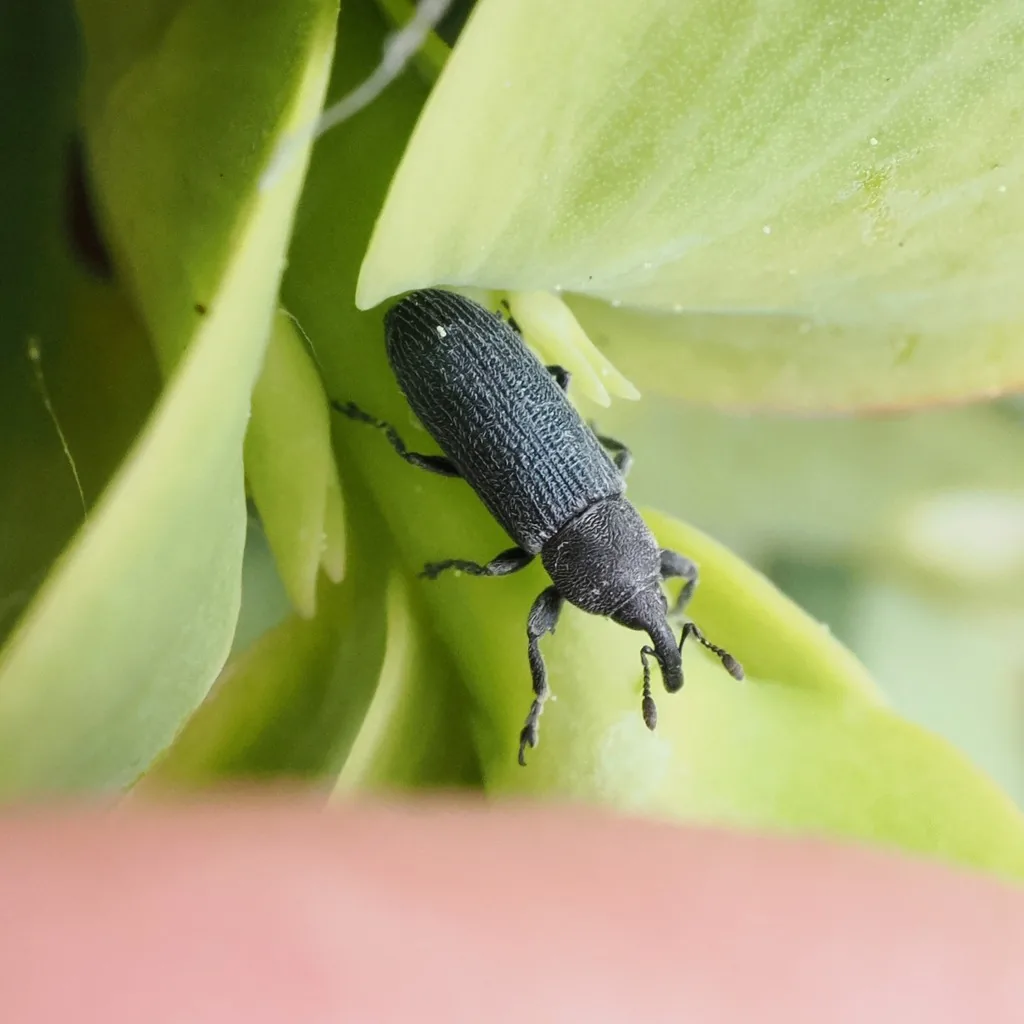
- Adults are elongated, bluish-black (rarely greenish-black) weevils with a long snout and elbowed antennae. Fresh adults have a faint metallic sheen that dulls to black with age. M. janthinus is the smaller, 2.4 to 3.4 mm against 3.2 to 6 mm for M. janthiniformis, and its snout curves less abruptly; otherwise the two are nearly identical.[1]
- Adult feeding punches a distinctive shot-hole pattern into toadflax shoot tips and leaves, more obvious on Dalmatian toadflax. Heavily attacked shoot tips may turn brown and shrivel.[1]
- Larvae are C-shaped, creamy white with a brown head, up to 5 mm long, and live entirely inside the stems; cut a stem open to find their short tunnels. Infested stems often snap off where larval feeding has weakened them.[1]
- Mecinus can be told from the other toadflax weevils by shape: Rhinusa seed-galling weevils have rounder bodies, and the toadflax beetle Brachypterolus pulicarius has no snout at all.[1]
Look-alikes
Where it lives
M. janthinus, native to Europe and Asia, was released from French and German stock on both toadflaxes in Canada in 1991 and moved to the United States from 1996. M. janthiniformis, from southeastern Europe, went into Canada on Dalmatian toadflax in 1992 and reached the United States after 1996 mixed in with the other species, mostly in western states. M. janthiniformis is now established across northwestern North America on Dalmatian toadflax; M. janthinus was slower to establish, especially where growing seasons are short and snow lies long, but is becoming widespread on yellow toadflax, with establishment confirmed as far north as central Alberta and control seen above 7,000 feet.[1]
Biology and life cycle
Adults overwinter inside the previous year's dead toadflax stems and emerge in early spring to feed on the new shoot tips. In their native range M. janthinus comes out a few weeks before M. janthiniformis; in North America emergence timing varies with latitude, elevation, aspect and lingering snow, and in Utah the season's progress is best tracked by degree days.[1][3]
Females chew a hole in the stem, lay one egg in it and cap it with chewed plant tissue; a female lays 60 to 160 eggs in her life under laboratory conditions. The larvae feed through three stages in short tunnels inside the stem, M. janthinus usually lower down than M. janthiniformis.[1]
Pupation takes place in midsummer in chambers within the feeding tunnels, adults form by late summer, and they stay in the pupal chambers until the following spring. There is one generation a year, and everything from egg to emerging adult happens in the same stem.[1]
In northern Utah, M. janthiniformis eggs hatched in spring and early summer, larvae were in the stems in June, the first adults formed in mid-July and most had finished pupating by early August. Two thirds or more survived from hatching to adulthood; most deaths came during larval development, mainly from at least three species of parasitic wasps. Males appear on the plants first and females peak later, around the time the toadflax reaches full height and begins flowering widely.[2][3]
Dead Dalmatian toadflax stems stand above the snow, so the overwintering adults inside are exposed to swings in temperature and humidity. Where temperatures fall below about -28 C (-18.5 F), 75 to 100 percent of the adults can die, though populations rebound over time. Both species are strong fliers; M. janthinus adults disperse readily in spring because yellow toadflax offers no overwintering rosette to feed on.[1]
Damage and signs
- Adult chewing weakens the plant, can suppress flowering and seed set and severely stunts the shoots; crowds of M. janthiniformis adults on new growth can brown and shrivel the shoot tips.[1]
- Larval mining severs the stem's water- and nutrient-conducting tissue, so mined stems dry out and die, and the feeding probably drains the root reserves the plant needs to persist from year to year. Repeated yearly attack by adults and larvae can reduce toadflax density strikingly, and M. janthiniformis has cut Dalmatian toadflax dramatically at some northwestern sites.[1]
- The effect of either weevil on hybrid toadflax has not been fully determined.[1]
Health risk
These are plant-feeding weevils and weed biological control agents; none of these sources describes any risk to people.[1][2]
Control
Prevention
The adults overwinter inside the standing dead stems, so last year's toadflax stems carry this year's weevils. Expect heavy winter losses after extreme cold, and slower establishment of M. janthinus where seasons are short and snow heavy.[1]
Traps and physical control
For collecting or monitoring, Utah work found degree-day accumulation a better guide than the calendar for when adults, and especially females, peak on the plants; summer monitoring can be done by cutting stems open to count larvae and pupae.[3][2]
Biological control
The weevils are the control; match the species to the weed, M. janthiniformis for Dalmatian toadflax and M. janthinus for yellow toadflax, and expect results from repeated yearly attack rather than a single season.[1]
Common questions
- How do I know if the stem weevils are in my toadflax?
- Look for the small elongated blue-black weevils on stems and leaves in spring and early summer and for shot-holed shoot tips. Later in the season, split a few stems: larvae, pupae or adults in short tunnels, or stems that snap at a weak point, mean the weevils are established.[1]
- Which species do I have?
- Most likely the one that matches the weed: M. janthiniformis on Dalmatian toadflax and M. janthinus on yellow toadflax. The adults are nearly identical apart from size and snout curve, and early releases carried both species mixed together, so sorting out where each is established is still in progress.[1]
- Why did the weevils disappear after a hard winter?
- The adults spend winter in dead stems above the snow, and where the temperature drops below about -28 C most of them die. Surviving populations have rebuilt over time.[1]
Sources
- North American Invasive Species Management Association (PDF hosted on Bugwood), “Toadflax Biocontrol Agents: History and Ecology in North America. In: Winston, ed., Biological Control of Weeds in North America, NAISMA-BCW-2022-29-TOADFLAXES-A (2022).” bugwoodcloud.org/resource/files/27419.pdf (accessed 2026-11-10)
- Environmental Entomology (Entomological Society of America), “Willden and Evans (Utah State University). Summer development and survivorship of the weed biocontrol agent, Mecinus janthiniformis (Coleoptera: Curculionidae), within stems of its host, Dalmatian toadflax (Lamiales: Plantaginaceae), in Utah. Environmental Entomology 48: 533-539 (2019), doi:10.1093/ee/nvz042.” doi.org/10.1093/ee/nvz042 (accessed 2026-11-10)
- Environmental Entomology (Entomological Society of America), “Willden and Evans (Utah State University). Phenology of the Dalmatian toadflax biological control agent Mecinus janthiniformis (Coleoptera: Curculionidae) in Utah. Environmental Entomology 47: 1-7 (2018), doi:10.1093/ee/nvx174.” doi.org/10.1093/ee/nvx174 (accessed 2026-11-10)
- iNaturalist, “Mecinus janthiniformis taxon page (order and family).” www.inaturalist.org/taxa/493909 (accessed 2026-11-10)