On this page
How to identify it
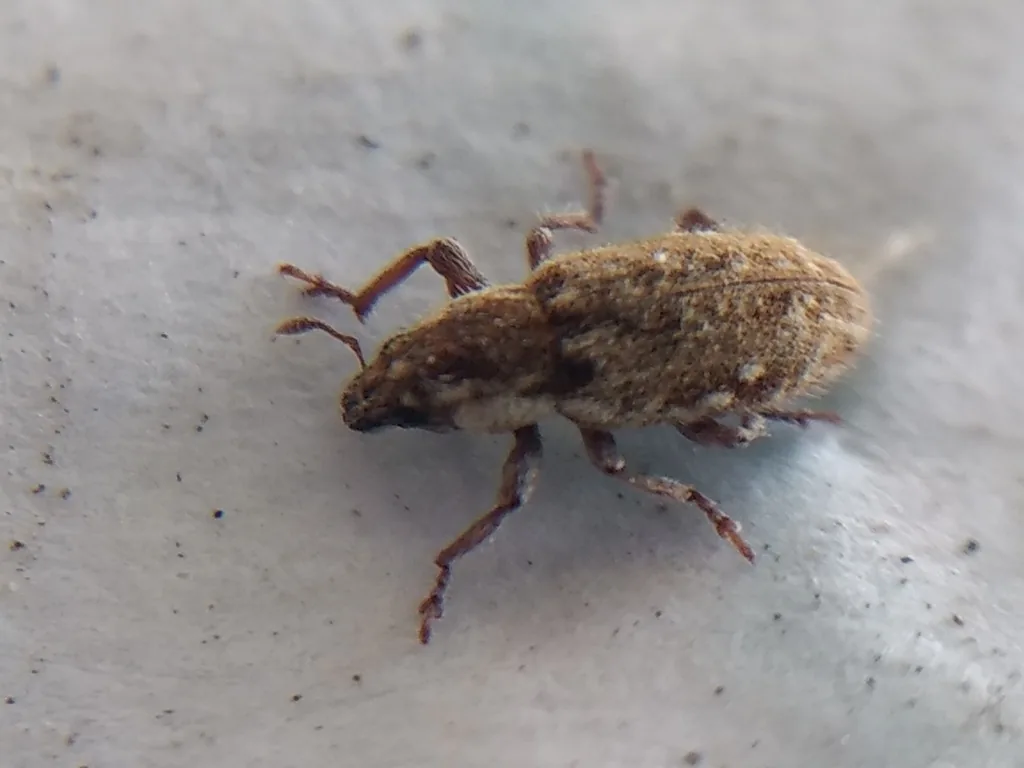
- Adults of both species are about 4 to 5 mm (1/5 inch) long, mottled brown, gray and whitish, with a short, broad snout and a coat of erect grayish hairs that gives them a shaggy look. Their dirt-colored markings hide them in soil and litter when they drop from a plant.[1][2]
- The seed weevil is often slightly longer and wider than the stem weevil, but color varies so much within populations that color cannot be used to tell them apart.[1]
- The surest sign of either weevil is a round hole about 1/16 inch (1.5 mm) across in a puncturevine bur or stem, where the adult chewed its way out. Adults also leave brown to grayish sunken feeding scars on almost any above-ground part of the weed.[2]
- Larvae are hidden inside the plant: C-shaped and white to yellow-brown with a dark brown head, about 5 mm long when fully grown. Pupae are creamy white, up to 4 mm long. Eggs are dark yellow and cylindrical, laid in chewed pits that the seed weevil seals with a dark cement.[1][2]
Where it lives
Both weevils are native to the Mediterranean. Italian stock was released in California and five other western states in 1961, and the weevils now occur throughout California wherever puncturevine grows. The seed weevil is reported established across the central and western United States and Hawaii, the stem weevil in the southeastern and southwestern states and Hawaii. Both are sensitive to cold and do best at warm, low-elevation sites; at higher elevations and latitudes, including much of the West, cold winters keep their numbers too low to matter.[1][2]
Biology and life cycle
Adults overwinter in soil litter or sheltered spots on plants near where they fed and come out in spring. They feed on the undersides of stems during the heat of the day, where their round scars are a good place to look for them.[1][2]
The seed weevil female chews a pit in a young bur, lays an egg and seals it with dark cement. The larva eats the seeds and surrounding tissue, passes through four stages and pupates in its feeding cell; the adult then chews a round exit hole. Egg to adult takes about 25 to 30 days, and there can be up to four generations a year in warm climates.[1][2]
The stem weevil female chews a pit in the root crown or the underside of a stem. Its larva mines the stem or crown, pupates in the mine, and emerges through a round hole after about 39 to 44 days. Warm areas see several generations a year, colder ones one or two.[1][2]
Stem weevil adults live about four months and lay about 250 eggs; seed weevil adults live about three months and lay about 200.[2]
Both weevils can breed only on Tribulus and on certain native caltrops (Kallstroemia) of the Southwest, which is why they passed quarantine testing before release. Two native parasitic wasps and predators such as bigeyed bugs reduce their numbers, and at some sites the seed weevil is heavily parasitized.[2][1]
Damage and signs
- Seed weevil larvae kill seeds and can cause burs to turn brown and drop early. The spines still form, so the weevil does nothing about the burs already on the ground this year or last; its effect is on how many seeds the plant leaves behind.[1][2]
- Stem weevil larvae feed on the vascular tissue, weakening stems so they die early, dry up or break, which lowers the plant's vigor and seed output. The mining is not visible unless the stems are cut open.[1][2]
- Adult feeding scars do little harm. Working together, and especially where puncturevine is short of water, the two weevils have reduced weed cover and seed production by as much as 80 percent in warmer parts of the United States, and the area covered by puncturevine in California has shrunk. The stem weevil is slightly more effective alone.[1][2]
- Both weevils also attack native Kallstroemia caltrops of the Southwest, and adults have been found on many other introduced plants with negligible impact. They should not be released where native caltrops grow.[1]
Health risk
These are plant-feeding weevils and weed biological control agents; neither source describes any risk to people.[1][2]
Control
Prevention
Keep irrigation water and runoff from reaching puncturevine. Dry plants produce less seed and grow less, and they die more readily from weevil feeding.[2]
Do not count on the weevils at high elevations or in cold-winter areas, where they rarely build up, and do not move them to sites where native caltrops grow.[1]
Biological control
The weevils are the control: find round exit holes in burs and stems and leave the weevils alone. UC IPM credits them with significantly reducing puncturevine's spiny seedpod production. They work best together and where the weed is moisture-stressed.[2]
Common questions
- Are these weevils a garden pest?
- No. They reproduce only on puncturevine and its relatives in the caltrop family. Adults may be found on other plants but do negligible harm there.[1][2]
- The weevils are here but the spiny burs are still a problem. Why?
- The seed weevil kills seeds inside the bur, but the bur and its spines still develop, and the weevil has no effect on burs from past years lying on the ground. Its payoff is fewer seeds for next year, not fewer spines this year.[1]
- Can I get puncturevine weevils for my property?
- In California they already occur wherever puncturevine grows. Redistribution to cold or high sites has mostly failed, including moves from Colorado to Oregon, because the weevils do not survive cold winters well.[2][1]
Sources
- North American Invasive Species Management Association (PDF hosted on Bugwood), “Andreas (Washington State University Extension), Bowers (New Mexico State University) and Milan (Bureau of Land Management). Puncturevine Biocontrol Agents: History and Ecology in North America. In: Winston, ed., Biological Control of Weeds in North America, NAISMA-BCW-2024-9-PUNCTUREVINE-A (2024).” bugwoodcloud.org/resource/files/29216.pdf (accessed 2026-11-10)
- University of California Statewide IPM Program, “Puncturevine Weevils (Natural Enemies Gallery).” ipm.ucanr.edu/natural-enemies/puncturevine-weevils/ (accessed 2026-11-10)
- iNaturalist, “Microlarinus lareynii taxon page (order and family).” www.inaturalist.org/taxa/269290 (accessed 2026-11-10)