On this page
How to identify it
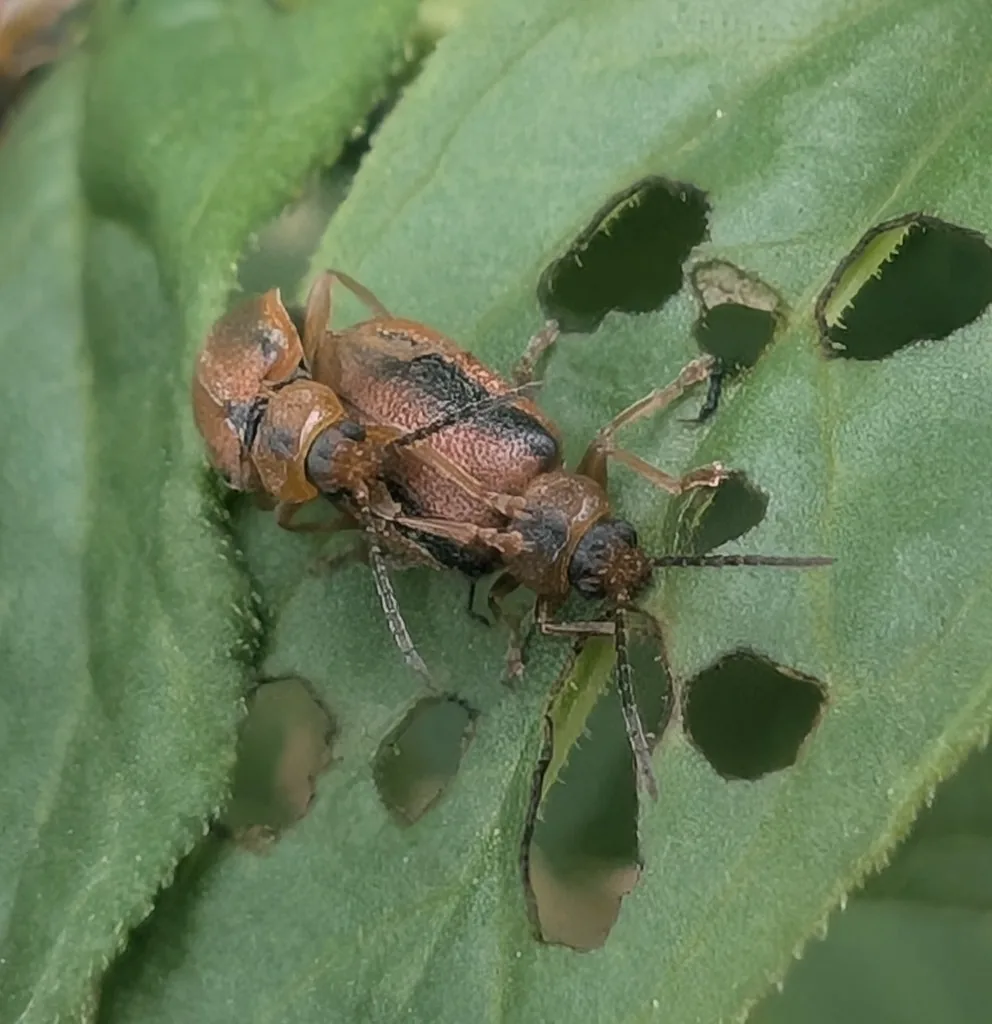
- Adults are small, light brown leaf beetles, sometimes with a dark stripe on the wing covers. The two species look and live so much alike that they are very hard to tell apart in the field and are usually treated as one group.[4]
- Eggs are laid in small clusters of 2 to 10 on stems, at leaf bases or under leaves. They are cream colored with a dark stripe of the female's droppings across the top.[4][2]
- Larvae are yellow to orange with a black head and reach only about 6 mm (1/4 inch) when full grown.[4]
- Adult feeding leaves round 'shot holes' in the leaves. Larvae scrape off leaf tissue but leave one surface intact, so leaves look like small windowpanes.[2][4]
Look-alikes
| Look-alike | How to tell them apart |
|---|---|
| Golden loosestrife beetle and black-margined loosestrife beetle | The two released species are nearly identical in appearance and life cycle and are extremely difficult to tell apart in the field, so release programs treat them together as Galerucella beetles.[4] |
Where it lives
Native to Europe. Released in many U.S. states since the 1990s, including Minnesota, New Jersey and states in the West; in Minnesota and New Jersey they are now established at most release sites and have spread on their own to new loosestrife stands.[1][4][5]
Biology and life cycle
Adults spend the winter in leaf litter or soil under the host plant and come out in spring as new loosestrife shoots appear. They feed for several days before laying eggs.[2][4]
Egg laying peaks in May and June and continues into mid-July; each female can lay up to about 500 eggs over a 45-day period. Larvae hatch in 7 to 10 days and move to the shoot tips, where young larvae feed hidden in leaf or flower buds.[4][2]
Larvae feed for about three weeks, then drop to pupate in the litter or soil under the plant. Pupation takes about two weeks, and new adults emerge from July through September. Egg to adult takes about 30 to 45 days.[4]
The beetles can have more than one generation a year. Western U.S. populations have evolved different day-length cues for entering winter dormancy since their release, and in a common-garden test, populations with more generations a year did more damage to loosestrife.[5][6]
Adults are mobile and good at finding their host plant. They have spread several miles from release sites within a few years, and in Minnesota they have been found on loosestrife more than 12 miles from where they were released.[2][1]
Damage and signs
- They feed on purple loosestrife. At high numbers, more than 2 to 3 larvae per centimeter of shoot, they can strip whole stands of loosestrife, cutting its growth and seed production.[2][1]
- In New Jersey's monitored plots, loosestrife cover dropped by 70 percent and the tallest plants went from about two meters to about one meter after beetle releases.[4]
Health risk
The sources describe them only as leaf-feeding beetles on purple loosestrife; they mention no harm to people.[2][4]
Control
Prevention
No control is needed; they are beneficial weed-control insects. Biological control does not wipe out purple loosestrife but keeps it a small part of the wetland plant community, and loosestrife can return for a while when beetle numbers drop.[1][4]
Biological control
In Minnesota, volunteers and agencies help by collecting adults in spring, around late May when plants are 1 to 3 feet tall, and moving them to loosestrife stands without beetles. Check with the state's invasive species staff first; a permit is needed, and it is illegal to move loosestrife flowers, seed heads or roots with the beetles.[3]
Common questions
- What is eating holes in the purple loosestrife at my pond?
- Likely loosestrife beetles. Adults chew round shot holes, and their yellow-to-orange larvae leave windowpane-like patches on the leaves.[2][4]
- Where are the beetles easiest to find?
- They favor sunny spots. On warm, dry days they gather near the tops of plants; on cool, damp days they hide deep among the leaves.[3]
- Will loosestrife beetles eat my garden plants?
- They were tested for years in Europe and in North American quarantine before release to make sure they were safe, and the sources describe them feeding only on purple loosestrife.[1][2]
Sources
- Minnesota Department of Natural Resources, “Purple loosestrife control: Biological.” www.dnr.state.mn.us/invasives/aquaticplants/purpleloosestrife/biocontrol.html (accessed 2026-11-09)
- Minnesota Department of Natural Resources, “Galerucella calmariensis and G. pusilla.” www.dnr.state.mn.us/invasives/aquaticplants/purpleloosestrife/biocontrol_gc.html (accessed 2026-11-09)
- Minnesota Department of Natural Resources, “Purple Loosestrife Biocontrol: How to Collect and Move Loosestrife Beetles (July 2025).” files.dnr.state.mn.us/natural_resources/invasives/aquaticplants/purpleloosestrife/pl-biocontrol-how-to-collect.pdf (accessed 2026-11-09)
- New Jersey Department of Agriculture, “Release of Galerucella calmariensis and Galerucella pusilla to Control Purple Loosestrife, Final Report 2017 (Phillip Alampi Beneficial Insect Laboratory).” nj.gov/agriculture/divisions/pi/pdf/purpleloosestrife.pdf (accessed 2026-11-09)
- Environmental Entomology (Entomological Society of America), “Divergence in photoperiod responses of a classical biological control agent, Galerucella calmariensis (Wepprich and Grevstad 2021, Environmental Entomology 50:306-316), abstract.” pubmed.ncbi.nlm.nih.gov/33346818/ (accessed 2026-11-09)
- Environmental Entomology (Entomological Society of America), “Photoperiod response influences both voltinism and impact in a biological control agent (Grevstad and Wepprich 2025, Environmental Entomology 54:1187-1195), abstract.” pubmed.ncbi.nlm.nih.gov/41118279/ (accessed 2026-11-09)
- iNaturalist, “Galerucella calmariensis taxon page (order and family).” www.inaturalist.org/taxa/543350 (accessed 2026-11-09)