On this page
How to identify it
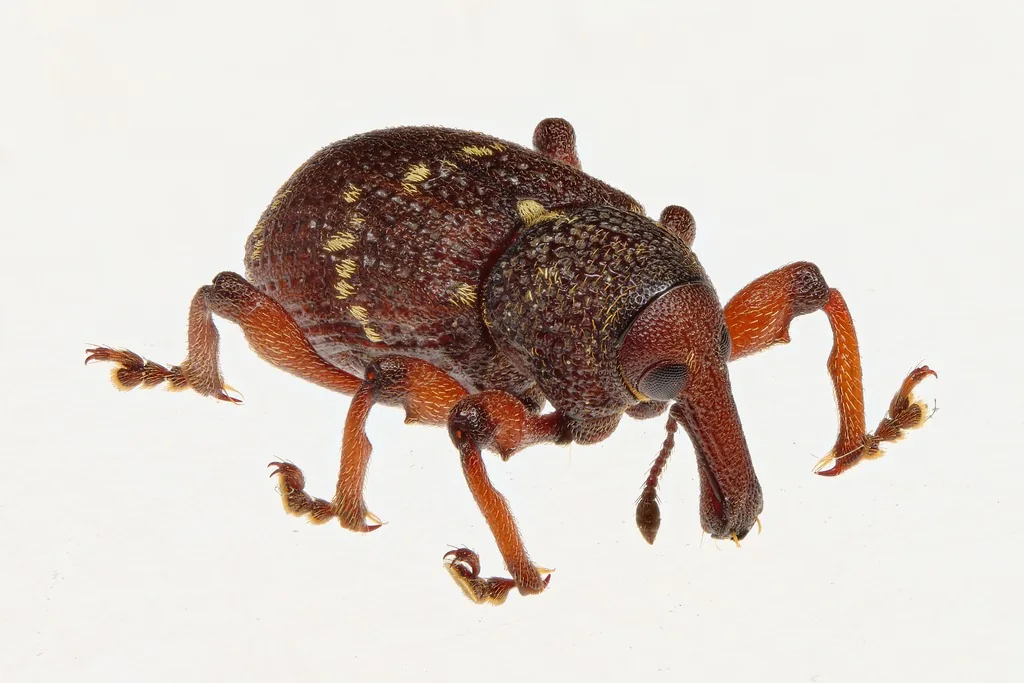
- Adults are thick-bodied, reddish-brown weevils up to 12 mm long with a long snout and two rows of dots made of white hairs down the back. Of the four loosestrife biocontrol beetles, it is the only one that is both large and long-snouted: the Galerucella leaf beetles are golden-brown, oval, about 5 mm and snoutless, and the loosestrife flower weevil is dark with pale shoulder patches and only about 2 1/2 mm long.[1]
- Larvae are C-shaped, off-white grubs with brown heads, up to 10 mm long, and live hidden in the roots and lower stems, where their tunnels are packed with frass. Their damage shows only when a root is cut open.[1]
- Eggs are white and oval, laid singly in the soil beside the plant or in the stem near the soil line.[1][2]
- Adult feeding leaves characteristic chew marks along leaf margins, sometimes with an 'ink dot' of frass on the leaf, and stem tips may wilt and die above a feeding site.[1]
Look-alikes
| Look-alike | How to tell them apart |
|---|---|
| Loosestrife leaf beetles (Galerucella calmariensis and G. pusilla) | Golden-brown, oval leaf beetles about 5 mm long without a snout; their larvae have dark spots down the back and feed openly on the foliage, leaving windowpane and shot-hole patterns.[1] |
| Loosestrife flower weevil (Nanophyes marmoratus) | The other loosestrife weevil: dark with light shoulder patches, only about 2 1/2 mm long, with a long snout; its whitish larvae feed inside the flower buds.[1] |
Where it lives
Native to Europe and Asia, the weevil was released across the United States and Canada beginning in 1992 using stock mainly from Germany and Finland. It is believed well established in Oregon, New York and Minnesota and perhaps Washington and Idaho, and may be established throughout purple loosestrife's North American range, but because the adults are nocturnal and the larvae underground its presence is hard to confirm. In Minnesota it is one of the four beetles introduced for loosestrife control.[1][3]
Biology and life cycle
Adults overwinter and come out shortly after purple loosestrife shoots sprout in spring. They are most active at night and are best looked for at dusk, in the early morning or on cool, overcast or rainy days; on warm sunny days they hide in litter at the base of the plants.[1][2]
Females lay eggs singly, up to 100 a year, from May into September, in the soil near the host or in the stem close to the ground. The eggs hatch in about 11 days.[1][2]
Young larvae mine the stem or the outside of the root and then tunnel into the root center, where they overwinter and keep feeding for one to two years through three larval stages. They stay active as long as soil temperatures allow; flooding stops their feeding but they can survive many weeks under water.[1][2]
Pupation takes place in the root crown, mainly in early summer, and new adults emerge from June to October. Adults mate within two weeks and can live up to three years, overwintering several times. A generation often takes two years, or one year when eggs are laid early.[1][2][4]
In Europe the weevil was found in every habitat of its host except permanently flooded sites, with about three quarters of plants attacked where it occurred, and adults make dispersal flights that let them find scattered loosestrife stands.[4]
Damage and signs
- Adult chewing on leaves and stems is of little consequence. The larvae do the damage, hollowing the roots and filling them with frass. Up to 40 larvae have been found in one root system; small roots can be severely damaged or killed, while large old rootstocks withstand substantial feeding and need several larval generations before the effect shows.[1][2]
- Attacked plants lose their reserves, grow smaller, produce less seed and sometimes die. The Minnesota DNR describes larval feeding as destroying the plant's nutrient source for leaf development, leading to the complete destruction of mature plants.[1][3][2]
- Root feeding complements the defoliation by Galerucella leaf beetles, often producing significant decreases in purple loosestrife and increases in native plants. In four years of field cage experiments the two agents did not compete, though very heavy leaf-beetle feeding that kills root tissue can reduce weevil larval survival.[1][5]
- No nontarget effects have been reported.[1]
Health risk
A plant-feeding weevil and a weed biological control agent; none of these sources describes any risk to people.[1][2]
Control
Prevention
It tolerates a wide range of conditions and survives long submersion, but permanently flooded sites keep adults off the plants and eventually kill the larvae, so it cannot be expected to work in standing water.[1]
Biological control
This weevil is the control, released on purpose against purple loosestrife; leave it alone. Its establishment and impact are hard to judge because the larvae are hidden and the adults work at night, so do not assume it is absent just because you have not seen it.[1]
Common questions
- Why have I never seen this weevil on my loosestrife?
- Adults feed mostly at night and hide in litter at the base of the plants by day, and the larvae are inside the roots. Look at dusk, early in the morning or on cool, overcast, rainy days, or check leaf margins for its chew marks.[1][2]
- How long does it take the root weevil to kill purple loosestrife?
- Several larval generations on large old rootstocks, each generation often taking two years. Small root systems can be killed much sooner when many larvae attack them.[1][2]
- Does it work together with the leaf beetles?
- Yes. Root feeding below ground complements defoliation above it, and field studies found no competition between the two over four years; together they often bring significant declines in loosestrife.[1][5]
Sources
- North American Invasive Species Management Association (PDF hosted on Bugwood), “Purple Loosestrife Biocontrol Agents: History and Ecology in North America. In: Winston, ed., Biological Control of Weeds in North America, NAISMA-BCW-2023-28-PURPLE LOOSESTRIFE-A (2023).” bugwoodcloud.org/resource/files/27701.pdf (accessed 2026-11-10)
- Minnesota Department of Natural Resources, “Hylobius transversovittatus (Purple loosestrife biological control).” www.dnr.state.mn.us/invasives/aquaticplants/purpleloosestrife/biocontrol_ht.html (accessed 2026-11-10)
- Minnesota Department of Natural Resources, “Purple loosestrife control: Biological.” www.dnr.state.mn.us/invasives/aquaticplants/purpleloosestrife/biocontrol.html (accessed 2026-11-10)
- Oecologia (Springer), “Blossey. Herbivory below ground and biological weed control: life history of a root-boring weevil on purple loosestrife. Oecologia 94: 380-387 (1993), doi:10.1007/BF00317113.” doi.org/10.1007/BF00317113 (accessed 2026-11-10)
- Oecologia (Springer), “Hunt-Joshi and Blossey. Interactions of root and leaf herbivores on purple loosestrife (Lythrum salicaria). Oecologia 142: 554-563 (2005), doi:10.1007/s00442-004-1747-4.” doi.org/10.1007/s00442-004-1747-4 (accessed 2026-11-10)
- iNaturalist, “Hylobius transversovittatus taxon page (order and family).” www.inaturalist.org/taxa/221940 (accessed 2026-11-10)