On this page
How to identify it
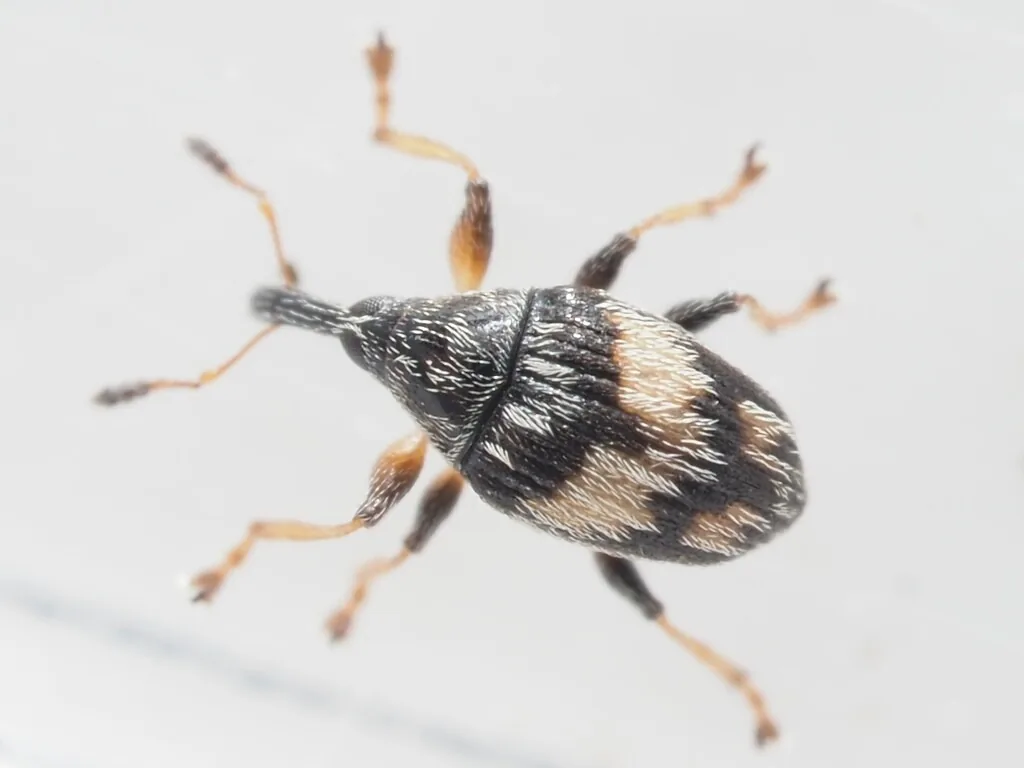
- Adults are very small, up to 2.5 mm long, with a wide body and a long snout. They are dark brown with orange legs and large whitish-yellow patches on the shoulders.[1]
- Larvae are C-shaped, creamy white with a brown head, up to 2 mm long, and live hidden inside purple loosestrife flower buds. Eggs are tiny, spherical and white.[1]
- Attacked buds stay closed and often fall off. Buds that remain on the spike show the holes the new adults chewed to leave their pupation chambers, which are easiest to see in late summer and fall.[2][1]
Look-alikes
| Look-alike | How to tell them apart |
|---|---|
| Loosestrife leaf beetles (Galerucella) | The two leaf-feeding agents are golden-brown, somewhat oval, about 5 mm long and have no long snout. Their larvae have dark spots down their backs and feed openly on the foliage, leaving window-pane and shot-hole damage, while flower weevil larvae feed only inside buds.[1] |
| Loosestrife root weevil (Hylobius transversovittatus) | The root weevil is reddish brown, thick-bodied and up to 12 mm long, with a long snout; its whitish larvae feed inside the roots rather than the flower buds.[1] |
Where it lives
Native to Europe and Asia. Weevils collected in France and Germany were released in the United States beginning in 1994, and German stock went to Manitoba in 1997. The species is now established in at least 12 states and four Canadian provinces, is well adapted to the range of conditions purple loosestrife grows in, and is one of the four loosestrife agents released in Minnesota after testing in Europe and in North American quarantine between 1987 and 1991.[1][3]
Biology and life cycle
Overwintered adults appear on purple loosestrife in mid to late spring and feed first on the shoot tips and youngest leaves. As soon as flower buds form they move up to the flower spikes, where they feed on the buds, mate and begin laying eggs.[1][2]
Each female lays 60 to 100 eggs over the summer, one per bud, inserted into the tip of the bud before the petals have fully developed; in Minnesota egg laying runs into August. The larva eats the stamens, usually the petals, and then the ovary, passing through three stages, and pupates in the bud it destroyed.[1][2]
Development from egg to adult takes about a month. The new adults emerge mainly in August, feed on whatever green leaves remain, and then overwinter in the leaf litter. There is one generation a year.[1][2]
Damage and signs
- Adult and larval feeding make the flower buds abort, which lowers the plant's seed output. At high weevil densities larval feeding can cut a plant's seed production by as much as 60 percent, and attack rates in Europe can exceed 70 percent of buds. The weevil does not kill established plants; its value is in slowing spread.[1][2]
- Its populations are often held down by the leaf beetles: heavy Galerucella defoliation leaves fewer flowers to feed on. On its own it is probably less important than the other agents, since purple loosestrife does not seem to be limited by seed, but it complements the leaf beetles by attacking flowers on plants that escape defoliation and is considered an important agent where loosestrife is declining and the other agents are scarce.[1]
- The Minnesota DNR credits the flower weevil with severely reducing purple loosestrife seed production. No nontarget effects have been reported.[3][1]
Health risk
A tiny plant-feeding weevil; none of these sources describes any risk to people.[1][2]
Control
Prevention
No control is needed. The flower weevil is an approved biological control agent of purple loosestrife with no reported nontarget effects, and its exit holes in old buds are a sign the program is working at a site.[1][2]
Biological control
Releases are made by agencies and their partners: in Minnesota the DNR introduced four approved loosestrife beetles, including this weevil, after the species passed host testing in Europe and in North American quarantine.[3]
Common questions
- Why are the flower buds on the purple loosestrife closing up and dropping?
- Larvae of the loosestrife flower weevil are eating the stamens, petals and ovary inside. Attacked buds stay closed and often fall; the ones that stay on the spike show exit holes by late summer.[2][1]
- Does it kill purple loosestrife?
- No. It reduces seed output, by up to 60 percent on heavily attacked plants, which can slow the weed's spread, but it does not kill existing plants. The leaf beetles and the root weevil do the heavier damage.[1]
- How do I tell it from the loosestrife leaf beetles?
- Size and shape: the flower weevil is only about 2.5 mm, dark with pale shoulder patches and a long snout, and it stays on the flower spikes. The leaf beetles are golden brown, about 5 mm, with no snout, and chew the foliage.[1]
Sources
- North American Invasive Species Management Association (PDF hosted on Bugwood), “Purple Loosestrife Biocontrol Agents: History and Ecology in North America. In: Winston, ed., Biological Control of Weeds in North America, NAISMA-BCW-2023-28-PURPLE LOOSESTRIFE-A (2023).” bugwoodcloud.org/resource/files/27701.pdf (accessed 2026-11-10)
- Minnesota Department of Natural Resources, “Nanophyes marmoratus (Purple loosestrife biological control).” www.dnr.state.mn.us/invasives/aquaticplants/purpleloosestrife/biocontrol_nm.html (accessed 2026-11-10)
- Minnesota Department of Natural Resources, “Purple loosestrife control: Biological.” www.dnr.state.mn.us/invasives/aquaticplants/purpleloosestrife/biocontrol.html (accessed 2026-11-10)
- iNaturalist, “Nanophyes marmoratus taxon page (order and family).” www.inaturalist.org/taxa/455171 (accessed 2026-11-10)