On this page
How to identify it
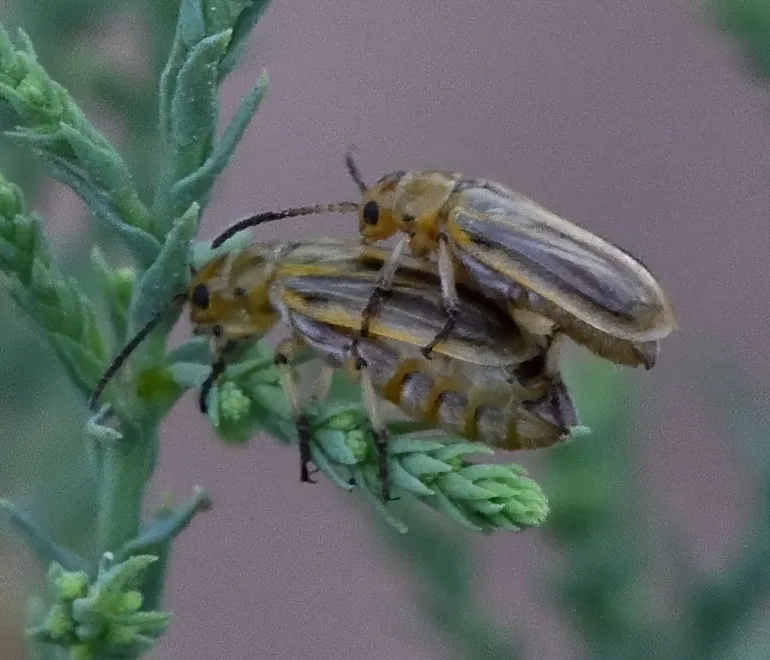
- Adults are small leaf beetles, 5 1/2 to 6 mm long, tan to yellow, with two dark stripes on each wing cover; the stripes are bold in some populations and faint in others.[1]
- Larvae are up to 1 cm long, spotted grayish black, with distinct yellow or cream stripes running lengthwise.[1]
- Eggs are tan and round, laid in small clusters on saltcedar foliage.[1]
- Both larvae and adults are easy to find on saltcedar leaves and shoots through the growing season, often in large groups. The four species look so much alike, and have hybridized so widely, that they cannot easily be told apart without genetic testing.[1]
Look-alikes
| Look-alike | How to tell them apart |
|---|---|
| Coniatus splendidulus (a weevil) and Opsius stactogalus (a leafhopper) | Two other foliage feeders accidentally introduced with saltcedar. Both are green and 4 mm or shorter; the weevil adult is mottled green to brown with a long, downward-pointing snout, and its larvae are bright green with black heads.[1] |
Where it lives
Released in the western United States beginning in 2001, tamarisk beetles are now established across most of saltcedar's invaded range in North America, from Wyoming to Texas and into northern Mexico. The northern tamarisk beetle (D. carinulata), first released in Utah and other western states, is now widespread, while in Texas and New Mexico the other three species have hybridized extensively.[1][2][3]
Biology and life cycle
They are specialists on saltcedar (Tamarix). The northern tamarisk beetle is a highly specialized leaf-eater whose main hosts are the hybrid saltcedars lining western streams and rivers.[2][3][1]
Adults spend the winter in leaf litter under the shrubs. In spring they come out, feed, and gather in large groups in response to a pheromone given off by the males.[1]
Each female lays 100 to 200 eggs in groups of up to 25 on the foliage. The larvae hatch in about five days, feed on young growth through three stages, and then drop into the litter under the plant to pupate.[1]
In late summer, shortening days cue the adults to stop breeding and prepare for winter. The northern tamarisk beetle has two generations a year north of the 38th parallel; the other species have three to five.[2][1]
The northern tamarisk beetle populations first released needed the long summer days of northern latitudes; farther south they went dormant too early, which at first kept them from establishing south of the 38th parallel. Their daylength cue has since evolved, letting them spread south and persist as far as northern Mexico.[1][2][3]
Numbers swing in boom and bust cycles: a stand may be completely stripped, followed by a year or more when beetles are scarce or absent. Flooding, predation by birds and ants, and severe late-winter freezes all knock populations down.[1]
Damage and signs
- Larvae and adults eat saltcedar leaves and sometimes scrape the bark off young twigs, which dries the stems out. Newly stripped shrubs turn straw-colored and quickly leaf out again, but repeated defoliation causes dieback, leaving dead gray branches, and eventually kills some plants. In some Nevada stands, 70 percent of plants died within five years.[1]
- Feeding on other plants is limited. Spillover onto the ornamental athel tamarisk (Tamarix aphylla) has been seen only where nearby saltcedar was heavily eaten, and those trees recovered the next year.[1]
- Because saltcedar is used as nesting habitat by the endangered southwestern willow flycatcher, releases have been restricted near its nesting areas.[1]
Health risk
They are plant-feeding leaf beetles, and none of these sources describes any risk to people.[1][2][3]
Control
Prevention
Do not collect or move tamarisk beetles yourself. A moratorium bars interstate movement and release of Diorhabda, Arizona and New Mexico do not allow introduction or redistribution, and redistribution onto federal lands is prohibited.[1]
Biological control
Tamarisk beetles are themselves a biological control program, and their feeding on saltcedar is the intended result; no control is needed. When moving beetles to new sites under the rules in force, take care not to carry along the two unapproved saltcedar insects.[1]
Common questions
- Why are the saltcedar trees along the river brown?
- In much of the West, brown, straw-colored saltcedar in summer is the work of tamarisk beetles and their larvae stripping the leaves. Newly defoliated plants usually leaf out again; only repeated defoliation causes dieback.[1]
- Do tamarisk beetles eat other plants?
- They are specialists on saltcedar (Tamarix). Beyond it, only limited, temporary spillover feeding has been recorded, on the related athel tamarisk and in open field tests on the native Frankenia salina, after nearby saltcedar had been stripped.[2][1]
- Can I bring tamarisk beetles to my property to kill saltcedar?
- Not across state lines. Interstate movement and release are under a moratorium, Arizona and New Mexico prohibit releases, and redistribution onto federal lands is not allowed.[1]
Sources
- North American Invasive Species Management Association (PDF hosted on Bugwood), “Bean (Colorado Department of Agriculture) and Dudley (University of California, Santa Barbara). Saltcedar Biocontrol Agents: History and Ecology in North America. In: Winston, ed., Biological Control of Weeds in North America, NAISMA-BCW-2023-33-SALTCEDARS-A (2023).” bugwoodcloud.org/resource/files/28116.pdf (accessed 2026-11-09)
- Evolutionary Applications (Wiley), full text in PubMed Central (PMC9753830), “Clark, Bitume, Bean, Stahlke, Hohenlohe and Hufbauer. Evolution of reproductive life-history and dispersal traits during the range expansion of a biological control agent. Evolutionary Applications (2022), doi:10.1111/eva.13502.” doi.org/10.1111/eva.13502 (accessed 2026-11-09)
- Current Research in Insect Science (Elsevier), full text in PubMed Central (PMC12051650), “Clark, Bean, Bitume, Stahlke, Hohenlohe and Hufbauer. Heritability of body size matches trait evolution in the range expansion of a biological control agent. Current Research in Insect Science (2025).” pmc.ncbi.nlm.nih.gov/articles/PMC12051650/ (accessed 2026-11-09)
- iNaturalist, “Diorhabda taxon page (order and family).” www.inaturalist.org/taxa/335472 (accessed 2026-11-09)