On this page
How to identify it
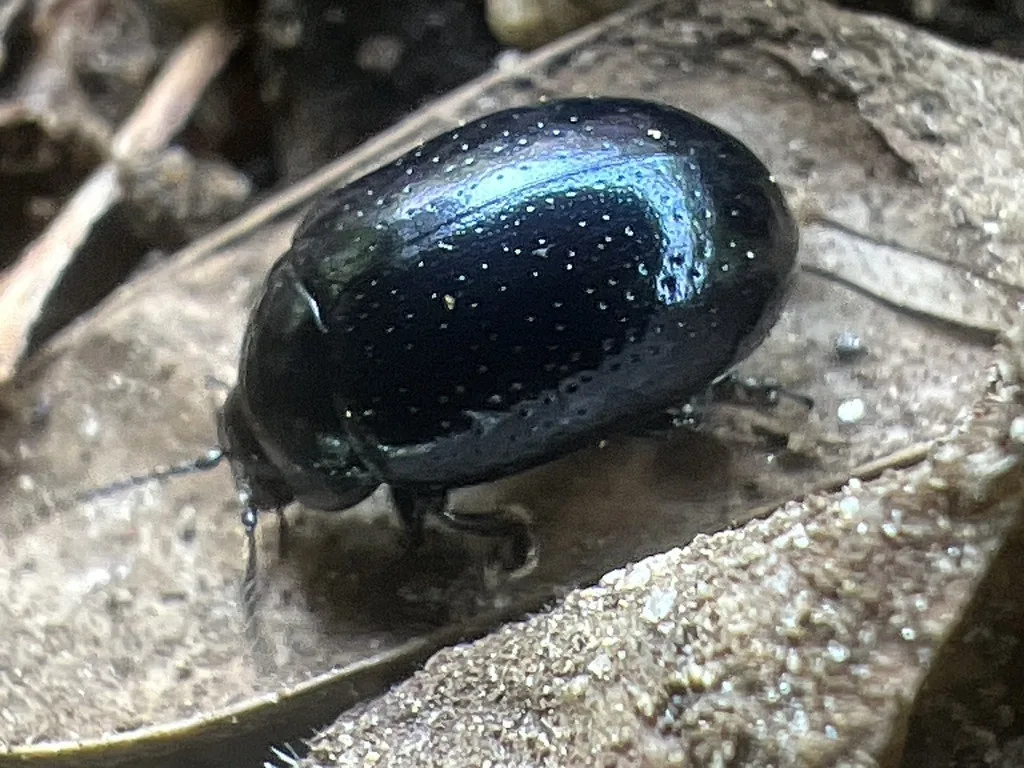
- Adults are oval, robust leaf beetles about 1/4 inch (6 mm) long with a downward-pointed head, shiny metallic and colored blue, bronze, green or purple. The two species look alike; beetles with blue undertones are always C. quadrigemina.[2][1]
- Larvae are plump and somewhat humpbacked, orange when young and gray, orangish or pinkish later, growing to about 1/4 inch (6 mm). They feed on the lower leaves and stem bases of Hypericum, mostly before sunrise, because eating St. Johnswort makes them sensitive to light.[2][1]
- Eggs are orange, oblong and about 1 mm long, laid singly or in clusters on leaves. Pupae are hidden in cells in the top inch of soil.[2][1]
- Ragged-edged, chewed leaves, shoots and stems on a Hypericum plant point to Chrysolina feeding. Adults often feed in clusters in early summer and again in fall; in mid to late summer they are resting in the soil.[2][1]
- The moth Aplocera plagiata also defoliates St. Johnswort, so finding the beetles or their larvae is the way to confirm which insect is responsible.[1]
Where it lives
Native to Europe and Asia, C. hyperici was released in California in 1945 and C. quadrigemina in 1946, both via Australia, and were spread to other western states, then to British Columbia in the early 1950s and Hawaii in 1965. Both are now established in several states and provinces, especially in the East, and throughout California wherever Klamathweed grows. They do best in warm, sunny regions with wet winters and poorly in shade, on barren rocky ground, and where summers are rainy. C. quadrigemina favors milder, drier sites; C. hyperici tolerates cold and moisture better.[1][2]
Biology and life cycle
The beetles have one generation a year and spend much of it in rhythm with their host. Adults emerge mainly in April and May as St. Johnswort bolts and buds, feed through early summer, then drop to the soil and rest through the hot, dry months without feeding.[2][1]
Shortening days in fall bring the adults back to the plants, where they feed and lay eggs on the basal regrowth. A female can lay about 1,000 eggs over a life of several months. The beetles overwinter mostly as eggs or larvae; where fall moisture is poor, adults overwinter instead and lay in spring.[2][1]
Larvae feed from late fall through winter and spring on the lowest leaves and stem bases. Mature larvae burrow about an inch into the soil in late winter or spring and pupate there.[2][1]
Populations boom and bust with their weed: when the beetles bring St. Johnswort down, their own numbers crash, the weed rebounds at lower levels than before, and the cycle repeats.[1]
The two species often occur together and are hard to tell apart. C. hyperici is reported from a wider area, but C. quadrigemina is usually the more abundant and effective one at drier, warmer sites, and the most common Chrysolina on Hypericum in California.[1][2]
Damage and signs
- On Klamathweed the beetles are the intended control. Larval feeding can wipe out stands, and the striking summer and fall defoliation by adults adds to it. By the early 1940s the weed covered more than 2 million acres of California rangeland; after the beetles' release in 1946 it had fallen by over 99 percent by 1957, and it is still considered under complete control there. Grateful landowners put up a monument to the beetles.[2][1]
- Where summers are rainy or sites are shaded, St. Johnswort recovers from defoliation and infestations persist, though at well below historical levels.[1]
- In landscapes, adults and larvae chew ornamental Hypericum species, especially creeping St. Johnswort (H. calycinum). Heavy feeding can defoliate plants when beetles are abundant, but irrigated plants generally recover and the damage is mainly aesthetic.[3][2]
- C. quadrigemina also lays eggs and feeds on the native Hypericum concinnum and H. punctatum, with no population-level impact reported.[1]
Health risk
These are plant-feeding leaf beetles; none of these sources describes any risk to people.[1][2][3]
Control
Prevention
On landscape Hypericum, UC IPM says control is generally not warranted. Water deeply and regularly during the dry season, especially in hot weather, and protect roots from compaction and soil disturbance; vigorous plants tolerate moderate feeding.[3]
Sanitation
In hot areas, removing litter under the plants may reduce survival of the adults that rest there through summer. Keeping the soil under plants moist in spring may raise disease and mortality among the larvae pupating near the surface.[3]
Biological control
Entomopathogenic nematodes (Heterorhabditis or Steinernema species) applied to the soil under plants in late winter, shortly before the larvae pupate, may provide control. Watch the lowest parts of the plant for larvae to time the application.[3]
On rangeland Klamathweed the beetles are the control and need no management; they do their best work in warm, sunny places with wet winters and poorly in shade or on barren, rocky ground.[1][2]
Pesticides
If the chewing cannot be tolerated, Bacillus thuringiensis ssp. galleriae kills leaf beetle adults and larvae that eat sprayed foliage; because it does not persist, UC IPM suggests two applications about 10 days apart on the lower foliage when young larvae are present. Azadirachtin and spinosad are other foliar options. UC IPM advises against carbamates, organophosphates and pyrethroids because of their effects on bees, natural enemies and surface water. Systemic neonicotinoids such as imidacloprid applied in fall or spring give season-long control.[3]
Common questions
- Are Klamathweed beetles good or bad?
- Both, depending on the plant. On the invasive, livestock-poisoning weed Klamathweed they are one of the great successes of biological weed control. On ornamental St. Johnswort ground covers they are a chewing pest, though irrigated plants usually recover.[2][3]
- When do the beetles do their damage?
- Larvae chew the lower leaves and stem bases from late fall through winter and spring; adults feed higher on the plant mainly in spring and early summer, rest in the soil through hot weather, and feed again more lightly in fall.[2][3]
- Should I spray my St. Johnswort?
- Usually not. UC IPM says vigorous, well-watered plants tolerate moderate feeding and that control is generally not warranted. If damage is intolerable, Bacillus thuringiensis ssp. galleriae, azadirachtin or spinosad on the lower foliage when young larvae are present are the first choices.[3]
Sources
- North American Invasive Species Management Association (PDF hosted on Bugwood), “Randall, Andreas, Milan and Moffat. Common St. Johnswort Biocontrol Agents: History and Ecology in North America. In: Winston, ed., Biological Control of Weeds in North America, NAISMA-BCW-2024-18-COMMON ST JOHNSWORT-A (2024).” bugwoodcloud.org/resource/files/33586.pdf (accessed 2026-11-10)
- University of California Statewide IPM Program, “Klamathweed Beetle (Natural Enemies Gallery).” ipm.ucanr.edu/natural-enemies/klamathweed-beetle/ (accessed 2026-11-10)
- University of California Statewide IPM Program, “Klamathweed Beetle (Home and Landscape).” ipm.ucanr.edu/home-and-landscape/klamathweed-beetle/ (accessed 2026-11-10)
- iNaturalist, “Chrysolina quadrigemina taxon page (order and family).” www.inaturalist.org/taxa/143351 (accessed 2026-11-10)