On this page
How to identify it
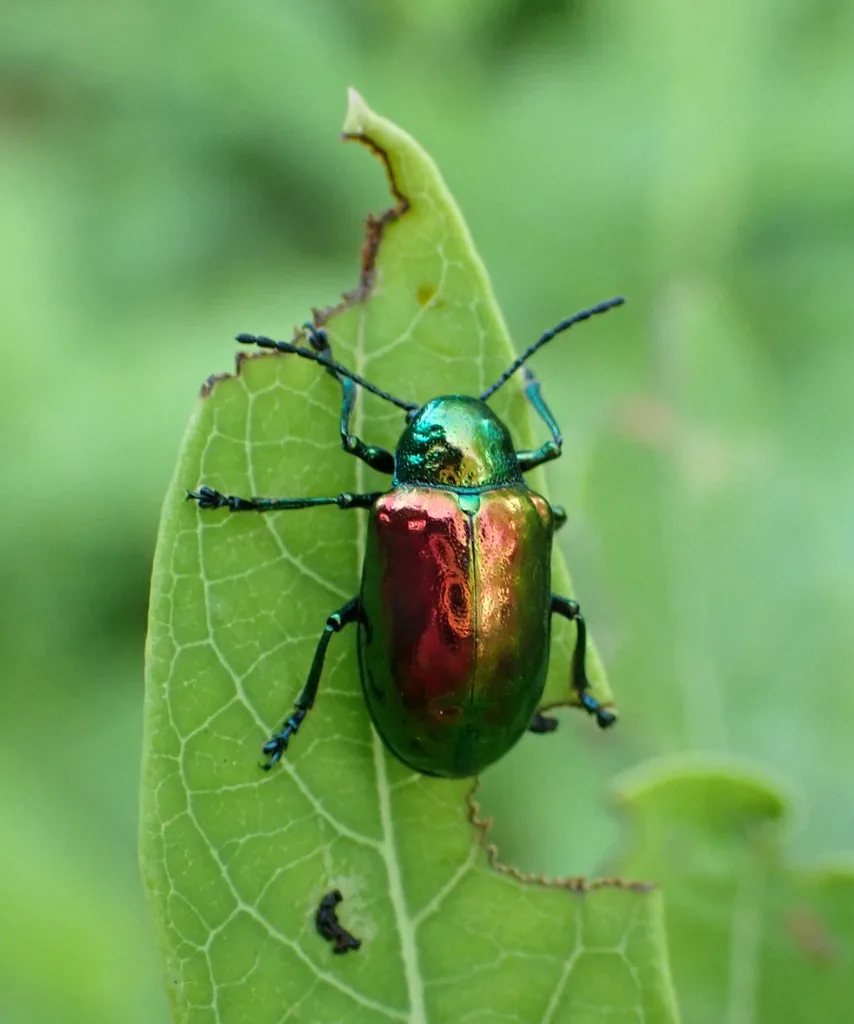
- Adults are about 3/8 inch long (8 to 11 mm), shiny metallic blue-green with a coppery shine on the wing covers.[2][3][1]
- The antennae and legs are bluish black, and the antennae are long and thread-like.[2]
- Larvae, which live in the soil, are white with a brown head.[2]
- Look for it on the leaves of dogbane plants, especially hemp dogbane along roadsides, field edges, railroad tracks and other open, disturbed ground.[2][3]
Look-alikes
| Look-alike | How to tell them apart |
|---|---|
| Cobalt milkweed beetle | The cobalt milkweed beetle, a close relative, is blue rather than shiny green. Where the two meet, toward the western edge of the dogbane beetle's range, they hybridize; hybrids range from blue-green to brown-purple and can't reproduce.[2] |
| Six-spotted tiger beetle | Also shiny green, but it darts along trails, running and flying fast, and is seen mostly in spring; the dogbane beetle stays on its dogbane host plants through the summer, chewing the leaves.[4][2][3] |
Where it lives
It ranges across most of the United States east of the Rocky Mountains and into southern Canada, west to the Rockies, Utah and Arizona, with several known localities in the Pacific Northwest.[2][3]
Biology and life cycle
It feeds mainly on dogbanes: hemp dogbane (Indian hemp, Apocynum cannabinum) and spreading dogbane (A. androsaemifolium). MDC and ADW say it also feeds on milkweeds, but in an Iowa study it was never seen feeding on milkweed, and it refuses milkweed in feeding-choice experiments.[2][3][1]
Adults emerge in early summer and spend their 6- to 8-week life on the host plants; in Iowa they are found from mid-June to mid-August.[2][3]
Dogbane defends itself with a milky latex that gums up insect mouthparts. Instead of cutting leaf veins first, the beetle feeds on the low-latex tissue toward the leaf tip and along the leaf margins, then wipes its mouthparts by walking backward, leaving latex bands about 2 mm wide and 2 cm long on the plant.[2][3]
Adults mate about once a day, usually early in the day. After mating, the male rides on the female's back to guard her, so the whole process usually lasts more than an hour and a half.[2]
Females lay eggs through the summer in masses of small capsules, about 3 mm wide and 2 mm tall, on the leaves and stems of the host plants and nearby vegetation.[2][3]
Newly hatched larvae drop to the ground and tunnel down to the roots, where they feed and spend the winter. They pupate in a chamber in the soil, and the new adults dig their way up in early summer.[3][2]
It is a fairly mobile beetle: in an Iowa study, beetles moved between dogbane patches hundreds of times a year, and the longest recorded move was about 4 km.[3]
It takes up toxic cardenolides from its host plant and releases them from glands on its pronotum and wing covers when disturbed, which deters predators; larvae with high levels of the toxin are parasitized less often by parasitic wasps.[2]
Damage and signs
Health risk
ADW lists no known negative impacts on people. When disturbed, the beetle releases cardenolides, bitter plant toxins, from glands on its back to deter predators.[2]
Control
Prevention
No control is needed for people's sake: ADW lists no known negative economic impacts on humans, and the beetle lives on dogbane, a plant often regarded as a weed.[2][3]
Common questions
- What is the shiny metallic green beetle on the dogbane by my road?
- Probably the dogbane leaf beetle: about 3/8 inch long, iridescent blue-green with a coppery sheen, and found on hemp dogbane and spreading dogbane.[2][3][1]
- Does the dogbane beetle eat milkweed?
- Sources disagree. MDC and ADW say it also feeds on milkweeds, but in an Iowa study it was never seen eating milkweed and it refused milkweed in feeding-choice tests.[1][2][3]
- How does the dogbane beetle deal with the plant's sticky sap?
- It skips the leaf veins and feeds on low-latex tissue near the leaf tip, then wipes the latex off its mouthparts by walking backward. Latex bands about 2 mm wide and 2 cm long left this way have been seen on dogbane plants.[2]
Sources
- Missouri Department of Conservation, “Dogbane Beetle (Field Guide).” mdc.mo.gov/discover-nature/field-guide/dogbane-beetle (accessed 2026-11-08)
- Animal Diversity Web, University of Michigan Museum of Zoology, “Chrysochus auratus (J. Tolchin, 2013).” animaldiversity.org/accounts/Chrysochus_auratus/ (accessed 2026-11-08)
- Ecological Entomology (Royal Entomological Society / Wiley), “Dispersal ability and host-plant characteristics influence spatial population structure of monophagous beetles (M. J. St Pierre, S. D. Hendrix and C. K. Lewis), Ecological Entomology 30: 105-115 (2005).” doi.org/10.1111/j.0307-6946.2005.00659.x (accessed 2026-11-08). Read via Wiley full-text passages (abstract, Methods, Discussion).
- Missouri Department of Conservation, “Six-Spotted Tiger Beetle (Field Guide).” mdc.mo.gov/discover-nature/field-guide/six-spotted-tiger-beetle (accessed 2026-11-08)
- iNaturalist, “Chrysochus auratus taxon page (order and family).” www.inaturalist.org/taxa/84162 (accessed 2026-11-08)