On this page
How to identify it
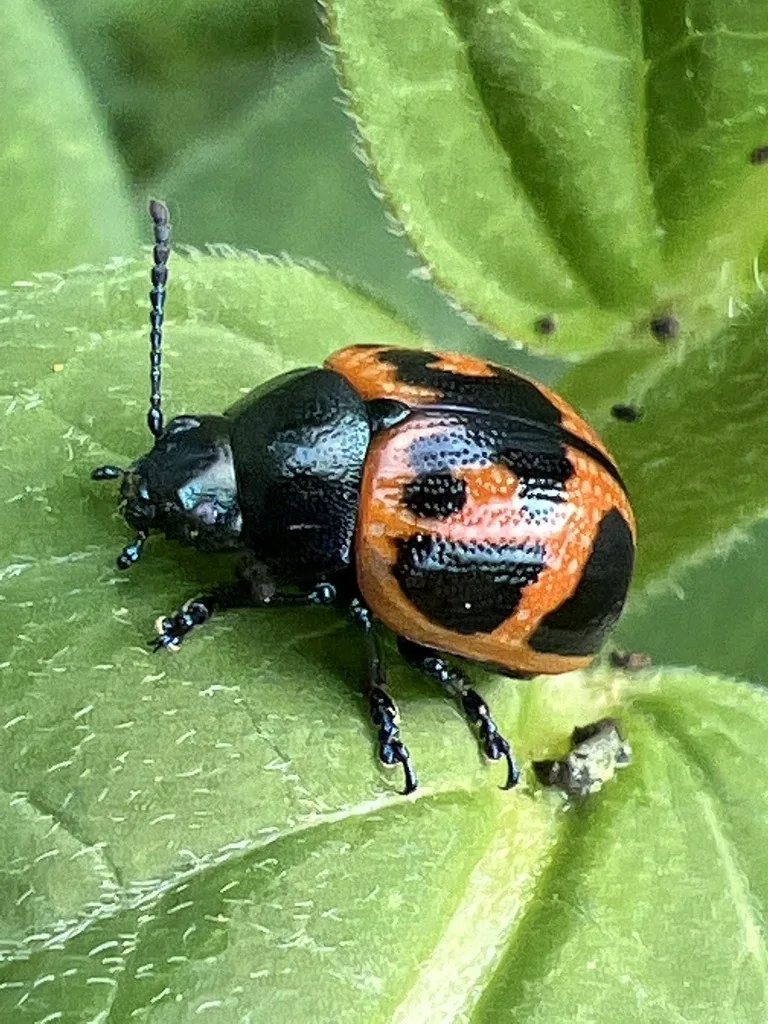
- Adults are oval, robust leaf beetles nearly 1/2 inch long (12 to 13 mm) with a black head and black pronotum.[1][2]
- The wing covers are orange or yellow with dark blue to black blotches. The exact pattern varies from beetle to beetle, but the two wing covers mirror each other almost perfectly.[2][1]
- The legs are metallic blue.[2]
- Larvae are pudgy and orange or gray, with a row of black dots along each side and a black collar.[1]
- Look for them on milkweed in meadows, grassy areas, roadsides and wetlands.[1][2]
Look-alikes
| Look-alike | How to tell them apart |
|---|---|
| Colorado potato beetle larvae | Swamp milkweed leaf beetle larvae are very similar in size to Colorado potato beetle larvae but can be told apart by a clear, translucent covering, and they feed on milkweed leaves.[2] |
Where it lives
It lives over most of North America east of the Rocky Mountains, south into northern Mexico, wherever its milkweed hosts grow. GBIF holds about 17,000 U.S. records since 1990, with the most from Ohio.[2][3]
Biology and life cycle
Swamp milkweed is the favorite food plant, but it also eats other milkweeds and other members of the dogbane family. ADW notes that some Texas populations use Cynanchum unifarium and that Enslenia albida has been recorded as a host in Illinois.[1][2]
Mating takes place on the host plant, and females attach their eggs to the undersides of milkweed leaves.[1]
Newly hatched larvae eat some of the unhatched eggs in their cluster, about 17% of the eggs on average under optimum conditions, and 3% to 5% of first-stage larvae are eaten by their clutch mates.[2]
The larvae go through four instars and feed on milkweed leaves, then drop to the ground and burrow in to pupate.[2][1]
There is one generation a year in the north and at least two in the south. The last generation of the year overwinters as adults, sheltering among leaves, often inside the fuzzy basal whorls of mullein leaves.[2][1]
Adults are active by day. They can fly but tend to stay near their host plants, and males fight each other over host plants and mates.[2]
Its natural enemies include a damsel bug and the larvae of a hover fly that eat the eggs and larvae, stink bugs in the genus Podisus, and many kinds of spiders.[2]
Damage and signs
- Adults and larvae chew milkweed leaves. Before an adult feeds, it clips the side veins of the leaf to drain the sticky, toxic sap that is the plant's defense against plant-eating insects.[1][4]
- Milkweeds fight back: in a study of five closely related milkweeds, feeding by this beetle and by monarch caterpillars triggered extra latex in four of the species and changes in cardenolide toxins in three.[5]
Health risk
ADW lists no known adverse effects of this beetle on people, and MDC describes none.[2][1]
Control
Prevention
No control is needed for people's sake: ADW lists no known adverse effects on humans. The beetle feeds on milkweeds and a few related plants.[2][1]
Biological control
Several predators attack it: a damsel bug eats the eggs and larvae, hover fly larvae prey on all larval stages, and Podisus stink bugs and many kinds of spiders also prey on it.[2]
How it handles milkweed's defenses
Many milkweed-feeding insects cut leaf veins before feeding. Cutting the veins first blocks the latex from flowing to the part of the leaf the insect is about to eat; in experiments, leaves with cut veins even became edible to generalist insects that normally ignore milkweed.[4][1]
Milkweeds also contain cardenolides, toxins that work by blocking an essential pump in animal cells, the sodium pump. The beetle has adapted to them and uses them, along with its warning colors, for protection from predators.[2][6]
A 2012 study found that this beetle carries the same change in that pump (the Na,K-ATPase) that helps the monarch butterfly resist cardenolides, an example of unrelated milkweed specialists arriving at the same solution.[6]
Common questions
- What is the round orange-and-black beetle on my milkweed?
- If it is nearly 1/2 inch long with a black head and orange wing covers blotched in black, it is most likely the swamp milkweed leaf beetle, a leaf beetle that feeds on milkweeds.[1][2]
- Why does it cut the veins of milkweed leaves?
- Milkweed defends itself with sticky, toxic sap. The beetle clips the side veins of a leaf first, draining the sap before it starts to eat.[1][4]
- Where do swamp milkweed leaf beetles spend the winter?
- As adults, tucked among sheltering leaves, often in the fuzzy basal whorls of mullein leaves.[1][2]
Sources
- Missouri Department of Conservation, “Swamp Milkweed Leaf Beetle (Field Guide).” mdc.mo.gov/discover-nature/field-guide/swamp-milkweed-leaf-beetle (accessed 2026-11-11)
- Animal Diversity Web, University of Michigan Museum of Zoology, “Labidomera clivicollis (B. Bodnariuk and B. Scholtens, 2014).” animaldiversity.org/accounts/Labidomera_clivicollis/ (accessed 2026-11-11)
- Global Biodiversity Information Facility (GBIF), “Labidomera clivicollis: U.S. occurrence records since 1990 by state (GBIF occurrence search).” api.gbif.org/v1/occurrence/search?taxonKey=1047370&country=US&hasGeospatialIssue=false&occurrenceStatus=PRESENT&year=1990%2C2026&facet=stateProvince&facetLimit=400&limit=0 (accessed 2026-11-11)
- Science, via PubMed, “Vein-cutting behavior: insect counterploy to the latex defense of plants (Dussourd and Eisner 1987).” pubmed.ncbi.nlm.nih.gov/3616620/ (accessed 2026-11-11)
- Journal of Chemical Ecology, via PubMed, “Specificity of herbivore-induced hormonal signaling and defensive traits in five closely related milkweeds (Asclepias spp.) (Agrawal et al. 2014).” pubmed.ncbi.nlm.nih.gov/24863490/ (accessed 2026-11-11)
- Proceedings of the National Academy of Sciences, via PubMed, “Community-wide convergent evolution in insect adaptation to toxic cardenolides by substitutions in the Na,K-ATPase (Dobler et al. 2012).” pubmed.ncbi.nlm.nih.gov/22826239/ (accessed 2026-11-11)
- iNaturalist, “Labidomera clivicollis taxon page (order and family).” www.inaturalist.org/taxa/82582 (accessed 2026-11-08)