On this page
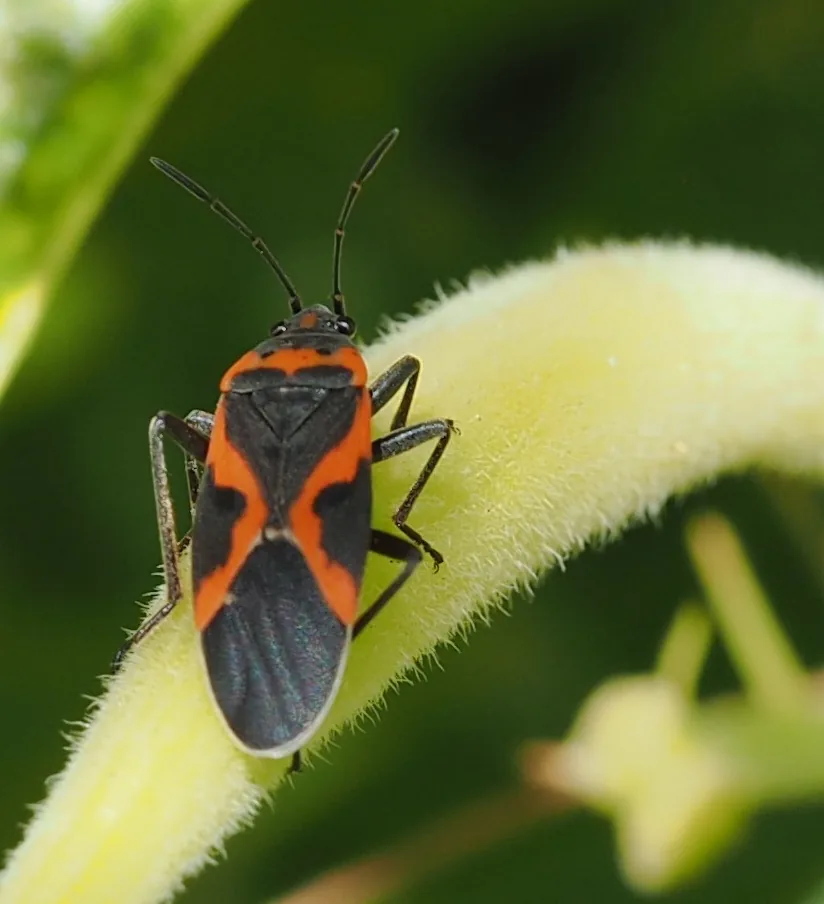
How to identify it
Look-alikes
| Look-alike | How to tell them apart |
|---|---|
| Large milkweed bug | Larger (1/2 to 1 inch) with orange-black-orange bands across each wing instead of an X.[1] |
| Boxelder bug | Has a thin red line down the shield behind the head instead of a wide band, and lives on box elder trees.[1] |
| False milkweed bug | Very similar but feeds on false sunflower; its black mark looks like two overlapping hearts and it has a T- or Y-shaped orange head mark.[1] |
Where it lives
Widespread; found statewide in Missouri in open, grassy areas with milkweeds and other wildflowers.[1]
Biology and life cycle
Females lay eggs on milkweeds in spring; there is at least one generation a year and adults overwinter.[1]
In Missouri it is seen from June until the first hard freeze in October.[1]
Its bright colors warn predators that it stores toxins from milkweed sap.[1]
Damage and signs
Health risk
None to people or pets.[1]
Control
Prevention
Usually no control is needed; gardeners growing milkweed for monarchs see it as a common milkweed visitor.[1][2]
Common questions
- What is the black bug with an orange X on my milkweed?
- Probably the small milkweed bug.[1][2]
- Is it a boxelder bug?
- No; boxelder bugs have a thin red line down the shield behind the head and live on box elder.[1]
- Does it hurt milkweed?
- It mainly feeds on ripening seeds; it is common on milkweed plantings.[1][2]
Sources
- Missouri Department of Conservation, “Small Milkweed Bug (Field Guide).” mdc.mo.gov/discover-nature/field-guide/small-milkweed-bug (accessed 2026-10-16)
- University of Florida IFAS Extension (EDIS, Featured Creatures), “Getting the Most out of Your Milkweed (ENY-2140).” ask.ifas.ufl.edu/publication/IN1482 (accessed 2026-10-16)
- iNaturalist, “Lygaeus kalmii taxon page (order and family).” www.inaturalist.org/taxa/1019598 (accessed 2026-10-06)