On this page
How to identify it
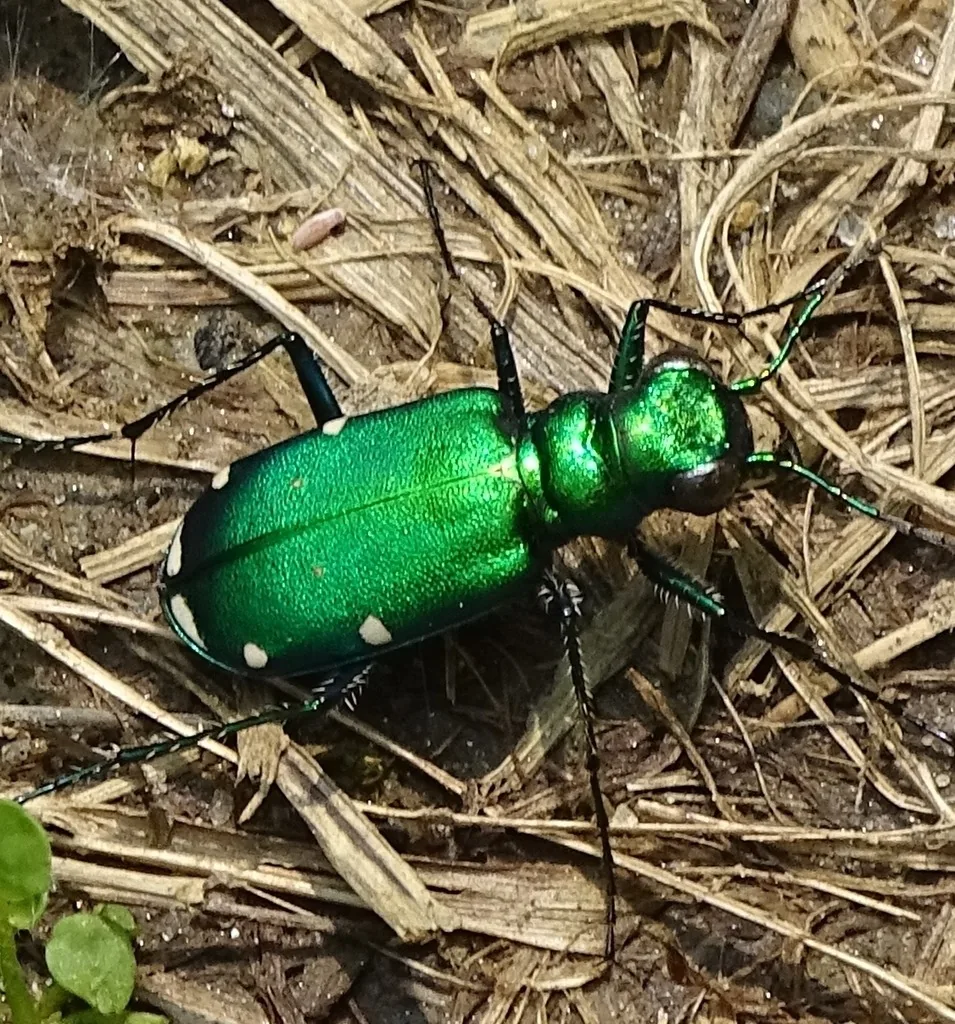
- Adults are about 1/2 inch long (12 to 14 mm) and shiny metallic green, sometimes blue, with long legs, large sickle-shaped jaws and big bulging eyes.[4][1]
- Most have six small white spots along the edges of the wing covers, but the count varies: some have two, four or eight, and some have none.[4][2]
- As in other tiger beetles, the bulging eyes make the head wider than the narrow, neck-like pronotum behind it.[3]
- Its movements give it away: it runs in short dashes with pauses in between, and it is a fast flier that lands just ahead of you on a trail, pauses, then flashes away again.[2][3][1]
- The larva is a whitish or tan, grub-like insect with six legs, a large dark head, big pincer-like jaws and usually a hump behind the head. It lives in a vertical burrow in the soil and waits near the entrance.[1][4]
Look-alikes
| Look-alike | How to tell them apart |
|---|---|
| Emerald ash borer | Both are metallic green, but the emerald ash borer is a slow-moving wood borer of ash trees; the tiger beetle's body shape and quick movements set it apart.[4] |
| Punctured (sidewalk) tiger beetle | The punctured tiger beetle is iridescent brown to copper with a row of metallic green pits on each wing cover and is active in summer; the six-spotted tiger beetle is bright metallic green and most often seen in spring.[5][4][1] |
| Antlion larvae (doodlebugs) | Tiger beetle larvae are also called doodlebugs, but antlion larvae sit at the bottom of small cone-shaped pits in sand or dust, while tiger beetle larvae wait at the top of a straight vertical burrow in the soil.[3][4] |
Where it lives
The Missouri Department of Conservation calls it probably the most familiar tiger beetle in Missouri, and the University of Minnesota describes it as especially common on trails and other sunny spots in forests and nearby fields.[1][4]
Biology and life cycle
Adults are active from spring into early summer, which is when most people notice them on trails.[4][1]
Adults are active hunters that chase prey down on foot or on the wing, so they catch both walking and flying insects; MDC lists caterpillars, ants, beetles and spiders among the prey they grab with their jaws.[4][3][2]
A tiger beetle running at top speed can't see clearly and has to stop to get its sight back, which is why it moves in a dash, stop, dash pattern.[2][4]
Tiger beetle females lay eggs one at a time in shallow holes in the soil, and each larva digs its burrow where it hatches.[3]
The six-spotted tiger beetle's larval burrow can be up to 2 feet deep. Hooks on the larva's abdomen anchor it in the burrow so it can lunge at passing prey without being pulled out.[4]
The larvae spend their whole stage underground and are rarely seen, and the adults overwinter in their larval burrows.[4]
Few predators are fast enough to catch adult tiger beetles, but the larvae and eggs are eaten by animals ranging from grackles and moles to sandpipers and skunks.[3]
Damage and signs
Health risk
Tiger beetles have large, strong jaws, and MDC cautions that they can pinch hard if you handle them. MDC and the University of Minnesota describe no other risk to people.[3][4]
Control
Prevention
There is nothing to control: MDC notes that because tiger beetles hunt other insects, many people classify them as helpful, and the University of Minnesota says the six-spotted tiger beetle contributes to natural control of insects and other arthropods.[3][4]
To keep ground and tiger beetles around, Penn State suggests conserving their habitat: less soil disturbance from tillage, and surface vegetation and mulch that give them shelter. Conserving them helps natural regulation of pests and reduces the need for chemical controls.[5]
Common questions
- Is the shiny green beetle on my hiking trail an emerald ash borer?
- Probably not. An iridescent beetle that lands ahead of you on a trail, pauses and flashes away is a tiger beetle, and MDC says the six-spotted tiger beetle is known by its shiny green color along with that fast running and flying. Emerald ash borers move slowly and have a different body shape.[3][1][4]
- Can a six-spotted tiger beetle bite?
- It can pinch. Tiger beetles have large, powerful jaws for catching prey, and MDC warns they can pinch hard if handled.[3][2]
- Where do six-spotted tiger beetle larvae live?
- In a straight burrow in the soil that can be up to 2 feet deep. The larva waits near the entrance and grabs insects that walk past.[4][3]
Sources
- Missouri Department of Conservation, “Six-Spotted Tiger Beetle (Field Guide).” mdc.mo.gov/discover-nature/field-guide/six-spotted-tiger-beetle (accessed 2026-11-08)
- Missouri Department of Conservation, “Creature Feature: Six-Spotted Tiger Beetle (Xplor, March/April 2024).” mdc.mo.gov/magazines/xplor/2024-03/creature-feature-six-spotted-tiger-beetle (accessed 2026-11-08)
- Missouri Department of Conservation, “Tiger Beetles (Field Guide group page).” mdc.mo.gov/discover-nature/field-guide/tiger-beetles (accessed 2026-11-08)
- University of Minnesota Department of Entomology, “Six-Spotted Tiger Beetle (Small Wonders, M. Greenebaum).” entomology.umn.edu/node/1241 (accessed 2026-11-08)
- Penn State Extension, “Ground and Tiger Beetles (Coleoptera: Carabidae).” extension.psu.edu/ground-and-tiger-beetles-coleoptera-carabidae/ (accessed 2026-11-08)
- iNaturalist, “Cicindela sexguttata taxon page (order and family).” www.inaturalist.org/taxa/49566 (accessed 2026-11-08)