On this page
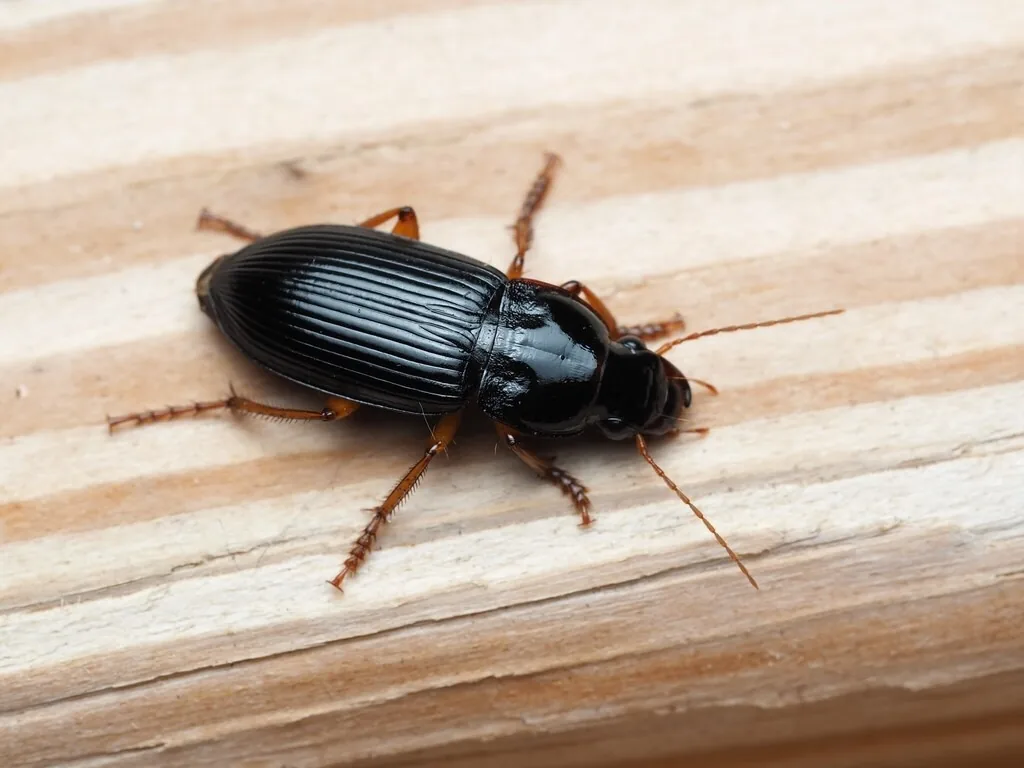
How to identify it
Look-alikes
| Look-alike | How to tell them apart |
|---|---|
| Root weevils (such as the black vine weevil) | Root weevils are small, dark snout beetles with rows of pits along the back that feed on plants. They are slow-moving, while ground beetles are swift predators, and Pacific Northwest extension specialists warn not to confuse the two.[6][5] |
Where it lives
Penn State Extension lists it among the dominant ground beetles of Central Pennsylvania crop fields, and researchers collected 80 of the beetles at night in Brookings, South Dakota, for laboratory feeding studies.[1][2]
Biology and life cycle
Adults are most active in August and September and are rarely seen before mid-July. They breed in autumn, and the species spends the winter as larvae.[1]
It is a seed eater that also hunts. Seeds it takes include giant foxtail, green bristle grass, Japanese bristle grass, lambsquarters, redroot pigweed, velvetleaf, broomcorn millet and hairy cupgrass. Animal prey includes aphids, adult cucumber beetles and the larvae of black cutworms, armyworms and European corn borers.[1]
It has been observed feeding on seeds buried as deep as about 10 mm (3/8 inch), and it is thought to time its breeding to the ripening of grass seeds such as foxtail.[1]
Researchers describe it as facultatively granivorous, eating seeds as well as animal prey. In laboratory tests, beetles fed antibiotics to knock down their gut bacteria ate 43 percent fewer lambsquarters (Chenopodium album) seeds but just as many house cricket eggs, evidence that gut bacteria help it digest seeds.[2]
Its defense is chemical. Glands in the abdomen, called pygidial glands, produce, store and spray defensive compounds, and this species makes formic acid, a chemical that deters predators.[4][3]
Damage and signs
- It is a beneficial insect, not a pest. Penn State Extension notes that ground beetles help protect crops by eating weed seeds and insect pests.[1]
Health risk
Penn State treats it as a beneficial weed seed predator, and none of these sources describes any risk to people. Like other ground beetles, it defends itself with chemicals sprayed from glands in its abdomen, in this species including formic acid.[1][3][4]
Control
Prevention
This is a beetle to keep, not control. Penn State recommends conserving ground beetles with non-inversion tillage, such as chisel plowing instead of moldboard plowing, and with permanent strips of perennial vegetation at field edges, such as raised, grass-seeded 'beetle banks.'[1]
Go easy on insecticides where you want ground beetles. Both conventional insecticides and neonicotinoid seed treatments can kill large numbers of this species.[1]
Common questions
- Is the Pennsylvania dingy ground beetle a pest?
- No. Penn State Extension describes it as a weed seed predator that also eats insects such as aphids, cutworms and cucumber beetles.[1]
- What does it eat?
- Mostly weed seeds, such as foxtails, lambsquarters, pigweed and velvetleaf, plus insects. In laboratory studies it ate both lambsquarters seeds and house cricket eggs.[1][2]
- How can I encourage ground beetles like this one?
- Give them permanent vegetated ground to overwinter and breed, such as field edges or a beetle bank, cut back on deep tillage and limit insecticides. Ground beetles have been about twice as abundant in crop fields next to beetle banks and other uncultivated habitat.[1]
Sources
- Penn State Extension, “Ground and Tiger Beetles (Coleoptera: Carabidae).” extension.psu.edu/ground-and-tiger-beetles-coleoptera-carabidae/ (accessed 2026-11-09)
- PLoS ONE (Public Library of Science), full text in PubMed Central (PMC2877093), “Lundgren and Lehman. Bacterial Gut Symbionts Contribute to Seed Digestion in an Omnivorous Beetle. PLoS ONE 5: e10831 (2010), doi:10.1371/journal.pone.0010831.” doi.org/10.1371/journal.pone.0010831 (accessed 2026-11-09)
- Journal of Chemical Ecology (Springer), indexed in PubMed (PMID 33689113), “Rork, Xu, Attygalle and Renner. Primary Metabolism co-Opted for Defensive Chemical Production in the Carabid Beetle, Harpalus pensylvanicus. Journal of Chemical Ecology 47: 334-349 (2021), doi:10.1007/s10886-021-01253-2 (abstract).” doi.org/10.1007/s10886-021-01253-2 (accessed 2026-11-09)
- Arthropod Structure & Development (Elsevier), indexed in PubMed (PMID 30703537), “Rork, Miko and Renner. Pygidial glands of Harpalus pensylvanicus (Coleoptera: Carabidae) contain resilin-rich structures. Arthropod Structure & Development 49: 19-25 (2019), doi:10.1016/j.asd.2018.12.004 (abstract).” doi.org/10.1016/j.asd.2018.12.004 (accessed 2026-11-09)
- Pacific Northwest Pest Management Handbooks (Oregon State University, Washington State University and University of Idaho Extension), “Strawberry-Root weevil (Pacific Northwest Insect Management Handbook).” pnwhandbooks.org/insect/small-fruit/strawberry/strawberry-root-weevil (accessed 2026-11-09)
- University of Kentucky Entomology Extension, “Some Common Strawberry Pests, ENTFACT-207 (R. Bessin).” entomology.ca.uky.edu/files/ef207.pdf (accessed 2026-11-09)
- iNaturalist, “Harpalus pensylvanicus taxon page (order and family).” www.inaturalist.org/taxa/147935 (accessed 2026-11-09)