How to identify it
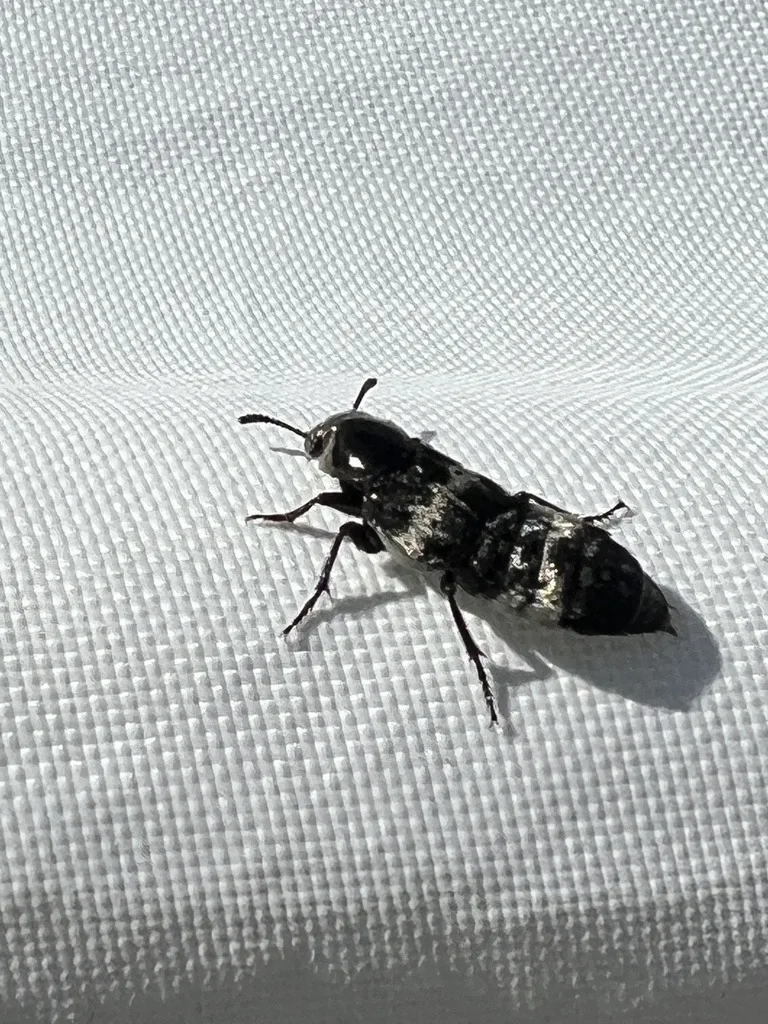
- Short, squarish wing covers leave much of the abdomen exposed, which is the easiest way to recognize a rove beetle.[1][2][4]
- Most common species are slender, shiny brown to black beetles from about 1/4 inch to 1 inch long, though many are smaller.[1][2]
- When disturbed or running, many raise the tip of the abdomen upward like a scorpion.[1][2]
- The hairy rove beetle, one of the largest and most often noticed, is about 1/2 to 1 inch long, glossy black, with bands of yellowish-gray hairs on the wing covers and abdomen.[3]
Look-alikes
Where it lives
Found throughout North America, with roughly 4,000 species. The hairy rove beetle ranges from California to Florida and north into Canada and Alaska.[2][3]
Biology and life cycle
Most live in moist places in soil or decaying matter: under rocks and debris, in compost, leaf litter, mushrooms, dung and carrion.[2][1]
Many are predators of fly eggs and maggots, mites, springtails and other small insects; some are scavengers and a few larvae are parasites of root maggots.[2][4]
Most species are active at night, and adults of some are drawn to lights; adults are usually strong fliers.[1][2][4]
The hairy rove beetle feeds on maggots at carcasses; its egg-to-adult cycle takes about 37 days.[3]
Damage and signs
Health risk
Their strong jaws can give a sharp bite or jab, and some species produce toxins that can cause a localized skin reaction, so don't handle them bare-handed.[1][3]
Control
Keep them out
Close off or screen openings around doors, windows and foundations to keep them out.[1]
Sanitation
Repeat invasions often point to a dead animal, ant or termite nest, or animal droppings nearby; removing that source solves the beetle problem.[1][3]
Traps and physical control
Indoors, sweep or vacuum them up, or catch them and release them outside.[1]
Pesticides
WSU recommends no insecticides for home situations, and outdoors no control is needed because most rove beetles are beneficial.[1]
Common questions
- Why do I have rove beetles in my house?
- Individual beetles fly in toward exterior lights. Larger numbers indoors may mean a dead rodent or other animal in an attic, soffit or wall.[3][1]
- Can rove beetles hurt you?
- They can bite with their strong jaws, and some species give off fluids that can cause a skin reaction, so pick them up with a tissue or container rather than bare hands.[1][3]
- Are rove beetles beneficial?
- Yes. Most are predators or scavengers, and some help control filth flies and root maggots.[1][2][3]
Sources
- Washington State University Extension, “Rove beetles (Hortsense fact sheet).” pestsense.cahnrs.wsu.edu/fact-sheet/rove-beetles/ (accessed 2026-10-06)
- University of Wisconsin-Madison Division of Extension, Wisconsin Horticulture, “Rove Beetles, Staphylinidae (reviewed February 2025).” hort.extension.wisc.edu/articles/rove-beetles-staphylinidae/ (accessed 2026-10-06)
- University of Florida/IFAS Extension, Featured Creatures, “Hairy Rove Beetle, Creophilus maxillosus (EENY687, reviewed September 2021).” edis.ifas.ufl.edu/publication/IN1179 (accessed 2026-10-06)
- New Mexico State University Cooperative Extension Service (hosted by Utah State University Extension), “Rove Beetles, O & T Guide T-07 (October 2006).” extension.usu.edu/planthealth/uppdl/files/factsheet/t-07-rovebeetles.pdf (accessed 2026-10-06)
- iNaturalist, “Creophilus maxillosus taxon page (order and family).” www.inaturalist.org/taxa/82463 (accessed 2026-10-06)