โœ— The Ear Myth Is False Moisture Attracted Easy DIY Control

Earwigs

Forficula auricularia โ€” European Earwig

The most misunderstood insect in North America. They do not crawl into ears. They do not pinch painfully. They are not dangerous. They are a moisture-attracted nuisance that's easy to control once you understand what draws them to your home.

Danger LevelNone โ€” completely harmless
Attracted ToMoisture, mulch, debris, lights
Active WhenNight โ€” hide by day
Control EaseHigh โ€” habitat reduction works
๐Ÿซฃ
Quick Reference Card
European Earwig
Size5/8 inch โ€” reddish-brown
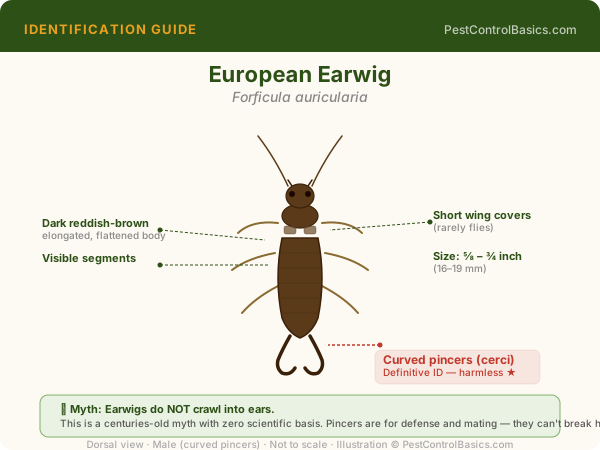
PincersCerci โ€” curved in males, straight in females
WingsYes โ€” rarely fly despite having wings
Where FoundMulch, leaf litter, under boards, debris
InsideBathrooms, basements โ€” moisture areas
Do They Bite?Rarely โ€” harmless pinch at most
Dangerous?No โ€” completely harmless to humans
Best ControlRemove mulch + dry out + perimeter spray
๐Ÿ“ FIELD GUIDE ILLUSTRATION
European earwig (Forficula auricularia) identification illustration with labeled anatomical features โ€” PestControlBasics.com

Original illustration by PestControlBasics.com. Use anatomical labels above to confirm your identification.

Myth vs. Fact

Everything you think you know about earwigs is probably wrong

โœ— The Myths

"Earwigs crawl into ears at night" โ€” This ancient folk belief is completely false. There is no scientific evidence that earwigs seek out human ears. The name comes from an Old English word "earwicga" โ€” which likely referred to a wing shape resembling an ear, not any behavior.

"Their pincers cause dangerous wounds" โ€” Earwig pincers (cerci) can produce a very mild pinch if handled roughly โ€” comparable to a paperclip. They cause no injury to humans and cannot break skin in any meaningful way.

"They spread disease or are venomous" โ€” Earwigs are not disease vectors, are not venomous, and pose zero medical risk to humans, pets, or children.

โœ“ The Facts

They are moisture-seeking nuisance insects. Earwigs need damp, dark environments to survive. Finding them in your home is a moisture signal โ€” check for plumbing leaks, drainage issues, and over-irrigated garden beds against the foundation.

They can damage garden plants. While harmless to humans, earwigs do feed on soft plant tissue, seedlings, and flower petals at night. They're a legitimate garden pest โ€” just not a human health concern.

They're easy to control. Remove moist harborage (mulch, debris, leaf piles) near the foundation, fix drainage, and apply a perimeter spray. Problem solved in most cases within 1โ€“2 weeks.

Biology & Behavior

Why they show up โ€” and where to look

Earwigs are nocturnal and thiphilic (moisture-loving). During the day they hide in tight, dark, moist spaces โ€” under mulch, boards, leaf litter, rocks, and debris. At night they emerge to feed on decaying organic matter, algae, and plant material.

They enter homes seeking moisture during hot, dry weather โ€” following the same cool, moist conditions they find in mulch beds. Common indoor locations: bathrooms, basements, laundry rooms, and any area near a moisture source. Finding them consistently indoors signals that entry points near moisture are unsealed.

๐Ÿ’ก The Mulch Connection

Dense mulch layered against the foundation is the primary earwig harborage site for most home infestations. Mulch holds moisture, provides darkness, and sits directly against the structure's entry points. Pulling mulch 6โ€“12 inches away from the foundation eliminates the primary harborage and dramatically reduces earwig pressure โ€” often more effectively than any chemical treatment.

Why They Mass-Invade Some Years

Earwig populations vary dramatically year to year based on winter moisture. Wet winters followed by warm springs cause population explosions. A single female lays 30โ€“50 eggs and guards them until hatching โ€” unusual maternal behavior for an insect. Mass invasions typically follow abnormally wet late-winter and spring weather.

Control Protocol

Three steps โ€” in this order

1
Remove Harborage
Pull mulch 6โ€“12 inches from foundation. Remove leaf piles, debris, boards, and stones near the structure. Earwigs cannot maintain populations without cool, moist hiding spots directly against the building.
2
Reduce Moisture
Fix any drainage that pools near the foundation. Ensure gutters discharge away from the building. Reduce irrigation frequency near foundation plantings โ€” let soil dry between waterings. Repair any plumbing drips under sinks.
3
Perimeter Spray
Apply bifenthrin or permethrin along the foundation band (3 feet up, 3 feet out) and around all entry points. Treat in early evening when earwigs are becoming active. Reapply after rain. This kills stragglers after habitat modification.
๐ŸŒฟ
Perimeter Spray โ€” Primary Treatment
Bifenthrin Perimeter Spray (Talstar, Bifen IT)
How to apply: Mix per label directions and apply with a pump sprayer along the foundation โ€” 3 feet up the wall and 3 feet out from the structure. Also treat under decks, around utility penetrations, and where mulch meets the house. Apply in early evening when earwigs are beginning to move. Residual lasts 4โ€“8 weeks. Most effective when combined with mulch removal โ€” spray alone provides limited control if harborage remains.
โ˜…โ˜…โ˜…โ˜…โ’ธ
Effective
๐ŸชŸ
Granule Bait โ€” Garden & Perimeter
Monterey Sluggo Plus (Spinosad + Iron Phosphate)
How it works: Granule bait containing spinosad (earwig stomach poison) and iron phosphate (harmless to most wildlife). Sprinkle around garden beds, along the foundation, and in areas where earwigs are foraging. Earwigs eat the granules and die within 24โ€“48 hours. OMRI-listed for organic use โ€” safe around pets, birds, and beneficial insects when dry. Particularly effective for garden plant protection where spray use is less practical.
โ˜…โ˜…โ˜…โ˜…โ’ธ
Organic Option
๐ŸŒฟ The Oil Trap โ€” Free DIY Method

Fill a shallow tuna can halfway with vegetable oil and a few drops of soy sauce. Place at ground level near earwig activity areas. Earwigs are attracted to the oil and drown. Empty and refill every few days. Effective for monitoring and population reduction in garden beds โ€” free, chemical-free, and surprisingly efficient during peak earwig season.

Prevention

Keep them from coming back

Exterior Lighting

Earwigs are strongly attracted to white light โ€” they aggregate under porch lights and near illuminated windows at night. Replacing white exterior bulbs with yellow LED or sodium vapor bulbs dramatically reduces earwig attraction to the structure. Motion-activated lights over always-on lights for the same reason.

Mulch Alternatives

For foundation beds chronically afflicted with earwig pressure, switch from bark mulch to inorganic mulch alternatives: river gravel, crushed granite, or rubber mulch. These don't hold moisture the same way and provide far less earwig harborage. The 18-inch foundation clearance of bare soil or gravel is the professional standard.

Seal Entry Points

Caulk all gaps around windows, doors, utility penetrations, and weatherstripping at the foundation level. Earwigs enter through the same gaps as other moisture-seeking insects. Annual perimeter caulking in late summer prevents fall and winter indoor incursions.

DG
Derek Giordano
Certified Pest Control Operator ยท Former Business Owner
Derek ran his own pest control company in Florida for several years, servicing thousands of regular customers. All content is based on hands-on field experience and current EPA & university extension guidelines.

Related Resources

๐Ÿ“š Full Pest Library๐Ÿงช DIY vs. Pro Quiz๐Ÿ’ฐ Cost Guide๐ŸŒฟ IPM Guide๐Ÿ” Find a Pro
๐Ÿ”ฎ
Reviewed by Derek GiordanoContent on PestControlBasics.com is developed with input from certified pest management professionals and cross-referenced against EPA, CDC, and university extension guidance. Last reviewed: April 2026.
๐Ÿ“š Sources: EPA Termite Guide ยท NPMA Termite Info
Published: Jan 1, 2025 ยท Updated: Apr 7, 2026
๐Ÿ”— Deep-dive: Shore Earwig & Ring-Legged Earwig
Less-common earwig species found near water and in damp coastal/riparian environments.

When DIY education is more valuable than DIY treatment

Many homeowners default to attempting treatment before fully understanding the pest's biology, the product's mechanism, or the local pressure context โ€” and the time spent on premature treatment frequently exceeds what reading and learning would have cost. The high-leverage education investments: extension service publications for any pest causing recurring problems (free, locally-specific, written by entomologists), the EPA pesticide product label for any product being considered (free, legally-binding, contains far more information than the marketing copy), the regional integrated pest management center publications (free, organized by pest, includes the IPM hierarchy of interventions), and (where appropriate) a single consultation with a licensed pest management professional for diagnosis-only without commitment to ongoing service. Two hours of focused reading before starting treatment typically changes the approach to better-matched products, correct life-stage timing, and accurate identification โ€” producing better outcomes than buying a more expensive product at retail.

Pest pressure as a property value signal โ€” and how to address it before listing

Pest issues directly affect property valuation in several documented ways: termite damage is a standard inspection finding that can derail closings or require significant credits; rodent activity in attics and crawlspaces flags during inspections and creates buyer concerns about hidden damage; visible cockroach or bedbug activity raises the question of what else has been neglected. Sellers who address pest issues before listing โ€” ideally with documentation of treatment and a clean follow-up inspection โ€” preserve more value than those who try to negotiate around buyer-discovered issues. The investment is typically modest relative to the price impact: a pre-listing inspection by a licensed pest control company runs a few hundred dollars in most markets, and resolving common findings (rodent exclusion, ant treatment, wasp nest removal) is rarely a significant expense. The value preservation comes from removing inspection findings as negotiation leverage, not from any single repair.

Choosing a pest control company: questions worth asking

Pest control companies vary substantially in approach, training, and pricing, and the questions to ask before signing a contract often aren't the obvious ones. Worth asking: what's the technician's training and certification (state pest control certification is the floor; advanced training in IPM, structural inspection, or specific pest specialties is meaningful additional credentialing); what does the service include beyond visiting and spraying (inspection, monitoring, exclusion recommendations, follow-up scheduling); what guarantees apply if pests return between visits; what's the protocol for hard-to-resolve issues (some companies escalate to senior technicians or supervisors; others repeat the same approach); what active ingredients are used and whether the company will use specific products on request (homeowners with chemical sensitivities, pollinator gardens, or other concerns may want specific products); and what's the contract structure (per-visit, annual, multi-year). Worth less than expected: brand recognition and advertising spend (large national chains and small local operators both produce excellent and mediocre service); 'green' or 'organic' labels (which mean different things to different companies and often don't correspond to specific product or practice differences); price alone (typical pricing variance is modest, and the floor of cheap options often includes poor service).

Trap and bait psychology: why placement beats product choice

Across pest categories, placement is more important than the specific brand or formulation chosen, and the diagnostic data backs this up. A mediocre bait placed in the correct location outperforms a premium bait placed wrong; a basic snap trap on a runway outperforms a designer electronic trap in the middle of a room. The underlying reason is pest behavior: most pests follow predictable physical patterns โ€” walls, edges, vertical surfaces, harborage-to-food routes โ€” and traps or baits intersecting those patterns get encountered, while traps placed for human convenience often don't. Practical placement principles that apply across pest types: along walls rather than in open spaces, between harborage and food/water sources, near observed activity rather than in 'symmetric' patterns, and in higher density (more units, closer together) than feels intuitively right. Cockroach gels go in corners and crevices, not on open surfaces; rodent traps go perpendicular to walls with trigger toward the wall; pheromone traps for moths go where moth flight has been observed, not centrally; ant baits go on observed trails, not where ants are 'expected.' Spending time observing pest behavior before deploying traps almost always pays back.

Integrated pest management for households: the practical hierarchy

Integrated pest management (IPM) is a structured approach to pest control developed for agricultural and commercial settings that translates well to residential use. The hierarchy: prevention first (sanitation, exclusion, habitat modification to make conditions unfavorable for pests), monitoring second (sticky monitors, visual inspection, identifying pests at low population before infestation establishes), targeted intervention third (using the least disruptive effective method against an identified pest in an identified location), and broad chemical treatment last (when targeted approaches have failed or aren't feasible). The hierarchy matters because higher-level interventions are durable and address root causes, while lower-level chemical interventions address symptoms and require repeat application. Most residential pest control reverses this hierarchy โ€” chemical treatment first, sometimes prevention later โ€” and produces the predictable consequence of recurring problems. Households that adopt the IPM hierarchy (often without using the term) generally describe spending less time and money on pest issues over years even though specific incidents might take more thought to address than spray-and-forget approaches.

Understanding pest forecast reports and what they signal

Pest forecast reports โ€” issued by some state agricultural agencies, cooperative extension services, and commercial pest control companies โ€” are an underutilized resource for homeowners who want to anticipate rather than react to seasonal pest activity. These reports typically combine historical pest data, current weather conditions, and growing degree day calculations to predict when specific pests will emerge or peak in specific regions. A tick forecast for an upcoming spring season, a mosquito pressure forecast after a wet winter, a termite swarm prediction for a specific week in the Southeast โ€” these aren't speculation but reasonably calibrated predictions based on biological timing. For homeowners, the value is in scheduling preventive treatment and personal protection to match the predicted high-pressure windows rather than reacting after problems have established. Subscribing to a regional pest newsletter from a cooperative extension service or state agriculture department is free or low cost and produces these forecasts during relevant seasons. The information is dramatically more actionable than generic pest control content because it's calibrated to your specific region and current conditions.

The role of inspection in long-term cost reduction

An inspection is the cheapest tool in pest management, and homeowners systematically underspend on it. The economics are unambiguous: an annual or semiannual inspection costs a small fraction of what any moderate treatment costs, and it catches problems while they're still cheap to address. Termite damage detected in its first season requires perimeter treatment; the same damage discovered three years later may require structural repairs running into five figures. Rodent activity detected through droppings before nesting establishes requires sealing and a few traps; the same activity discovered after a multi-generation infestation has set up in wall voids requires removal, exclusion, sanitation, and sometimes drywall work. The pattern repeats across nearly every pest category. Even households that don't engage a regular pest service should treat the annual inspection as a baseline expense โ€” equivalent to the way they probably treat HVAC tune-ups, gutter cleaning, or smoke detector battery changes. The marginal cost of one trained set of eyes on the property each year is one of the most defensible expenses in home maintenance.

Finding regional pest data sources worth trusting

The quality of pest information available to homeowners varies enormously by source, and finding the reliable sources for your specific region is a one-time investment that pays off across years of pest management decisions. Cooperative extension services associated with land grant universities in each state are usually the highest-quality regional resource, producing fact sheets, identification guides, and treatment recommendations specifically calibrated to local conditions, pest species, and regulatory environments. State department of agriculture pest fact sheets are typically similar in quality and orientation. Local pest control company blog content varies in quality but can be useful when produced by experienced practitioners writing about their actual work rather than generic SEO content. National pest control sites tend to be less useful for the specific reason that they average across regions and don't address the conditions you're actually facing. Bookmarking two or three high-quality regional resources at the outset, and consulting them before making significant pest management decisions, raises the average quality of your decisions dramatically without much ongoing effort.

๐Ÿ—บ๏ธ US Distribution โ€” Earwigs

Common Occasional Not Present
States Present
49
Occasional
2
Primary Region
Continental US
๐Ÿ“Š Source: University extension services, USDA, CDC vector data, and published entomological surveys.