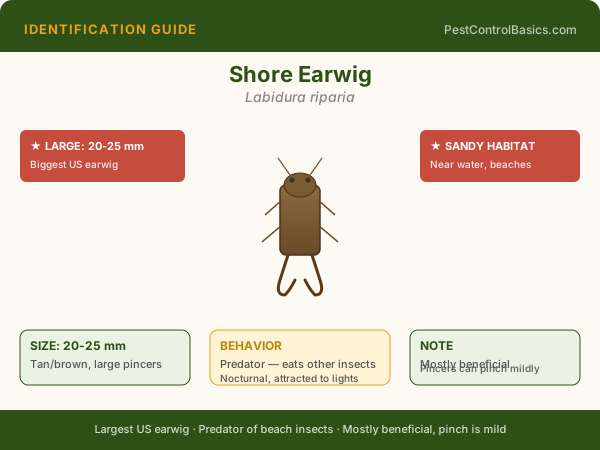
❓ Common Questions About 🐛 Shore & Ring-Legged Earwig
How do I confirm I actually have this pest (not something similar)?
The most reliable confirmation is a physical specimen — capture one and compare to reference images on this page. For cryptic pests (bed bugs, termites), look for secondary signs: frass, shed skins, mud tubes, or bites with a specific pattern. When uncertain, a professional inspection is faster than months of misidentification.
Can I treat this myself or do I need a professional?
DIY is effective for small, accessible infestations caught early. Professionals are worth the cost when: the infestation is inside wall voids or structural elements, multiple rooms are affected, you have health-risk pests (hantavirus, venomous species), or DIY has already failed twice.
How long until the infestation is completely gone?
Expect 3–8 weeks for most infestations with proper treatment. Insects with dormant life stages (pupae, eggs) extend the timeline because those stages are impervious to most insecticides. Follow-up treatments at 2 and 4 weeks catch each new cohort as they emerge.
What's the most common mistake people make treating this pest?
Treating only the visible pest population while ignoring the harborage site, entry point, or breeding location. Killing adults provides temporary relief but the population rebuilds from hidden egg cases, pupae, or new arrivals through unaddressed entry points.
Sources used across this site
Editorial sources used consistently across this site: the EPA pesticide registration database for current product use directions and active ingredient information; CDC for public health context on pest-borne disease; the National Pesticide Information Center (NPIC) for homeowner pesticide questions; university Cooperative Extension publications (UC IPM, NC State Extension, Penn State Extension, University of Florida IFAS, and others) for region-specific identification and treatment guidance; the National Pest Management Association (NPMA) for industry context; and peer-reviewed entomological literature for biology, resistance management, and emerging issues. Product reviews reflect editorial testing and aggregated user-reported outcomes rather than manufacturer-supplied claims. Where regional information matters, we link to state and local extension publications rather than generalizing across regions.
How professional pest control programs differ from one-off treatments
A single treatment — DIY or professional — addresses what's visible today, but most pest pressure is cyclical. Professional pest control programs that work long-term are structured around inspection, monitoring, treatment, and follow-up as a recurring cycle rather than discrete events. The inspection phase identifies conducive conditions (moisture, harborage, food access, exclusion gaps) that one-time treatments don't address. The monitoring phase uses sticky traps, bait stations, or visual sweeps to catch population rebounds early, before they become visible infestations again. The treatment phase targets the specific life stages active during that visit — different than blanket spraying everything. The follow-up phase verifies treatment efficacy and adjusts. Homeowners can replicate this structure on a quarterly or seasonal schedule without buying expensive equipment, and the underlying logic — track, treat targeted, verify — produces consistently better results than reactive treatment after problems become obvious.
How to use this guide effectively
This guide is one entry point in a connected library. Each pest profile, treatment guide, and tool on this site links to related references that go deeper than any single page can. Working through a pest problem effectively usually means starting with identification (so you know what you're treating), reading the species-specific treatment guide, checking the product or tool references for specific selection guidance, and confirming approach with the FAQ and troubleshooting sections. Bookmarking a few core references — the species profile, the relevant treatment guide, and one tool that supports the decision-making (product selector, cost estimator, treatment schedule) — gives you a workflow you can return to as the situation evolves. The structure is intentional: surface-level summary first, then increasing depth, with the deepest detail in the dedicated tool and reference pages.
How content is reviewed and updated
Content on this site is reviewed by Derek Giordano, a former pest control company owner and previously licensed Pest Control Operator in Florida with several years of field experience servicing thousands of regular customers. Reviews check treatment recommendations against current EPA-registered products and label use directions, cross-reference major treatment claims against university extension publications and CDC public health guidance, and verify that any product mentions reflect current registration status and reasonable consumer availability. Pages get updated as treatment recommendations evolve — pesticide products are deregistered, resistance patterns shift, regional pest distributions change. The 'Updated' date at the bottom of each page reflects the most recent review pass on that specific page; the site-wide approach to E-E-A-T (experience, expertise, authoritativeness, trustworthiness) follows Google's published guidance on health and safety topics.
When to escalate from DIY to professional
DIY pest control is appropriate for most common household pests when caught early and treated correctly. Escalation to a licensed professional makes sense in specific situations, not just when frustration builds. Wall-void and structural infestations — termites, carpenter ants, rodents nesting inside walls — usually require equipment and access homeowners don't have. Bedbugs at moderate-to-heavy infestation levels almost always require professional treatment; DIY rarely succeeds past the first few isolated bugs. Multi-unit dwellings (apartments, condos) need building-wide coordination that individual unit treatments can't replicate. Health-sensitive households — anaphylaxis risk to stings, immunocompromised individuals, pregnancy, infants — should default to professional because professionals can use the lowest-toxicity option that solves the problem rather than what's available at retail. The financial break-point is roughly when DIY material costs approach one professional visit; below that, DIY is usually fine.
Choosing a pest control company: questions worth asking
Pest control companies vary substantially in approach, training, and pricing, and the questions to ask before signing a contract often aren't the obvious ones. Worth asking: what's the technician's training and certification (state pest control certification is the floor; advanced training in IPM, structural inspection, or specific pest specialties is meaningful additional credentialing); what does the service include beyond visiting and spraying (inspection, monitoring, exclusion recommendations, follow-up scheduling); what guarantees apply if pests return between visits; what's the protocol for hard-to-resolve issues (some companies escalate to senior technicians or supervisors; others repeat the same approach); what active ingredients are used and whether the company will use specific products on request (homeowners with chemical sensitivities, pollinator gardens, or other concerns may want specific products); and what's the contract structure (per-visit, annual, multi-year). Worth less than expected: brand recognition and advertising spend (large national chains and small local operators both produce excellent and mediocre service); 'green' or 'organic' labels (which mean different things to different companies and often don't correspond to specific product or practice differences); price alone (typical pricing variance is modest, and the floor of cheap options often includes poor service).
The cost of doing nothing: implicit pest tolerance and its hidden expenses
Pest control discussions usually frame the costs of treatment without quantifying the costs of non-treatment, but the latter are often larger and almost always less visible. Cockroach allergens add measurable healthcare costs in homes with asthma. Rodent activity in attics damages insulation (reducing R-value and adding seasonal heating and cooling costs) and creates fire risk through wire chewing that doesn't show up until something fails. Termite damage in unmonitored properties produces structural repair bills in the five-figure range, often discovered during unrelated renovation. Stored-product pests destroy food inventory at rates that aren't tracked because items are discarded individually rather than tallied. The cumulative cost of doing nothing isn't a single line item but a sum of small chronic losses across years. The framing that helps: pest control isn't a luxury expense layered onto a working baseline; it's a maintenance expense that competes with the slow accumulating cost of allowing a problem to continue. Households running the comparison honestly almost always find that modest preventive spending is the cheaper path.
The role of local cooperative extension in pest decisions
State cooperative extension services — university-based educational and advisory programs in every state — are dramatically underused resources for residential pest decisions. Most state extensions employ entomologists who answer homeowner questions free of charge through county offices, online query forms, or scheduled call hours. The information available is specific to the state's pest pressure, climate, and recommended practices, and is typically much more locally accurate than national resources. Extension publications cover identification, life cycle, treatment options, and specific product recommendations for state conditions; the publications are peer-reviewed by university scientists and updated periodically based on current research. For any pest situation where identification is uncertain or treatment options are unclear, a clear photograph submitted to the state extension produces an identification, a brief biological explanation, and one or more treatment options within typically a few days. The benefit beyond any single inquiry is building familiarity with the local resource — extension contacts become a reference for future situations and produce better decisions than aggregated online advice.
Understanding pest forecast reports and what they signal
Pest forecast reports — issued by some state agricultural agencies, cooperative extension services, and commercial pest control companies — are an underutilized resource for homeowners who want to anticipate rather than react to seasonal pest activity. These reports typically combine historical pest data, current weather conditions, and growing degree day calculations to predict when specific pests will emerge or peak in specific regions. A tick forecast for an upcoming spring season, a mosquito pressure forecast after a wet winter, a termite swarm prediction for a specific week in the Southeast — these aren't speculation but reasonably calibrated predictions based on biological timing. For homeowners, the value is in scheduling preventive treatment and personal protection to match the predicted high-pressure windows rather than reacting after problems have established. Subscribing to a regional pest newsletter from a cooperative extension service or state agriculture department is free or low cost and produces these forecasts during relevant seasons. The information is dramatically more actionable than generic pest control content because it's calibrated to your specific region and current conditions.
Coordinating pest control with renovation and construction work
Renovation work is one of the highest-value moments for pest intervention, and it's also one of the most consistently missed. When walls are open, when slabs are exposed, when crawlspaces are accessible, when sill plates are visible — these are the windows during which exclusion work, soil treatment, perimeter sealing, and harborage elimination can be done at a fraction of their normal cost and with dramatically better completeness. The same caulk-and-foam exclusion job that takes hours of awkward work after the fact can be done in minutes when the wall cavity is open. A pre-construction termite soil treatment is dramatically more effective than any post-construction equivalent, but it has to happen before the slab is poured. Even non-structural renovations like flooring replacement, kitchen rework, or basement finishing create windows during which the home's pest-relevant geometry can be improved. The cost of pulling in a pest professional during the renovation envelope, even just for an inspection and recommendations, is almost always recovered in reduced future treatment costs and avoided structural damage. The conversation to have with general contractors is whether they're willing to coordinate with a pest specialist during the open-wall phase, and most reputable contractors are, particularly on larger jobs where the small additional scheduling complexity is offset by the value-add for the homeowner.
Pest control and HOA dynamics: where they overlap
Homeowners' associations vary widely in how they engage with pest control, and the variations create practical issues that affect individual treatment decisions. Some HOAs maintain common-area pest treatment programs that handle perimeter spraying, mosquito treatment, or rodent monitoring on shared property; others leave all pest control to individual homeowners. Some have rules about treatment products or notification requirements; others don't. Some include treatment in the HOA fee structure; others bill separately. For homeowners in HOA communities dealing with persistent pest pressure, understanding what the HOA does and doesn't do is the first step in figuring out what additional individual action is needed. For HOAs without coordinated programs in areas with significant pressure, organizing a neighborhood-level treatment plan often produces dramatically better results than individual treatment efforts that don't coordinate timing or coverage. The conversations are sometimes politically awkward in HOA contexts, but the underlying problem — that some pests are neighborhood-scale and unit-level treatment can't address them — is structural rather than personal. Bringing the issue to an HOA meeting with concrete proposals tends to produce more constructive responses than complaint-style framing.