On this page
How to identify it
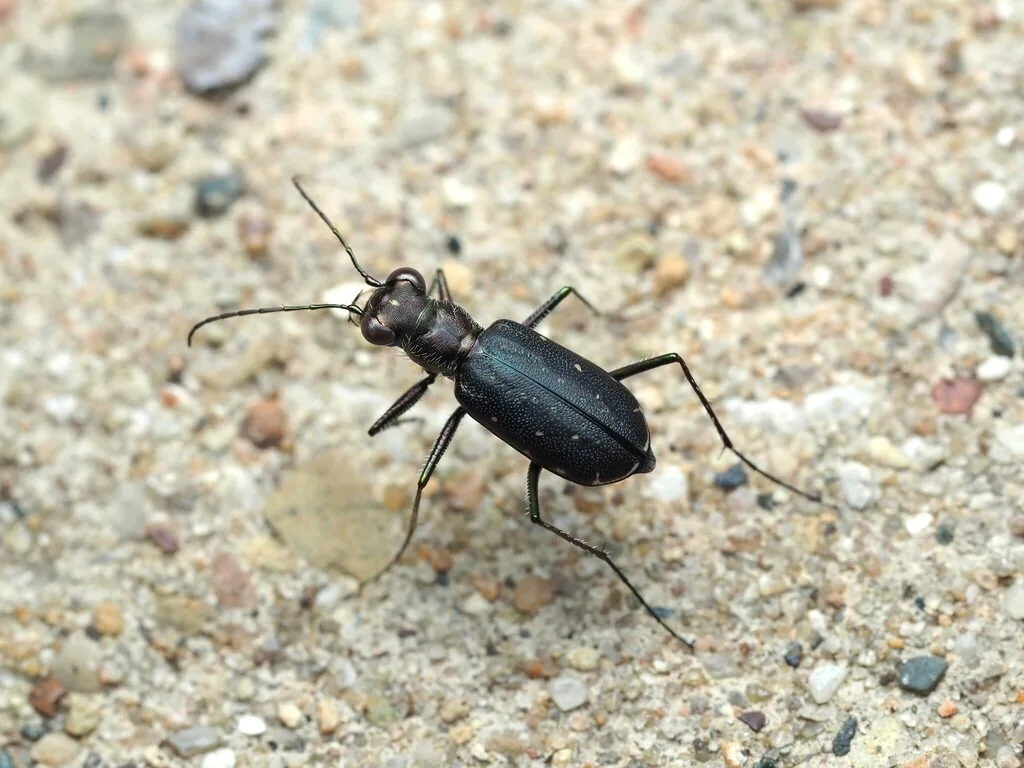
- Adults are about 11-14 mm long, dark to iridescent brown, copper, green, blue or purple, sometimes with small pale spots.[1][2]
- A row of small metallic pits runs along each wing cover, which gives it its name; the head is wider than the thorax and the jaws are large and pointed.[1][2]
- Handled beetles often give off a fruity, apple-like smell, a defensive chemical (benzaldehyde).[1]
Look-alikes
| Look-alike | How to tell them apart |
|---|---|
| Ground beetles | Tiger beetles are in the same family as ground beetles but are day-active, fast and quick to fly, with heads wider than the thorax.[2] |
Where it lives
CSU calls it the most common tiger beetle in Colorado, found from grasslands and field edges to cities; Penn State reports it commonly in cultivated fields.[1][2]
Biology and life cycle
Adults appear from mid-June, peak by mid-July and can be found into September; they are active in daytime and make short flights when approached.[1][2]
Larvae live in vertical burrows, 14-40 cm deep, in dry hard-packed soil, waiting at the entrance to ambush passing ants and other crawling insects.[1]
Larvae overwinter in the burrow and pupate there the next spring.[1][2]
Damage and signs
Health risk
None; adults are attracted to lights at night and sometimes wander indoors, but they are harmless.[1]
Control
Prevention
Common questions
- What is the shiny dark beetle that runs and flies ahead of me on the sidewalk?
- Likely the punctured (sidewalk) tiger beetle, which hunts on bare paths and makes short flights when approached.[1][2]
- Are tiger beetles harmful?
- No; they are predators of other insects.[1][2]
- Why does it smell like apples?
- Handled beetles release benzaldehyde, a defensive chemical with a fruity odor.[1]
Sources
- Colorado State University Extension (Colorado Insects of Interest, W. Cranshaw), “Punctured Tiger Beetle/Sidewalk Tiger Beetle (Colorado Insect of Interest).” wci.extension.colostate.edu/wp-content/uploads/sites/14/2017/03/SidewalkTigerBeetle.pdf (accessed 2026-10-15)
- Penn State Extension, “Ground and Tiger Beetles (Coleoptera: Carabidae).” extension.psu.edu/ground-and-tiger-beetles-coleoptera-carabidae/ (accessed 2026-10-15)
- iNaturalist, “Cicindelidia punctulata taxon page (order and family).” www.inaturalist.org/taxa/1643817 (accessed 2026-10-06)