On this page
How to identify it
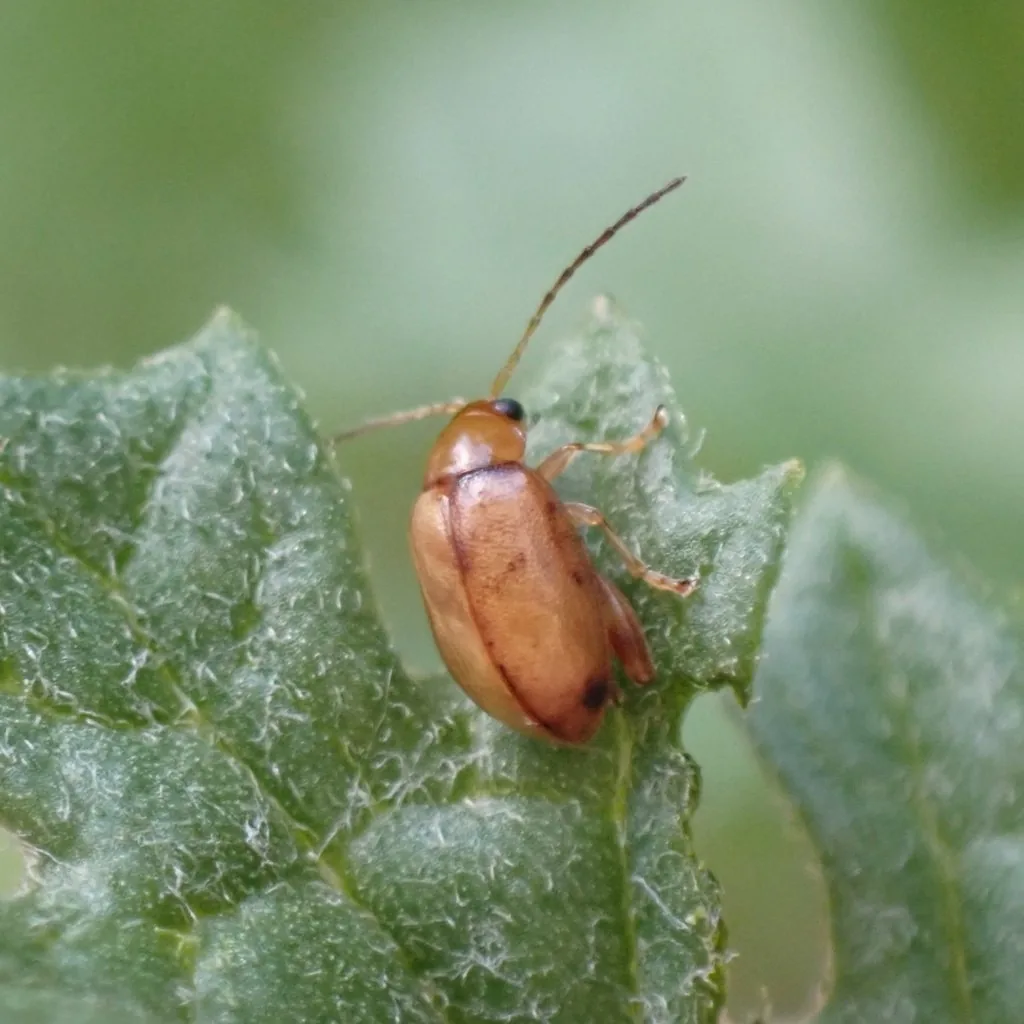
- Adults are golden brown and 2 to 4 mm long. They have working wings and can fly, but usually walk, or jump with their enlarged hind legs when disturbed. The Italian and Swiss strains look identical.[1]
- Larvae are translucent yellow when young and creamy white with a brown head when mature, found in the leaf stalks and root crown of tansy ragwort rosettes. Pupae are white, 2 to 4 mm. Eggs are under 1 mm, whitish yellow turning orange as they mature.[1]
- Adult feeding leaves a characteristic pattern of small shot-holes in the leaves, mostly on rosettes rather than flowering stems. The larval mining is hidden until a plant is pulled and its root crown split.[1]
Look-alikes
| Look-alike | How to tell them apart |
|---|---|
| Ragwort stem and crown-boring moth (Cochylis atricapitana) | Its larvae also mine tansy ragwort stems and root crowns, but they are larger than the flea beetle larvae and lack the brown head capsule.[1] |
| Cinnabar moth (Tyria jacobaeae) | The other main ragwort agent. Its caterpillars are conspicuous and colorful and strip whole plants of leaves, a very different sight from shot-holed rosettes; the flea beetle and the moth work well together.[1] |
| Ragwort seed head fly (Botanophila seneciella) | Attacks only the seed heads, where its larvae leave a frothy spittle.[1] |
Where it lives
Native to Europe and Asia. Italian beetles released in the western United States from 1968 established at low-elevation coastal sites, at or below about 1,300 feet, with warm summers and mild, moist winters; a cold-adapted population of that strain was later found at high elevation on Mt. Hood, Oregon, and moved to Montana. A Swiss strain released in California in 1969 failed, but a second Swiss introduction from 2002 has established in other western states above about 1,300 feet, where winters bring hard frosts and snow, up to about 5,500 feet. In Canada the Italian strain is abundant in cool coastal British Columbia and the Swiss strain is established there too. Both strains do best in dense, unshaded ragwort stands, and flooding interferes with the larvae and pupae.[1][3]
Biology and life cycle
Both strains have one generation a year and three larval stages, but their calendars differ. Italian-strain adults at low coastal elevations emerge in late spring, feed briefly on rosettes, then go dormant for the summer and become active again in the cooler, wetter fall. After two or three weeks of feeding they mate, and the females lay eggs around the bases of the rosettes, sometimes into early spring.[1]
The larvae hatch a couple of weeks later, mine the leaf stalks, then move into the root crown, where they keep mining through winter and early spring before leaving to pupate in the soil. High-elevation Italian populations shorten the summer dormancy and develop faster.[1]
Swiss-strain adults emerge in mid to late summer, feed for two or three weeks and lay eggs around the rosettes into early fall. The eggs overwinter, the larvae hatch in spring, feed in the petioles and then the root crown, and pupate in the soil in summer.[1]
The Mt. Hood population, started from low-elevation Italian stock in the early 1980s, has evolved: compared with the low-elevation beetles it came from, it shows changed summer dormancy and timing and performs better at high elevation, in ways that resemble the cold-adapted Swiss beetles.[3]
In northwest Montana the two strains are interbreeding. Of 15 sites sampled, seven held pure Swiss beetles, one pure Italian, and seven held hybrids making up 5 to 69 percent of the population.[2][1]
Damage and signs
- Adult shot-hole feeding interferes with the plant's photosynthesis and can reduce plant size; when beetles are numerous and the plants are short of water it can kill seedlings and rosettes. The larval stage is generally the most destructive: mining in the root crown drains the plant's reserves, can cut its seed output, and kills seedlings and small rosettes.[1]
- In the United States the Italian strain is established in high numbers at low-elevation coastal sites and has reduced tansy ragwort densities by over 90 percent at numerous sites, working well with the cinnabar moth. Cold-adapted Italian beetles at Mt. Hood and in Montana are few but hit the weed hard. The Swiss strain has cut ragwort by about 50 percent at many inland sites and does better in Montana than Idaho.[1]
- A two-year exclusion experiment in Montana found that Swiss beetles raised tansy ragwort mortality by 42 percent and hybrid beetles by 45 percent, while cutting the seed output of surviving plants by 44 and 72 percent. Beetle densities and the death rate of larger plants were higher where hybrids were present.[2]
Health risk
A plant-feeding flea beetle; none of these sources describes any risk to people.[1][2]
Control
Prevention
No control is needed. The flea beetle is an approved biological control agent of tansy ragwort, and shot-holed rosettes are the sign that it is at work.[1]
Biological control
Releases are made by agencies in both countries, and the strain matters: Italian beetles for low, mild coastal sites and Swiss beetles for colder inland sites above about 1,300 feet with snow cover. Both do best in dense, unshaded ragwort and poorly where the ground floods. Where the two strains meet, their hybrids have controlled ragwort at least as well as pure Swiss beetles, and hybridization may improve control at high elevation.[1][2]
Common questions
- What is making tiny holes all over my tansy ragwort rosettes?
- Adult tansy ragwort flea beetles. Their shot-hole feeding is mostly on rosette leaves, and the larvae are meanwhile mining the leaf stalks and root crown, which is where the plant really suffers.[1]
- Why did the beetles work on the coast but not in the mountains?
- The original Italian strain suits low elevations with mild, moist winters and goes dormant in summer. Colder, snowier inland sites need the Swiss strain released from 2002, or the cold-adapted Italian beetles from Mt. Hood, which evolved a different calendar after being introduced there.[1][3]
- Does the flea beetle kill tansy ragwort or just weaken it?
- Both. Root-crown mining kills seedlings and small rosettes outright and drains larger plants; in Montana experiments the beetles raised plant mortality by more than 40 percent and cut the seed output of survivors by up to 72 percent.[1][2]
Sources
- North American Invasive Species Management Association (PDF hosted on Bugwood), “Tansy Ragwort Biocontrol Agents: History and Ecology in North America. In: Winston, ed., Biological Control of Weeds in North America, NAISMA-BCW-2022-21-TANSY RAGWORT-A (2022).” bugwoodcloud.org/resource/files/25374.pdf (accessed 2026-11-10)
- Evolutionary Applications (Wiley), full text in PubMed Central (PMC6383738), “Szucs, Salerno, Teller, Schaffner, Littlefield and Hufbauer (Colorado State University and Montana State University). The effects of agent hybridization on the efficacy of biological control of tansy ragwort at high elevations. Evolutionary Applications 12: 470-481 (2019), doi:10.1111/eva.12726.” doi.org/10.1111/eva.12726 (accessed 2026-11-10)
- Evolutionary Applications (Wiley), full text in PubMed Central (PMC3552403), “Szucs, Schaffner, Price and Schwarzlander (University of Idaho). Post-introduction evolution in the biological control agent Longitarsus jacobaeae (Coleoptera: Chrysomelidae). Evolutionary Applications 5: 858-868 (2012), doi:10.1111/j.1752-4571.2012.00264.x.” doi.org/10.1111/j.1752-4571.2012.00264.x (accessed 2026-11-10)
- iNaturalist, “Longitarsus jacobaeae taxon page (order and family).” www.inaturalist.org/taxa/391861 (accessed 2026-11-10)