On this page
How to identify it
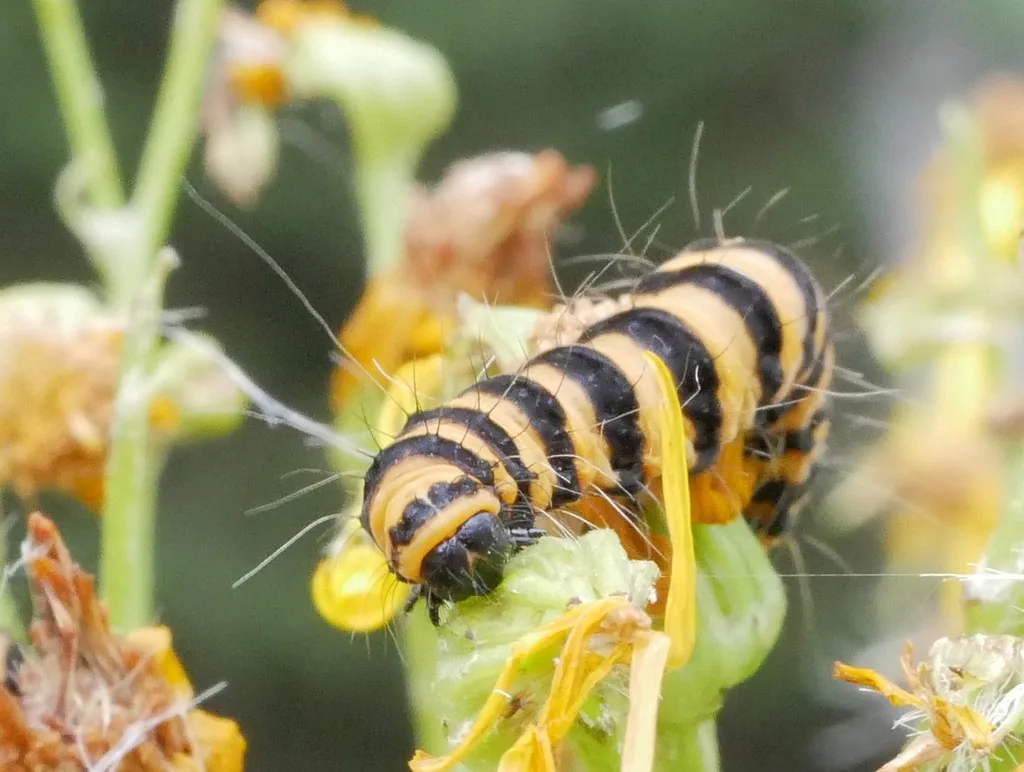
- The caterpillars are banded in orange and black and are easy to spot on ragwort in spring and summer. Up close the stripes stand out, but researchers found that from a distance the colors blend together and match the background.[1][2]
- The adult moth has a conspicuous red and brown wing pattern.[1]
- Look for the caterpillars, and the defoliated plants they leave, on tansy ragwort. The larvae are ragwort specialists, though in Oregon they have also been found developing on a few related native plants.[1][3][4]
Where it lives
It was introduced as a biological control agent. UC IPM rates its distribution in California, where it was first released in 1959, as wide, and in Oregon it has spread from the Willamette Valley into the Coast Range and Cascade Mountains.[1][6]
Biology and life cycle
There is one generation a year. Adults lay clusters of eggs on the undersides of ragwort leaves, and the caterpillars feed on the leaves and shoots in spring and summer. They pupate in the soil, and the adults emerge the following spring.[1]
The caterpillars feed on tansy ragwort, a plant that contains pyrrolizidine alkaloids, which are toxic to unspecialized insects and to vertebrates. A specialized enzyme lets them detoxify the alkaloids and build them up in their blood as a defense against predators, and alkaloids from ragwort stimulate females to lay eggs.[3][4]
In Oregon the moth has been reported developing on some native plants related to ragwort, including Senecio triangularis and Packera pseudaurea; this has not been seen in California.[1]
Oregon populations that moved into the cooler Coast Range and Cascades evolved a shorter egg-to-pupa development time within decades, which the researchers say regulators should consider when evaluating new biological control insects.[6]
Insect predators, parasites and a microsporidian disease can hold the moth back. One Nosema microsporidian was found in 63% of a population of larvae, though it appeared to do little harm.[1][7]
Damage and signs
- The caterpillars can completely defoliate tansy ragwort, which often leafs out again after fall rains begin. In a five-year experiment on the Oregon coast the moth cut ragwort seed production but not its cover or biomass; the flea beetle did most of the work, and UC IPM rates the moth as providing some additional control.[1][5]
- Biological control alone does not control tansy ragwort in grazed pastures, and disturbance that sprouts the seed bank brings temporary flare-ups that the insects bring back under control in 1 to 3 years.[1][5]
Health risk
The caterpillars store toxic alkaloids from their food plant as a defense against predators. Neither UC IPM nor the studies cited mention any bite, sting or other risk to people.[3][2][1]
Control
Prevention
UC IPM manages the cinnabar moth as a biological control agent rather than a pest. It notes that mowing in summer will probably kill the caterpillars and leave them without food, that herbicides that kill the ragwort also stop the insects from reproducing, and that where the agents are already present there is no need to release more.[1]
Biological control
To move caterpillars to a new ragwort patch, tap the plants in summer so larvae fall into an open container, and leave behind any with pinkish droppings, which are probably infected with a Nosema disease. Cinnabar moths and flea beetles may be available from your county Agricultural Commissioner in California.[1]
Common questions
- What are the orange-and-black caterpillars on tansy ragwort?
- Probably cinnabar moth caterpillars. UC IPM tells land managers to look for orange-and-black-banded caterpillars on ragwort in summer as a sign the moth is present. The moth was released to help control the weed, and summer mowing will probably kill the caterpillars.[1]
- Are cinnabar caterpillars poisonous?
- They store toxic pyrrolizidine alkaloids from ragwort as a defense against predators, and their bright stripes advertise it at close range. The sources cited here do not describe any risk to people.[3][2][1]
- Does the cinnabar moth get rid of tansy ragwort on its own?
- In a field study on the Oregon coast the ragwort flea beetle was the key factor controlling ragwort, while the moth mainly reduced seed production. UC IPM likewise says the flea beetle has the most impact and the moth provides some additional control, and that biological control alone does not control tansy ragwort in grazed pastures.[5][1]
Sources
- University of California Statewide IPM Program, “Weed Control User Tool (WeedCUT), Biological Control: Tansy Ragwort (M. J. Pitcairn, California Department of Food and Agriculture, and L. Smith, USDA).” weedcut.ipm.ucanr.edu/biological-control/tansy-ragwort/ (accessed 2026-11-09)
- Royal Society Open Science (via NCBI PubMed), “Distance-dependent aposematism and camouflage in the cinnabar moth caterpillar (Tyria jacobaeae, Erebidae) (J. B. Barnett, I. C. Cuthill and N. E. Scott-Samuel; Royal Society Open Science 5(2): 171396, 2018; abstract).” pubmed.ncbi.nlm.nih.gov/29515858/ (accessed 2026-11-09)
- Proceedings of the National Academy of Sciences (via NCBI PubMed), “Evolutionary recruitment of a flavin-dependent monooxygenase for the detoxification of host plant-acquired pyrrolizidine alkaloids in the alkaloid-defended arctiid moth Tyria jacobaeae (C. Naumann, T. Hartmann and D. Ober; Proceedings of the National Academy of Sciences 99(9): 6085-6090, 2002; abstract).” pubmed.ncbi.nlm.nih.gov/11972041/ (accessed 2026-11-09)
- Journal of Chemical Ecology (via NCBI PubMed), “Pyrrolizidine alkaloids as oviposition stimulants for the cinnabar moth, Tyria jacobaeae (M. Macel and K. Vrieling; Journal of Chemical Ecology 29(6): 1435-1446, 2003; abstract).” pubmed.ncbi.nlm.nih.gov/12918926/ (accessed 2026-11-09)
- Ecological Applications (via NCBI PubMed), “Effects of vegetation disturbances on insect biological control of tansy ragwort, Senecio jacobaea (P. B. McEvoy and N. T. Rudd; Ecological Applications 3(4): 682-698, 1993; abstract).” pubmed.ncbi.nlm.nih.gov/27759300/ (accessed 2026-11-09)
- Evolutionary Applications (via NCBI PubMed), “Evolving while invading: rapid adaptive evolution in juvenile development time for a biological control organism colonizing a high-elevation environment (P. B. McEvoy et al.; Evolutionary Applications 5(5): 524-536, 2012; abstract).” pubmed.ncbi.nlm.nih.gov/22949927/ (accessed 2026-11-09)
- Journal of Invertebrate Pathology (via NCBI PubMed), “Nosema tyriae n.sp. and Nosema sp., microsporidian parasites of cinnabar moth Tyria jacobaeae (E. U. Canning et al.; Journal of Invertebrate Pathology 74(1): 29-38, 1999; abstract).” pubmed.ncbi.nlm.nih.gov/10388544/ (accessed 2026-11-09)
- iNaturalist, “Tyria jacobaeae taxon page (order and family).” www.inaturalist.org/taxa/51781 (accessed 2026-11-09)