On this page
How to identify it
Look-alikes
| Look-alike | How to tell them apart |
|---|---|
| Banded woolly bear | Ohio State notes the banded woolly bear, the Isabella moth's caterpillar, is the other very common woolly bear.[2] |
Where it lives
Common across much of the United States, including Missouri and Ohio.[1][2]
Biology and life cycle
MU Extension reports caterpillars from spring to fall with two to three generations a year.[1]
In fall, woolly bears wander, crossing roads in search of sheltered places to overwinter.[2]
Damage and signs
- Caterpillars feed on more than 100 vegetable, field crop, fruit, flower and weed species.[1]
Health risk
MU Extension notes woollybear hairs can irritate sensitive skin when handled.[1]
Control
Prevention
Handle with care if you have sensitive skin, since the hairs can be irritating.[1]
Common questions
- What is the fuzzy yellow caterpillar in my garden?
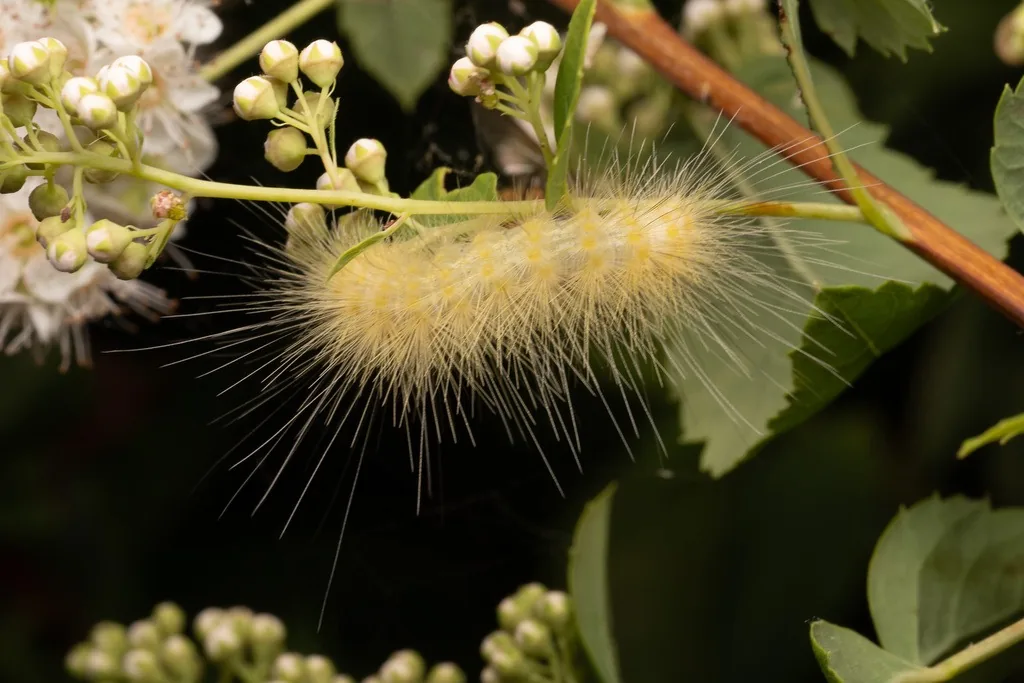
- Likely a yellow woollybear, the larva of the Virginian tiger moth.[1][2]
- Do woollybears sting?
- MU Extension says the hairs can irritate sensitive skin when handled.[1]
- Why are woolly bears crossing the road in fall?
- They are looking for sheltered spots to spend the winter.[2]
Sources
- University of Missouri Extension (Caterpillars in Your Yard and Garden, IPM1019), “Caterpillars in Your Yard and Garden, page 54: Yellow woollybear.” extension.missouri.edu/publications/ipm1019-54 (accessed 2026-10-15)
- Ohio State University Extension, Butler County, “Woolly Bear Caterpillars (November 10, 2015).” butler.osu.edu/news/woolly-bear-caterpillars (accessed 2026-10-15)
- iNaturalist, “Spilosoma virginica taxon page (order and family).” www.inaturalist.org/taxa/60839 (accessed 2026-10-06)