On this page
How to identify it
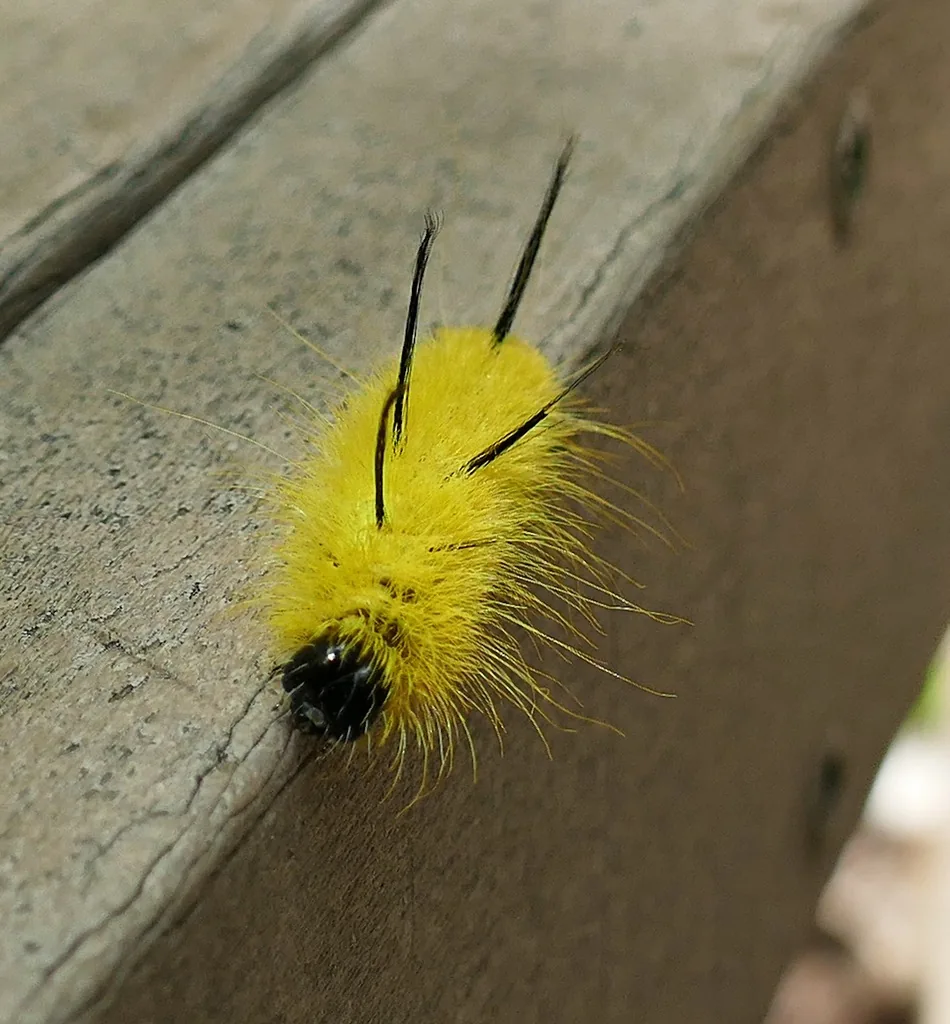
- Caterpillars are covered in long yellow, yellow-green or white hairs and carry slender black 'pencils' of hairs: two pairs near the front and a single one near the rear.[1][2]
- Caterpillars can grow to about 2 inches long.[1]
- The adult is a medium-sized, grayish moth with faint black zigzag markings; it comes to lights at night.[1][2]
Look-alikes
| Look-alike | How to tell them apart |
|---|---|
| Poplar dagger moth | In Colorado the related poplar dagger moth feeds on poplar, willow and birch; its caterpillars look and behave much the same.[2] |
Where it lives
It occurs widely in the eastern United States and in Colorado, where CSU reports it wherever boxelder grows and in towns with silver maple.[1][2]
Biology and life cycle
Winter is spent as a pupa in a dense silk cocoon in a sheltered spot near the host tree; moths emerge and lay eggs on young leaves in late spring.[2]
Caterpillars feed through summer and, once full grown, crawl down the trunk looking for a place to spin a cocoon, sometimes dozens of yards from the tree.[2]
CSU reports one generation a year in Colorado; NC State says there are probably two in North Carolina, with caterpillars seen from July through late October.[1][2]
Damage and signs
- Caterpillars eat the leaves of alder, ash, elm, maple, oak, willow and other hardwoods; in Colorado, boxelder and silver maple are common hosts.[1][2]
- After finishing a leaf, the caterpillar often clips its stem so it drops, which CSU says may help hide feeding from birds.[2]
- Only rarely do they become noticeable pests; most are seen one or two at a time.[1]
Health risk
NC State notes reports that the black hair pencils can break off in skin and cause a stinging feeling that may become a rash, so avoid handling the caterpillars with bare hands.[1]
Control
Traps and physical control
Control is rarely needed; wandering caterpillars that are ready to pupate can simply be stepped on or left alone.[1]
Pesticides
If noticeable defoliation does occur, most insecticides labeled for residential landscapes give adequate control; full-grown wandering caterpillars may appear resistant.[1]
Common questions
- Is the fuzzy yellow caterpillar with black spikes poisonous?
- It is the American dagger moth caterpillar; its black hair pencils are reported to cause stinging and a rash in some people, so don't handle it bare-handed.[1]
- Will it hurt my tree?
- Rarely. Most are seen singly, and defoliation is uncommon.[1]
- Why is it crawling across my driveway?
- Full-grown caterpillars leave the tree in late summer and fall to find a sheltered spot to spin a cocoon.[2]
Sources
- NC State Extension, “American Dagger Moth (PDIC Factsheet).” content.ces.ncsu.edu/american-dagger-moth (accessed 2026-10-15)
- Colorado State University Extension (Colorado Insects of Interest, W. Cranshaw), “American Dagger Moth (Colorado Insect of Interest).” webdoc.agsci.colostate.edu/bspm/arthropodsofcolorado/American-Dagger-Moth.pdf (accessed 2026-10-15)
- iNaturalist, “Acronicta americana taxon page (order and family).” www.inaturalist.org/taxa/1293501 (accessed 2026-10-06)