On this page
How to identify it
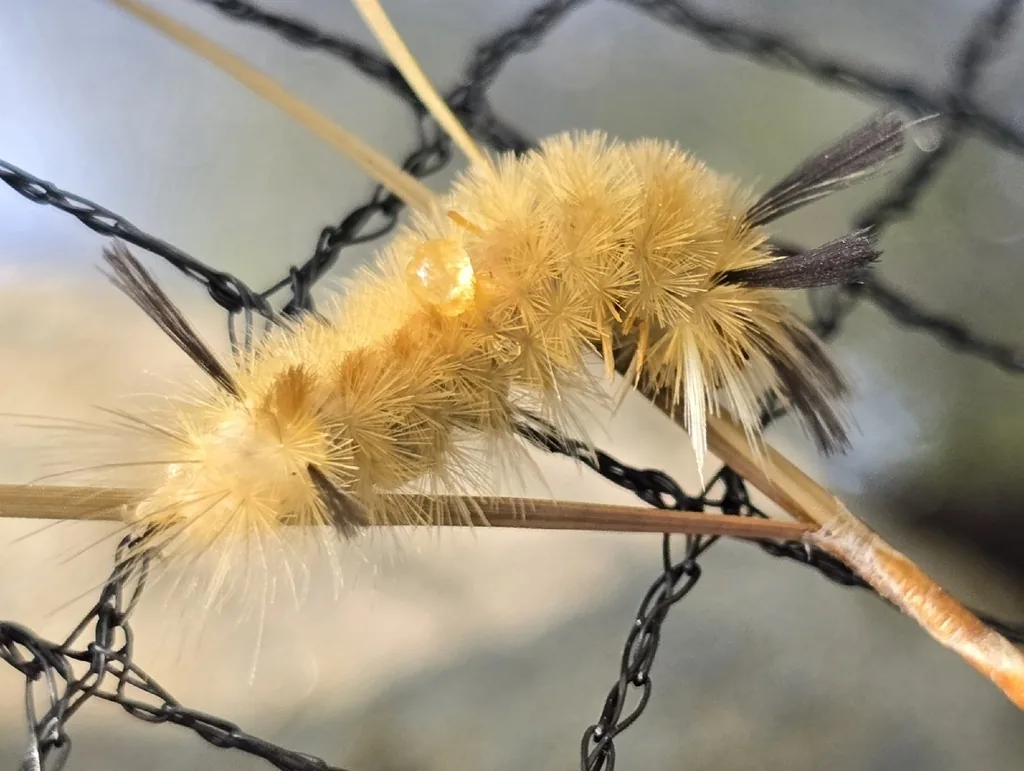
- Full-grown caterpillars are about 1 1/2 inches long, densely covered in tufts of white, silver-gray or black hairs, with long black and shorter white pencils pointing forward from behind the head, a pair sticking out sideways, and two black pencils pointing backward.[1][2]
- A row of dark gray tufts runs down the back.[1]
- The adult is a pale tan moth with mosaic-like wing bands.[1][2]
Look-alikes
| Look-alike | How to tell them apart |
|---|---|
| Sycamore (Harris') tussock moth | MDC notes the adults are basically identical to the sycamore tussock moth's.[2] |
Where it lives
Common in Missouri and across the eastern United States; caterpillars are usually seen from early summer to fall.[1][2]
Biology and life cycle
MU Extension reports two generations a year; the species overwinters in gray, felt-like cocoons spun from the caterpillar's hairs.[1][2]
Damage and signs
- Hosts include oak, willow, poplar, hickory, grape and hackberry; damage is not a concern.[1]
Health risk
The hairs can irritate sensitive skin, and MDC notes itchy rashes from touching them; children are most likely to pick them up, so don't handle fuzzy caterpillars with bare skin.[1][2]
Control
Prevention
Avoid touching fuzzy caterpillars with bare skin, especially if you're unsure of the species or your sensitivity.[2]
Common questions
- Can the fuzzy tan caterpillar give you a rash?
- Yes; banded tussock moth hairs can cause itchy rashes in sensitive people.[1][2]
- What does it eat?
- Leaves of oak, willow, poplar, hickory, grape and hackberry.[1]
- Is it the same as a white-marked tussock moth?
- No; MDC notes 'tussock moth' is used for both tiger moths like this one and the separate 'true' tussock moths.[2]
Sources
- University of Missouri Extension (Caterpillars in Your Yard and Garden, IPM1019), “Caterpillars in Your Yard and Garden, page 31: Pale tussock moth.” extension.missouri.edu/publications/ipm1019-31 (accessed 2026-10-15)
- Missouri Department of Conservation, “Banded Tussock Moth (Field Guide).” mdc.mo.gov/discover-nature/field-guide/banded-tussock-moth (accessed 2026-10-15)
- iNaturalist, “Halysidota tessellaris taxon page (order and family).” www.inaturalist.org/taxa/120217 (accessed 2026-10-06)