How to identify it
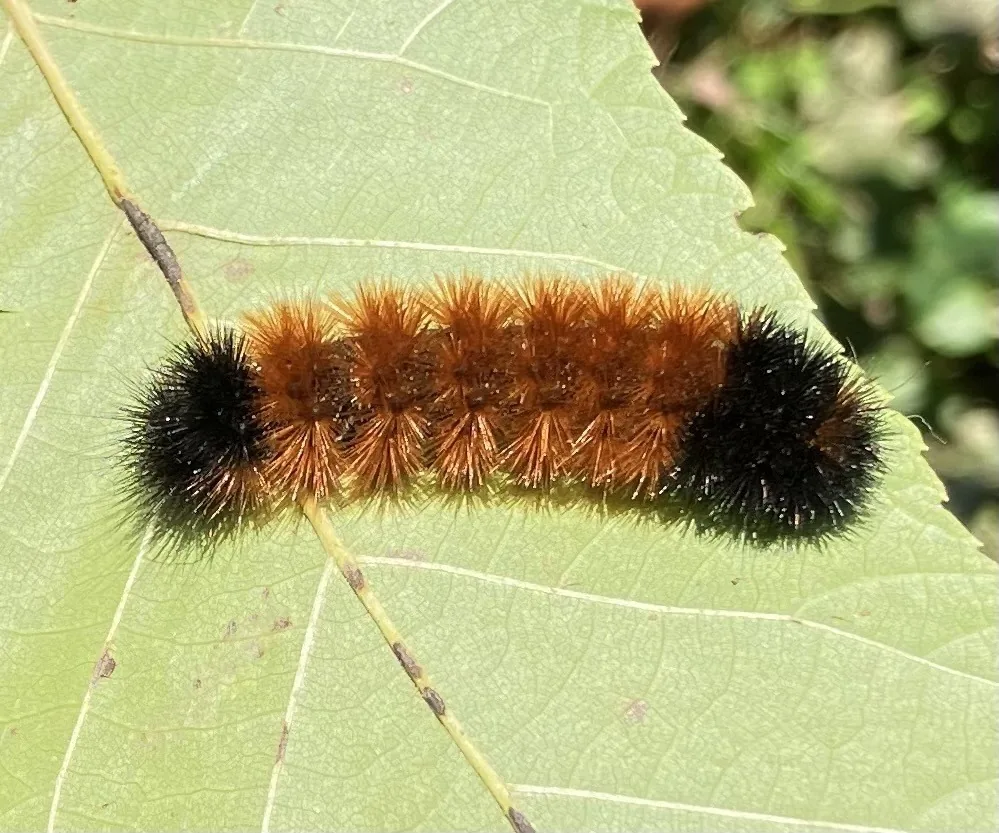
- Mature caterpillars are a little over an inch long and covered with stiff hairs: rusty red in the middle and black at both ends.[1]
- As caterpillars grow, black hairs are replaced with orange ones, so the rusty band is widest in mature woolly bears.[1]
- Adult Isabella moths are buff with small black spots; females have pink hind wings.[1]
Look-alikes
| Look-alike | How to tell them apart |
|---|---|
| Giant woolly bear | The giant woolly bear is a different species, the larva of the giant leopard moth, Hypercompe scribonia.[2] |
Where it lives
NC State Extension covers it in North Carolina, where it has one or two generations a year; it's the star of fall festivals in Vermilion, Ohio, and Banner Elk, North Carolina.[1]
Biology and life cycle
In fall, caterpillars look for shelter under bark, leaf litter or logs and can survive temperatures as low as minus 90°F.[1]
They overwinter as caterpillars or as pupae in flimsy cocoons; overwintered caterpillars feed again in spring, then pupate.[1]
Moths emerge to mate and lay eggs, often in batches of 100 or more, on weeds, trees and grasses.[1]
Damage and signs
- They feed on plantain and other non-crop plants such as dandelion, dock, aster, goldenrod and some grasses.[1]
Health risk
NC State Extension calls them virtually harmless to people.[1]
Control
Prevention
No control is needed: they're harmless, feed on weeds and are mostly seen in fall after they've finished feeding, so spraying makes no sense.[1]
Traps and physical control
If one wanders indoors, simply move it outside; NC State notes they're fun to rear on fresh plantain leaves.[1]
Common questions
Sources
- NC State Extension, “Banded Woollybear / Isabella Moth (PDIC Factsheet, reviewed October 3, 2026).” content.ces.ncsu.edu/banded-woollybear (accessed 2026-10-06)
- University of Florida IFAS Extension (Featured Creatures), “Giant Woolly Bear (larva), Giant or Great Leopard Moth (adult), Hypercompe scribonia.” edis.ifas.ufl.edu/publication/IN1043 (accessed 2026-10-06)
- iNaturalist, “Pyrrharctia isabella taxon page (order and family).” www.inaturalist.org/taxa/59675 (accessed 2026-10-06)