On this page
How to identify it
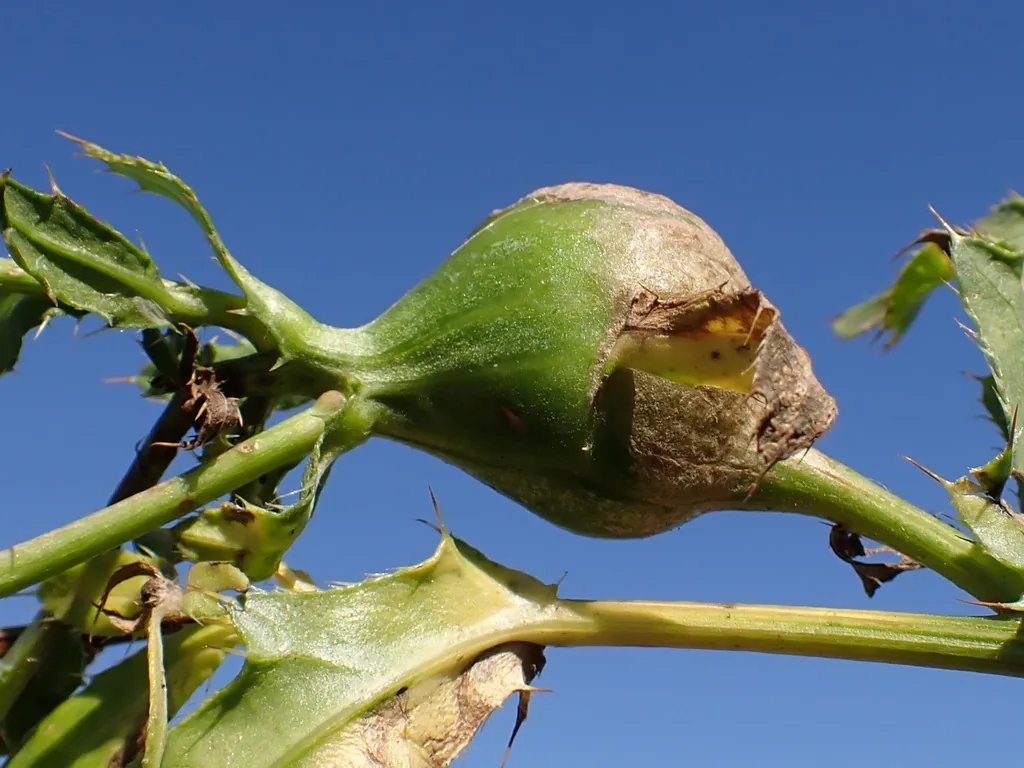
- The sign is the gall: an odd, wood-like swelling on a Canada thistle stem, formed where larvae entered a developing shoot tip. Galls become woody and hard as the tissue lignifies and are divided into several chambers, each holding one larva, with up to a dozen larvae in a gall.[1][4]
- Galls can sit on the main shoot or on lateral shoots; larger galls on young main stems do the most damage, reducing plant height by more than 50 percent.[2]
- Open a gall in winter or early spring and you find mature larvae, one per chamber; adults emerge in spring, and a gall that is opened and exposed to air prompts the larvae to pupate.[4][3]
Look-alikes
| Look-alike | How to tell them apart |
|---|---|
| Other Canada thistle biocontrol insects | Washington lists four released insects: the stem-mining weevil Ceutorhynchus litura, whose larvae mine the stem and leave exit holes near the ground; the defoliating beetle Cassida rubiginosa; the bud weevil Larinus planus, which reduces seed numbers; and the gall fly, the only one that produces stem galls.[2] |
| Goldenrod gall fly | A stem-galling fly covered on PestControlBasics; the thistle stem gall fly is monophagous, laying its eggs in Canada thistle and, only when denied that host, in two closely related thistles.[3] |
Where it lives
Released in the United States in 1977 (California) and in many states since; now widely distributed across the U.S. and southern Canada. South Dakota reports its galls as a common sight on Canada thistle in a wet summer, Washington lists it among its released Canada thistle agents, and it is widespread in North Dakota.[4][1][2]
Biology and life cycle
Adult females lay eggs on the shoot tips of Canada thistle among the developing leaves in June and July, 11 to 14 eggs per clutch; the eggs hatch after 7 to 10 days (4.3 days at 27 degrees C in the laboratory). The larvae move into the stem, which triggers the gall; more larvae make a larger gall and fitter flies.[4][3][2]
There is one generation a year. The fly overwinters as a mature (third-instar) larva inside the gall and the adults emerge in spring.[4][3]
The fly is monophagous: it lays eggs in Canada thistle and, when kept without that host, in the closely related weeds bull thistle (Cirsium vulgare) and plumeless thistle (Carduus acanthoides). It prefers wet environments, which is why South Dakota saw far more galls in a wet summer than in the dry season before.[3][1]
Parasitic wasps, chiefly eurytomids and pteromalids, attack the larvae inside the galls and are a key cause of mortality; in North Dakota the pteromalid Pteromalus elevatus was the dominant parasitoid and a little-known predatory clerid beetle, Isohydnocera tabida, was found living in the galls.[4]
Damage and signs
- The gall interrupts normal plant function and reproduction, diverting nutrients from vegetative growth and causing malformed seed heads with reduced seed production. In the original biology study, plants with one or two galls had roots weighing 65 and 78 percent less, and stems plus leaves 47 and 58 percent less, than ungalled plants.[1][3]
- Impact depends on whether galls form on main or lateral shoots and how early in the season the fly attacks; it hurts younger stems most. The fly reduces a thistle stand but will not eradicate it.[2][4][1]
Health risk
None of the sources mentions any effect on people; this is a plant-feeding fly released on purpose to suppress a noxious weed.[1][4]
Control
Prevention
No control is needed: the gall fly is a deliberately released biological control agent for a noxious weed. Its particular value is that it can reach isolated thistle stands that are hard to get to with other tools, and SDSU notes that galls combined with competition from desirable vegetation can be more effective than either alone.[1]
Traps and physical control
If you want to keep the flies working, do not mow or spray a thistle patch before they have laid their eggs in early summer; any tactic that removes vegetative growth before egg laying sends the flies elsewhere to find a suitable site. The fly alone will not manage Canada thistle, so it is one tool in an integrated weed program alongside mowing with herbicide treatments.[1][2]
Common questions
- Are the galls on my Canada thistle a problem?
- No. They are made by the thistle stem gall fly, a biological control insect; the galls stunt the thistle, divert nutrients from growth and reduce seed production.[1]
- Will the gall fly get rid of Canada thistle?
- Not by itself. It reduces the stand rather than eradicating it, and works best combined with competition from desirable plants and other control methods.[1][2]
- Could it attack garden plants?
- The fly is monophagous on Canada thistle; in tests it laid eggs in two closely related weedy thistles only when denied its host, and the authors recommended it for release as a promising agent.[3]
Sources
- South Dakota State University Extension, “Galls on Canada Thistle: Biological Management at Work (E. Jones, P. Rozeboom, J. Alms and D. Vos).” extension.sdstate.edu/galls-canada-thistle-biological-management-work (accessed 2026-11-10)
- Washington State University Extension, “Canada Thistle (Whitman County Extension weed sheet, February 2007; PDF).” wpcdn.web.wsu.edu/extension/uploads/sites/75/2013/11/CanadaThistle2007.pdf (accessed 2026-11-10)
- The Canadian Entomologist (Cambridge University Press), “Host specificity and biology of Urophora cardui (Diptera: Tephritidae), a biocontrol agent for Canada thistle (Cirsium arvense) (D. P. Peschken and P. Harris, The Canadian Entomologist 107(10), 1975; abstract).” www.cambridge.org/core/journals/canadian-entomologist/article/host-specificity-and-biology-of-urophora-cardui-diptera-tephritidae-a-biocontrol-agent-for-canada-thistle-cirsium-arvense/DE64FD2E7FF5F6373E639390FAD70394 (accessed 2026-11-10)
- Insects (MDPI, via NCBI PubMed Central), “Predatory and Parasitic Insects Associated with Urophora cardui L. (Diptera: Tephritidae) Galls on Canada Thistle, Cirsium arvense L., in North Dakota (S. J. Swenson et al., Insects 13(7):646, 2022; full text).” pmc.ncbi.nlm.nih.gov/articles/PMC9316070/ (accessed 2026-11-10)
- iNaturalist, “Urophora cardui taxon page (order and family).” www.inaturalist.org/taxa/63066 (accessed 2026-11-10)