On this page
How to identify it
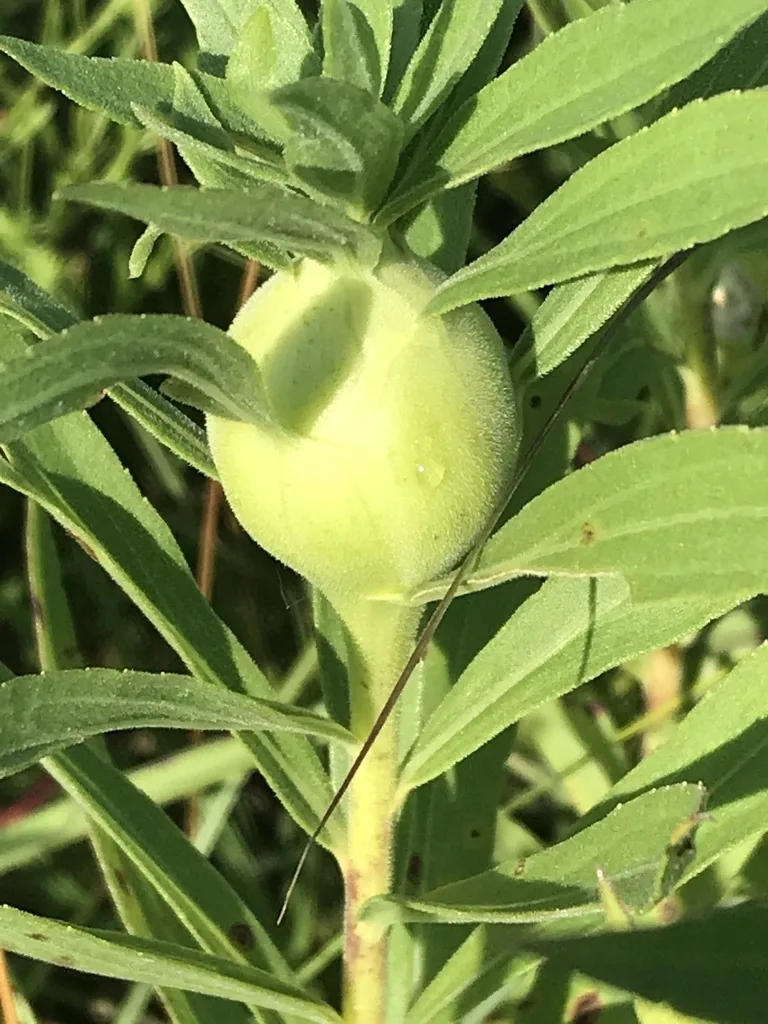
- The gall is a round swelling on the stem. It starts out the same size and color as the stem and grows to nearly the size of a golf ball, often with a reddish tinge or purple mottling. It has a hard, corky outer layer and turns brown and hard in fall.[1]
- Inside is a single white to cream-colored, oval maggot with no distinct head, about 1/4 inch long when grown, sitting in a chamber it has eaten out of the gall's center.[1]
- By fall, a pinhead-sized dark spot near the middle of the gall marks the exit tunnel the larva has chewed, with a thin layer left over the opening.[1]
- The adult is smaller than a house fly, with clear wings splotched with mottled brown; the female has a tube-shaped egg-laying organ at the tip of her abdomen. Adults are clumsy fliers that spend more time walking on goldenrod than flying.[1]
Look-alikes
| Look-alike | How to tell them apart |
|---|---|
| Goldenrod gall moth (Gnorimoschema gallesolidaginis) | Its stem galls are spindle-shaped or elliptical rather than round.[1] |
| Goldenrod bunch gall midge (Rhopalomyia solidaginis) | It makes a tight, rosette-like cluster of leaves at the tip of the stem, and only on Canada goldenrod, instead of a round swelling on the stem.[1] |
Where it lives
It occurs from coast to coast across much of central North America and north into northern Canada. Wherever it is found, it lives only on goldenrod.[1]
Biology and life cycle
It completes its whole life cycle on goldenrod. Separate races lay eggs only on Canada goldenrod, late goldenrod (Solidago altissima) or giant goldenrod (S. gigantea), and females find the right plant by tasting it with sensors on their feet and antennae as they walk over the buds.[1]
In spring, females lay eggs one at a time in fast-growing stems. A female may lay several eggs in one stem, but each stem usually ends up with just one gall. The eggs hatch after several days, and each larva feeds inside the stem where it hatched.[1]
The larva's saliva is thought to contain a chemical that mimics plant hormones and makes the stem grow abnormally. The gall shows about 3 weeks after the egg is laid, and the larva feeds on its soft center all summer, molting twice.[1]
The larva spends the winter inside the gall in its third stage. Cold triggers it to turn glycogen into glycerol and sorbitol, which work as antifreeze. It pupates in early spring, and the adult, which has no chewing mouthparts, pushes open the thin cap over its exit tunnel by inflating a balloon-like structure between its eyes.[1]
The larvae are freeze tolerant and face very cold, dry winter conditions. In laboratory tests, larvae that lost just 6 to 10% of their body weight to mild drying became markedly more likely to survive freezing at -15 C (5 F) and -20 C (-4 F).[2]
Adults emerge in mid-spring as new goldenrod stems come up and live about 10 to 14 days, doing nothing but mating and laying eggs. Males wait at the stem tips and rock rapidly side to side when a female approaches. Galls tend to occur in patches because the flies don't travel far from where they emerged.[1]
Populations from prairie and forest habitats have diverged genetically: flies survive better on, and prefer to lay eggs in, tall goldenrod from their own habitat, and they make galls of the size and shape typical of that habitat.[3]
Some tall goldenrod plants grow 'candy-cane' stems that nod at the tip for a while during growth, at the same time the fly is laying eggs. In a large field survey, plants with these stems were only half as likely to be punctured by egg-laying females.[4]
Two chalcid wasps (Eurytoma gigantea and E. obtusiventris) lay eggs through the young gall and their larvae eat the fly larva; tiny Mordellistena beetle larvae feed on it too; and downy woodpeckers and black-capped chickadees break into galls to eat it. The wasps find small galls easier to attack, while woodpeckers prefer the largest ones.[1]
Damage and signs
- The galls don't seem to have a debilitating effect on goldenrod, which still blooms despite them, though the leaves near a gall wither and turn brown.[1]
Health risk
The Wisconsin Horticulture article describes no bite, sting or other risk to people; the adults have no chewing mouthparts and live only to mate and lay eggs.[1]
Control
Prevention
No control is recommended. The galls don't seem to weaken goldenrod, which keeps blooming, and the larvae inside are food for wasps, beetles, woodpeckers and chickadees.[1]
Common questions
- What are the round balls on goldenrod stems?
- They are galls made by the goldenrod gall fly. Each one holds a single maggot that feeds inside through summer, spends the winter there, and leaves as a fly in spring.[1]
- Do goldenrod galls hurt the plant?
- Not much, apparently. Wisconsin Horticulture notes that the galls don't seem to have a debilitating effect, and the plants still bloom.[1]
- What eats goldenrod gall fly larvae?
- Chalcid wasps and tiny Mordellistena beetles develop on the larvae inside the galls, downy woodpeckers and black-capped chickadees peck into galls to eat them, and in some places ice anglers cut the galls open to use the larvae as fish bait.[1]
Sources
- University of Wisconsin-Madison Extension, Wisconsin Horticulture, “Goldenrod Gall Fly, Eurosta solidaginis (Susan Mahr).” hort.extension.wisc.edu/articles/goldenrod-gall-fly-eurosta-solidagnis/ (accessed 2026-11-09)
- Journal of Experimental Biology (via NCBI PubMed), “Mild desiccation rapidly increases freeze tolerance of the goldenrod gall fly, Eurosta solidaginis (N. A. Levis, S.-X. Yi and R. E. Lee Jr.; Journal of Experimental Biology 215: 3768-3773, 2012; abstract).” pubmed.ncbi.nlm.nih.gov/22899523/ (accessed 2026-11-09)
- Evolution (via NCBI PubMed), “Divergence of Eurosta solidaginis in response to host plant variation and natural enemies (T. P. Craig and J. K. Itami; Evolution 65(3): 802-817, 2011; abstract).” pubmed.ncbi.nlm.nih.gov/20955195/ (accessed 2026-11-09)
- Ecology (via NCBI PubMed), “Ducking as a means of resistance to herbivory in tall goldenrod, Solidago altissima (M. J. Wise and W. G. Abrahamson; Ecology 89(12): 3275-3281, 2008; abstract).” pubmed.ncbi.nlm.nih.gov/19137934/ (accessed 2026-11-09)
- iNaturalist, “Eurosta solidaginis taxon page (order and family).” www.inaturalist.org/taxa/85317 (accessed 2026-11-09)