On this page
How to identify it
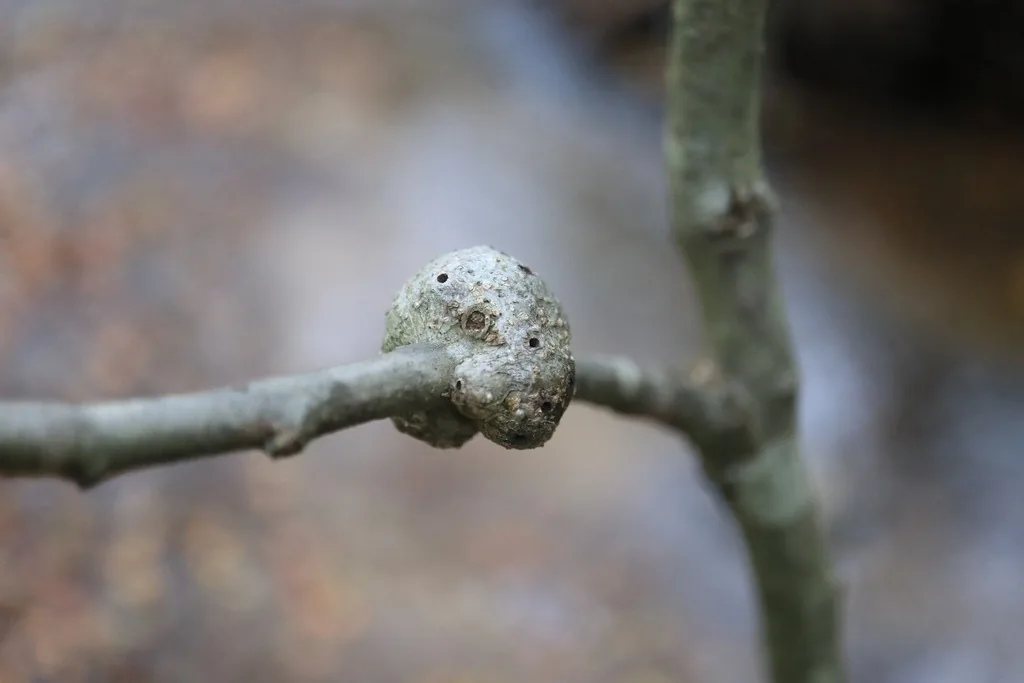
- Galls are solid, woody swellings on twigs up to about 2 inches across, sometimes merging into masses along more than 1.5 feet of branch.[1]
- Unlike horned oak galls, gouty oak galls stay smooth, without the small horns where wasps exit.[1][2]
- The adult wasps are tiny and rarely noticed; the galls are the sign.[1][2]
Look-alikes
| Look-alike | How to tell them apart |
|---|---|
| Horned oak gall | A twig gall of the related wasp Callirhytis cornigera that develops small horns, one per exiting wasp.[1][2] |
Where it lives
Occurs from southern Canada to Georgia; UMass notes woody oak stem galls have historically been a serious problem in Plymouth County, Massachusetts, and on Long Island, New York.[1][2]
Biology and life cycle
The life cycle is complex and not fully understood; woody twig galls take two or more years to mature.[1][2]
Larvae develop in cells at the center of the gall and feed only on gall tissue.[1][2]
Damage and signs
Health risk
Control
Traps and physical control
On small trees, prune out and destroy galls while they are small, before the adult wasps leave.[1][2]
Pesticides
Once a gall starts to form it can't be reversed, and insecticides offer little control unless timed exactly to the wasps' flight.[1][2]
Common questions
Sources
- UMass Extension Landscape, Nursery and Urban Forestry Program (Landscape Insect & Mite Guide), “Callirhytis quercuspunctata (Gouty Oak Gall Wasp).” www.umass.edu/agriculture-food-environment/landscape/publications-resources/insect-mite-guide/callirhytis-quercuspunctata (accessed 2026-10-16)
- Penn State Extension, “Galls on Oak (updated June 24, 2026).” extension.psu.edu/galls-on-oak (accessed 2026-10-16)
- iNaturalist, “Callirhytis quercuspunctata taxon page (order and family).” www.inaturalist.org/taxa/179371 (accessed 2026-10-06)