On this page
How to identify it
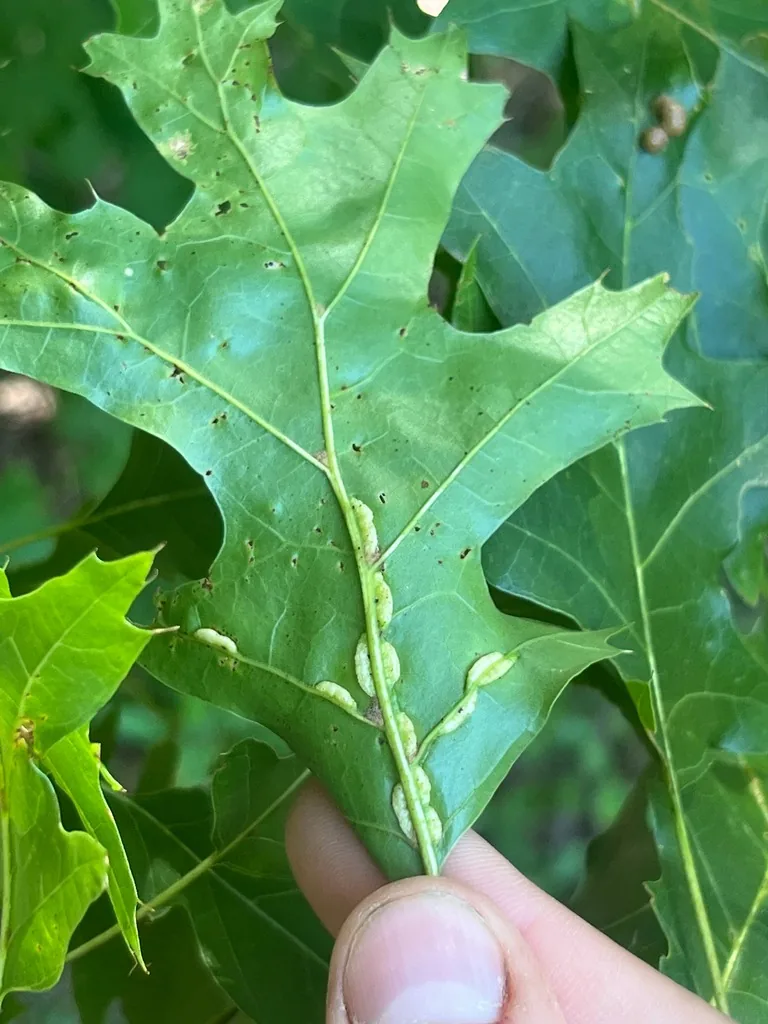
- Look for elongated, pocket-like swellings along the midrib and side veins on the underside of the leaves, which often twist and distort the leaf.[1][2][3]
- Adults are tiny mosquito-like flies about 3 mm (1/8 inch) long and are rarely noticed.[1][2][3]
- Each pocket holds a white maggot about 2 mm long.[1][2][3]
Where it lives
Reported on red oaks in North Carolina, Kansas and Oklahoma; in heavy years nearly every leaf on a tree is galled.[1][2][3]
Biology and life cycle
Females lay eggs in newly unfolding spring leaves; the maggots move to the veins, and gall tissue grows around each within a few days.[1][2][3]
By mid-spring to early summer the grown maggots drop to the ground and stay there until the next spring; there is one generation a year.[1][2][3]
Damage and signs
Health risk
Control
Biological control
Parasites, predators and diseases usually bring numbers down by the following year.[1]
Pesticides
Kansas State says there is no control; NC State notes only early spring sprays could work in theory, and most entomologists discourage trying.[1][2]
Common questions
Sources
- NC State Extension, “Oak Vein Pocket Gall Midge (PDIC Factsheet).” content.ces.ncsu.edu/oak-vein-pocket-gall-midge (accessed 2026-10-16)
- Kansas State University Research and Extension (Entomology), “Vein Pocket Gall (Kansas Bugs, May 2015, R. Cloyd).” www.k-state.edu/news/kansasbugs/articles/2015/05/vein-pocket-gall.html (accessed 2026-10-16)
- Oklahoma State University Extension, “Vein Pocket Gall (Digital Diagnostics).” extension.okstate.edu/programs/digital-diagnostics/insects-and-arthropods/vein-pocket-gall/ (accessed 2026-10-16)
- iNaturalist, “Macrodiplosis qoruca taxon page (order and family).” www.inaturalist.org/taxa/714129 (accessed 2026-10-06)