On this page
How to identify it
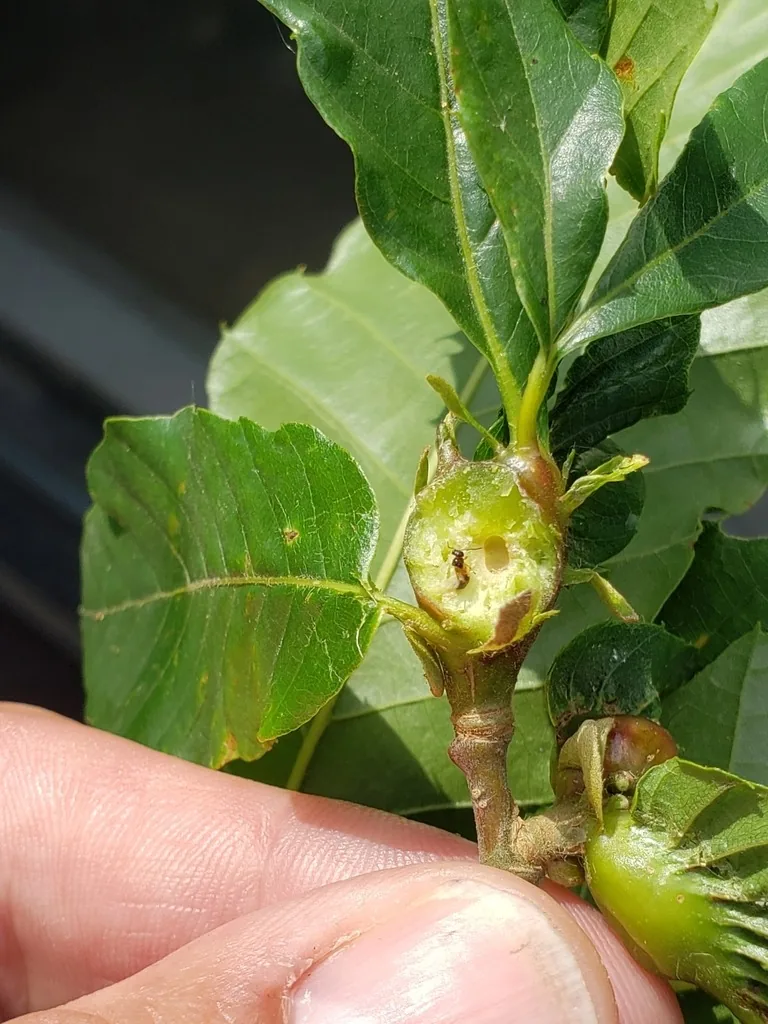
- Look for round, greenish-red galls about 1/2 to 1 inch across on new chestnut shoots, leaf stems or leaves in spring.[2]
- Old galls turn woody and dry and stay on the tree for years, with small leaves still attached in winter, which makes infestations easy to spot.[2]
- Adults are tiny wasps, 2.5 to 3 mm long; only females are known.[1][2]
Where it lives
Native to China; first found in the US in Georgia in 1974, it has spread to at least 12 states east of the Mississippi, reaching Connecticut in 2011 and Massachusetts in 2012.[1][2]
Biology and life cycle
There is one generation a year. Females lay up to 300 eggs inside buds in early summer, and young larvae overwinter hidden in the dormant buds.[1][2]
At budbreak the larvae trigger rapid gall growth; each gall has one to several chambers, and adults emerge in early summer.[1][2]
Damage and signs
Health risk
Control
Prevention
Moving infested chestnut plants is the main way it reaches new areas, and infested buds are very hard to detect.[2]
Traps and physical control
On small trees, scout for green galls in June and prune them out before adults emerge.[1]
Biological control
Torymus sinensis, a parasitoid wasp released in the eastern US in the 1970s, follows the pest and usually keeps damage low on established trees; leave old galls late in the season so it can develop.[1][2]
Pesticides
Insecticides are ineffective, partly because the larvae are sheltered inside buds and gall tissue.[1][2]
Common questions
Sources
- UMass Extension Landscape, Nursery and Urban Forestry Program (Landscape Insect & Mite Guide), “Dryocosmus kuriphilus (Asian Chestnut Gall Wasp).” www.umass.edu/agriculture-food-environment/landscape/publications-resources/insect-mite-guide/dryocosmus-kuriphilus (accessed 2026-10-16)
- University of Kentucky Entomology (ENTFACT), “Asian Chestnut Gall Wasp (ACGW) in Kentucky.” entomology.ca.uky.edu/entfact/asian-chestnut-gall-wasp-acgw-kentucky (accessed 2026-10-16)
- iNaturalist, “Dryocosmus kuriphilus taxon page (order and family).” www.inaturalist.org/taxa/357839 (accessed 2026-10-06)