On this page
How to identify it
- Adults are tiny wasps, 1 to 1.5 mm long, and females are larger than males.[2]
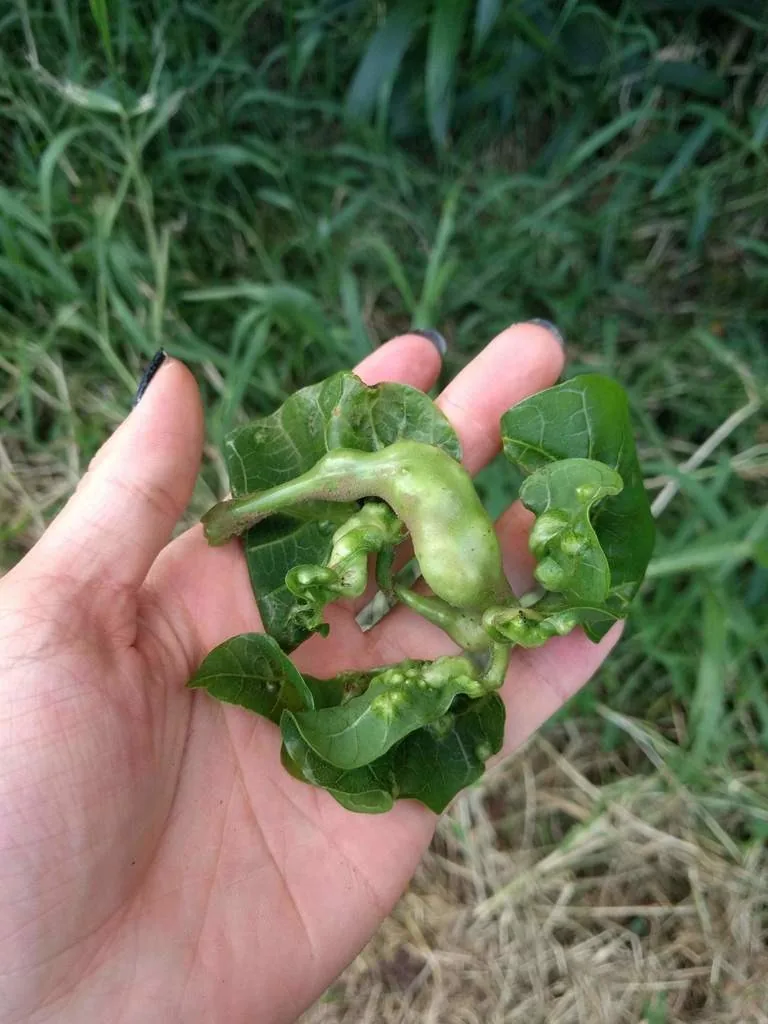
- The easiest sign is the galls: leaves, leaf stalks and young shoots become swollen and deformed and look nothing like the leaves of a healthy tree.[2][1]
- Galls that adults have left show the small exit holes the wasps cut to get out.[2]
Where it lives
First described in 2004 from specimens collected in Singapore, Mauritius and Reunion and first found in Hawaii in 2005, it is now on every major Hawaiian island; it is reported from Asia, Africa and Oceania and from restricted areas of the Americas and the Caribbean, and is thought to come from East Africa.[1][2]
Biology and life cycle
Females insert eggs into young leaf and stem tissue; the larvae make the plant form galls, pupate inside them, and the adults cut holes to emerge, completing the life cycle in about 20 days.[1][2]
Its hosts are Erythrina species, a genus of more than 100 tropical and subtropical trees used as ornamentals, living fences and shade trees.[2]
It spreads short distances by flying, on the wind and perhaps on clothing, and long distances probably on fallen infested leaves carried by boats or planes.[2]
Damage and signs
- Heavy infestations cause loss of growth and vigor, defoliation and dieback; trees often die as repeated cycles of regrowth and attack use up their reserves, and seedlings are killed outright.[1][2]
- PestNet reports that about 95 percent of Hawaii's native wiliwili and Indian coral trees, important trees of the endangered lowland dry forest, have been killed by the gall wasp.[2]
Health risk
It is a plant pest; the Hawaii Invasive Species Council and PestNet mention no risk to people.[1][2]
Control
Keep them out
Don't move Erythrina plants from places where the gall wasp is present to places where it hasn't established.[2]
Traps and physical control
Pruning has been tried without success, and no cultural control is recommended.[2]
Biological control
A parasitoid wasp from Tanzania, Eurytoma erythrinae, has been released in Hawaii since 2008 and has significantly reduced gall wasp infestations.[1][2]
A second parasitoid, Aprostocetus nitens, which can develop in the smaller galls on flowers, pods and seedlings, has been proposed for Hawaii; in October 2026 the state was still processing the import permits and had scheduled a public hearing on rules that include it.[1]
Pesticides
Trunk injection of imidacloprid has been trialed, but because of its cost it is recommended only for highly valued ornamental trees.[2]
Common questions
- Why are my coral tree's leaves swollen and twisted?
- Swollen, deformed leaves and shoots on an Erythrina are the galls of the erythrina gall wasp, where its larvae develop.[2][1]
- Can I save a coral tree with erythrina gall wasp?
- Pruning doesn't work; trunk injection of imidacloprid has been tried on valuable ornamental trees, and in Hawaii a released parasitoid wasp has greatly reduced infestations.[2][1]
Sources
- Hawaii Invasive Species Council, “The Target: Erythrina Gall Wasp (Quadrastichus erythrinae) (Biocontrol Hawaii).” dlnr.hawaii.gov/hisc/info/biocontrol/latest-biocontrol/erythrina-gall-wasp/ (accessed 2026-10-19)
- Pacific Pests, Pathogens & Weeds (ACIAR and the Pacific Community), “Erythrina gall wasp, Fact Sheet 268 (Pacific Pests, Pathogens & Weeds; G. Jackson, from Hawaii Department of Agriculture New Pest Advisory 05-03 and CABI).” apps.lucidcentral.org/pppw_v13/text/web_full/entities/erythrina_gall_wasp_268.htm (accessed 2026-10-19)
- iNaturalist, “Quadrastichus erythrinae taxon page (order and family).” www.inaturalist.org/taxa/199330 (accessed 2026-10-06)