On this page
How to identify it
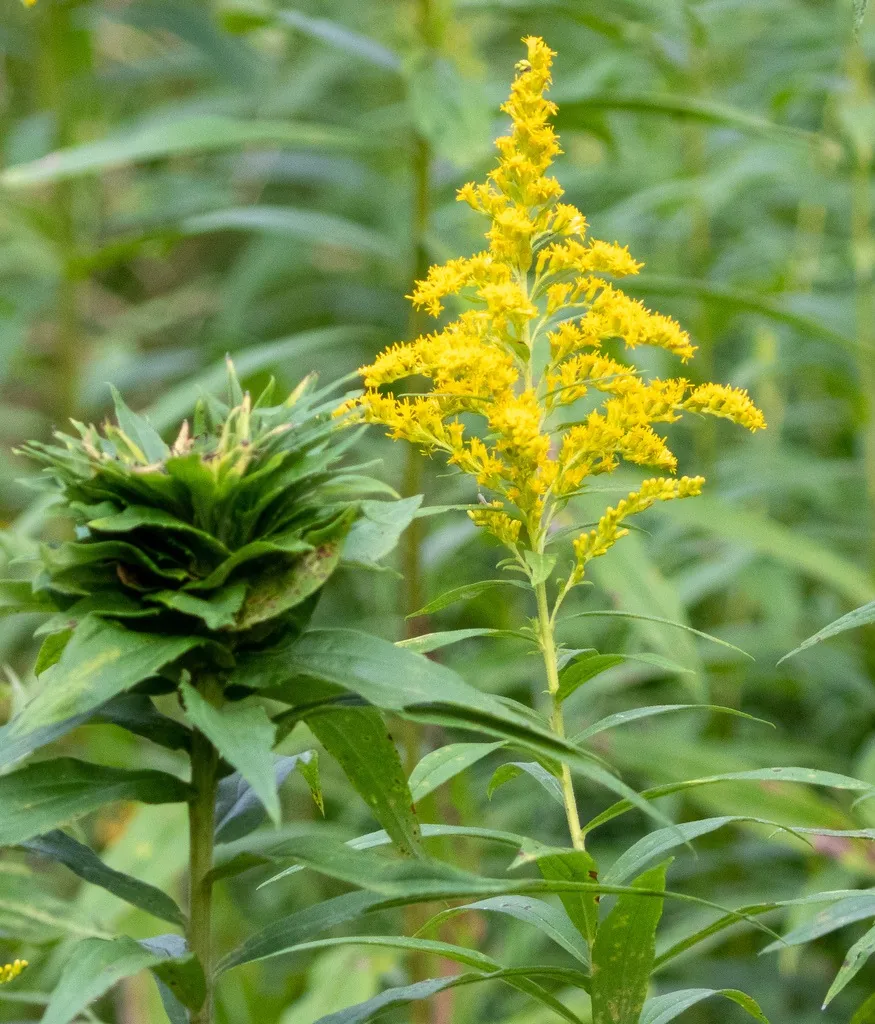
- Look for the gall rather than the insect: a closely bunched, rosette-like cluster of leaves at the very tip of a goldenrod stem, in the terminal bud.[1][3]
- The gall contains larval chambers; researchers studying it measure gall biomass, the number of larval chambers and their volume.[5]
- UW-Madison Extension describes the gall on Canada goldenrod. The research cited here was all done on tall goldenrod (Solidago altissima).[1][2][3][4][5]
Look-alikes
| Look-alike | How to tell them apart |
|---|---|
| Goldenrod gall fly | Makes a round swelling on the stem instead of a leafy rosette at the tip.[1] |
| Goldenrod gall moth (Gnorimoschema gallesolidaginis) | Makes a spindle-shaped or elliptical gall on the stem rather than a bunch of leaves at the tip.[1] |
Where it lives
In a survey of tall goldenrod across a 2,300 km north-south transect in the eastern United States, the galls were densest at middle latitudes. Studies cited here were carried out in old fields and at Michigan's Kellogg Biological Station.[3][2][5]
Biology and life cycle
It attacks the tip of the goldenrod stem, and its gall forms in the terminal bud.[1][4]
Some goldenrod plants have 'candy-cane' stems that nod at the tip while growing, a genetically controlled trait. Nodding happens during the egg-laying period of tip-attacking insects, and in a common-garden study candy-cane stems were galled only half as often as erect stems.[4]
Host-plant genetics strongly shapes gall numbers: goldenrod genotype was the best predictor of gall density and size within a year, and plots with more goldenrod genotypes held more galls. Gall density also swung several fold from year to year.[2][3]
Removing other plant-feeding insects from goldenrod led to more and larger galls. Adding soil nutrients over four years did not change gall density, though galls were smaller where carbon was added.[3]
Bunch galls work as shelter and food for other small animals: plants with bunch galls carried more arthropod species, with a different mix of species, than plants without.[2][3]
Damage and signs
Health risk
None of the sources mentions any bite, sting or other risk to people.[1][2][3][4][5]
Control
Prevention
None of the sources recommends any control. Ecologists describe the midge as an ecosystem engineer whose galls provide shelter and food for other arthropods.[1][2][3]
Common questions
- What are the leafy rosettes at the tops of my goldenrod?
- They may be galls of the goldenrod bunch gall midge, which make the stem tip form a closely bunched, rosette-like cluster of leaves.[1][3]
- Do bunch galls hurt goldenrod?
- They can stunt the plant: in a Michigan study galled plants were 7.1 cm shorter, and galled plants under drought were the least likely to set seed. None of the sources treats the midge as a pest.[5][1]
- Why are some goldenrod stems bent like a candy cane?
- Some goldenrods have stems that nod at the tip while growing. Researchers found that this habit coincides with the egg-laying season of tip-attacking insects, and nodding stems were galled by the bunch gall midge only half as often as erect stems.[4]
Sources
- University of Wisconsin-Madison Extension, Wisconsin Horticulture, “Goldenrod Gall Fly, Eurosta solidaginis (Susan Mahr).” hort.extension.wisc.edu/articles/goldenrod-gall-fly-eurosta-solidagnis/ (accessed 2026-11-09)
- Ecology (via NCBI PubMed), “Host-plant genotypic diversity mediates the distribution of an ecosystem engineer (K. M. Crawford, G. M. Crutsinger and N. J. Sanders; Ecology 88(8): 2114-2120, 2007; abstract).” pubmed.ncbi.nlm.nih.gov/17824442/ (accessed 2026-11-09)
- PeerJ (via NCBI PubMed), “Local and latitudinal variation in abundance: the mechanisms shaping the distribution of an ecosystem engineer (G. M. Crutsinger, A. L. Gonzalez, K. M. Crawford and N. J. Sanders; PeerJ 1: e100, 2013; abstract).” pubmed.ncbi.nlm.nih.gov/23862102/ (accessed 2026-11-09)
- Ecology (via NCBI PubMed), “Ducking as a means of resistance to herbivory in tall goldenrod, Solidago altissima (M. J. Wise and W. G. Abrahamson; Ecology 89(12): 3275-3281, 2008; abstract).” pubmed.ncbi.nlm.nih.gov/19137934/ (accessed 2026-11-09)
- Oecologia (via NCBI PubMed), “Climate warming and drought modify galling effects on tall goldenrod (E. G. Parker et al.; Oecologia 208(4): 51, 2026; abstract).” pubmed.ncbi.nlm.nih.gov/41933258/ (accessed 2026-11-09)
- iNaturalist, “Rhopalomyia solidaginis taxon page (order and family).” www.inaturalist.org/taxa/325437 (accessed 2026-11-09)