On this page
How to identify it
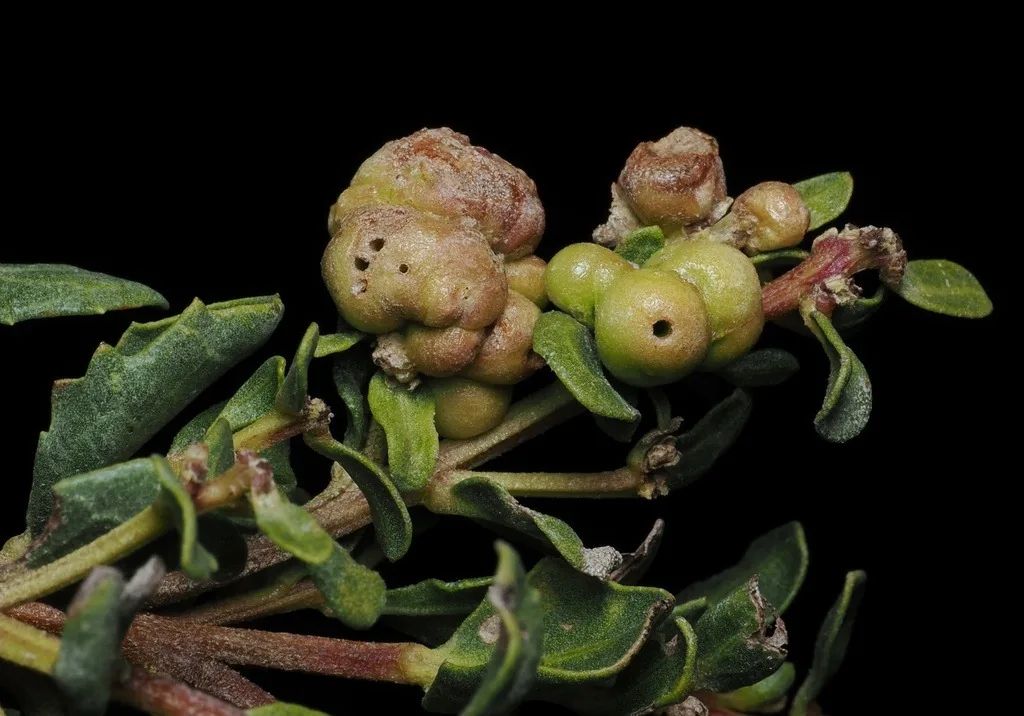
- The galls are globular swellings at the shoot tips, usually green but sometimes pinkish or red; old galls turn brown and dry.[1]
- Each gall holds many small chambers, up to about 100, with one orangish maggot (up to 1/10 inch, 2.5 millimeters, long) in each.[1]
- After the adults emerge, white to translucent cast pupal skins stick out of many tiny holes on the gall.[1]
- Adults are delicate flies about 1/16 inch (1.5 millimeters) long with long, slender legs and antennae. Females full of eggs have a swollen orange to reddish abdomen; males and spent females are slender and gray to pale.[1]
Where it lives
It is known from coyote brush in California: UC IPM covers it for California landscapes, and field studies of it have been done in Marin County.[1][3]
Biology and life cycle
Females lay tiny reddish eggs on actively growing shoot tips. The larvae chew in between the bud scales, and the tissue around them swells into a gall.[1]
The larvae pupate inside the gall. Just before emerging, the pupa chews a hole and pushes partly out, and the adult leaves its skin behind on the gall. Adults live about two days or less.[1]
Females do not mature new eggs as adults; a California study found they lay on average about 83 percent of the eggs they carry, and most run out of time before they run out of eggs.[2]
A generation takes about a month in warm weather, and there are several generations a year; where winters are mild, development continues year-round. Galls establish best in late winter and early spring, when coyote brush is actively growing.[1][3]
Damage and signs
- Galled shoots stop growing longer, which can make the plant look bushy. Green galls are easy to overlook among the foliage, and the midge does not threaten the survival of coyote brush.[1]
Health risk
It lives only in coyote brush galls; UC IPM describes no harm to people.[1]
Control
Prevention
No control is needed or recommended, and there are no known direct control options. The galls do not endanger the plant.[1]
Biological control
Many species of parasitic wasps attack the larvae in the galls.[1]
Common questions
- What are the round balls on the tips of my coyote brush?
- They are most likely galls of the coyote brush bud gall midge. Each one is packed with small chambers, each holding one orange larva.[1]
- Should I cut off coyote brush galls?
- There is no need. UC IPM recommends no control because the galls do not threaten the plant's survival, and parasitic wasps attack the larvae.[1]
Sources
- University of California Statewide IPM Program, “Baccharis Gall Fly (Home and Landscape).” ipm.ucanr.edu/PMG/GARDEN/PLANTS/INVERT/baccharisgallfly.html (accessed 2026-11-09)
- The American Naturalist (via NCBI PubMed), “Time limitation, egg limitation, the cost of oviposition, and lifetime reproduction by an insect in nature (J. A. Rosenheim et al.; The American Naturalist 172(4), 2008; abstract).” pubmed.ncbi.nlm.nih.gov/18793093/ (accessed 2026-11-09)
- Environmental Entomology (via NCBI PubMed), “Effect of microenvironment on development of a gall midge (Environmental Entomology 36(2), 2007; abstract).” pubmed.ncbi.nlm.nih.gov/17445380/ (accessed 2026-11-09)
- iNaturalist, “Rhopalomyia californica taxon page (order and family).” www.inaturalist.org/taxa/55698 (accessed 2026-11-09)