On this page
How to identify it
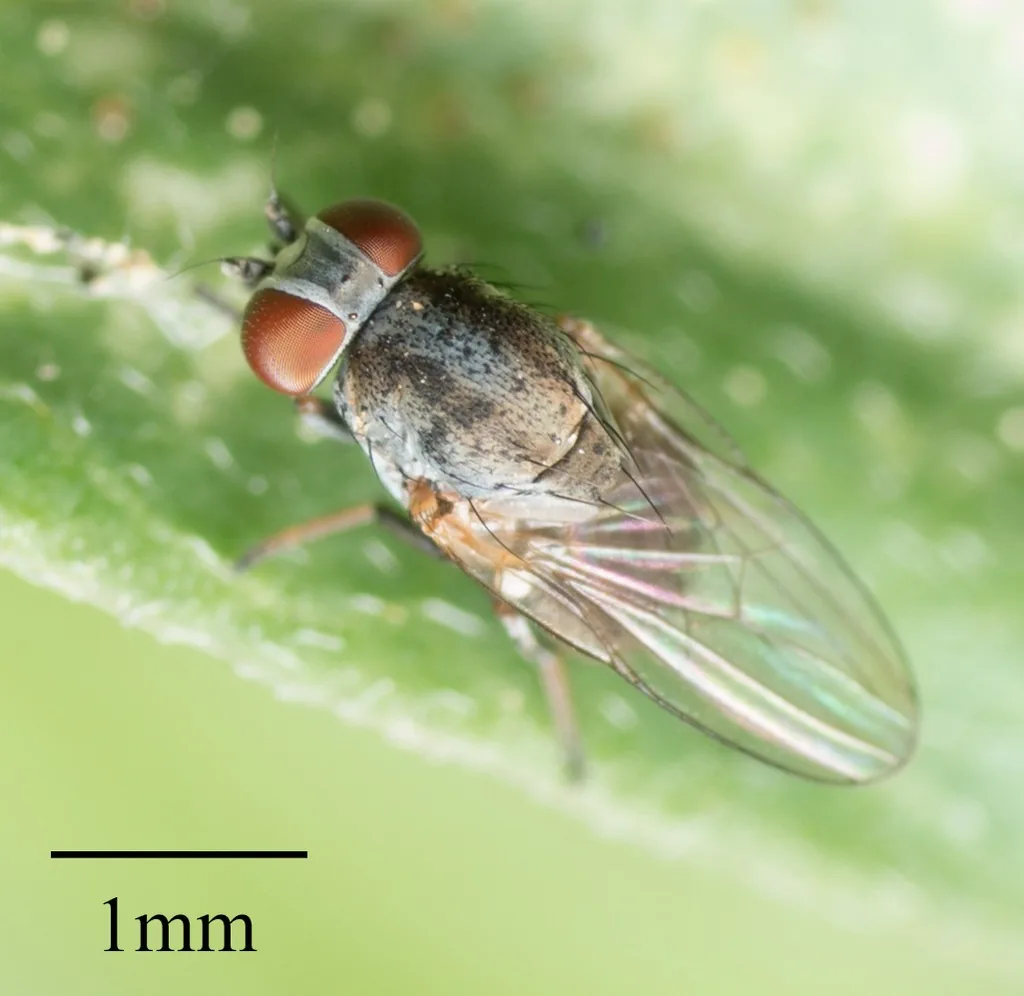
- Adults are stocky flies only 1 to 4 millimeters (1/25 to 1/8 inch) long, with prominent eyes and a head as wide as or wider than the thorax. They are called silver flies because many are grayish to silver, often with a powdery whitish coating on the body; some have dark stripes on the thorax or dark spots or bands on the abdomen, and a few are mostly brown or shiny black.[1]
- Larvae are small, segmented maggots with a wrinkly skin, usually yellowish or whitish, 5 millimeters (1/5 inch) or less long, with a rounded rear end bearing two widely spaced breathing tubes. Some are brownish, greenish, coated in grayish wax or tinted by the prey showing through the skin.[1]
- They pupate inside a hardened brown or orangish case (a puparium) up to 4 millimeters long, with two small projections at the rear, stuck to the plant near where the larva fed. Eggs are oval, whitish and no more than 0.5 millimeter long.[1]
- Silver fly larvae feeding on hemlock woolly adelgid give off a black substance when disturbed. It contains compounds the larvae take up from the adelgids, which act as feeding deterrents in other insects.[7]
Look-alikes
| Look-alike | How to tell them apart |
|---|---|
| Aphid midge larvae | Predatory midge larvae also feed in aphid colonies. Aphid fly larvae that feed in the open are told apart by the two widely separated breathing tubes on the rear end and six to eight pairs of fleshy legs (prolegs) under the abdomen.[1] |
| Hover fly larvae | Hover fly (syrphid) larvae also hunt aphids and often occur alongside aphid fly larvae; the same rear breathing tubes and prolegs separate aphid fly larvae.[1] |
Where it lives
More than 330 species are known worldwide, including Leucopis and related genera in California. The silver fly Leucotaraxis argenticollis occurs across the Northern Hemisphere, while L. piniperda and the other Leucotaraxis species are North American; the two hemlock woolly adelgid predators are native to the Pacific Northwest.[1][3][7]
Biology and life cycle
Larvae prey on adelgids, aphids, mealybugs, phylloxera, scales and related sap-feeding insects, but not whiteflies. Many species specialize on one kind of prey, such as aphids or adelgids.[1]
Females lay single eggs near prey colonies. Larvae pass through three stages and then pupate. There are one to several generations a year, and they spend the winter as inactive mature larvae or pupae in sheltered spots.[1]
Adults rarely visit flowers. They feed on honeydew, either from leaves or straight from the prey: they stroke an aphid's back until it releases a droplet, the same way ants milk aphids. The slow-moving larvae are usually ignored by ants tending aphids.[1]
Leucotaraxis silver flies feed on adelgids on conifers. In the West, a lineage of L. argenticollis is abundant on hemlock woolly adelgid, while a genetically distinct eastern lineage feeds mostly on pine adelgids.[3][6]
In their native western range, silver flies are attacked by small parasitic wasps that emerge from the fly puparia.[8]
Damage and signs
- Aphid flies do no damage. Their larvae eat plant-feeding insects, and UC IPM says they are believed to be important biological control agents of certain adelgids, aphids and phylloxera.[1]
Health risk
The sources describe aphid flies only as predators of plant-feeding insects; they mention no bites, stings or other harm to people.[1]
Control
Prevention
No control is needed. Aphid flies are beneficial predators believed to be important in keeping certain adelgids, aphids and phylloxera in check, so leave them alone.[1]
Biological control
Two silver fly species were studied for safety and permitted by the USDA for release against hemlock woolly adelgid in the East, where Laricobius beetles alone have not been enough. Flies were recovered in Virginia in 2022 and 2023 near earlier release sites, and L. argenticollis has reproduced in the wild in New York, although researchers report that establishment has not yet been confirmed.[2][5][7][6]
Common questions
- What are silver flies, and why are they released on hemlocks?
- Silver flies are Leucotaraxis aphid flies from the Pacific Northwest whose larvae eat hemlock woolly adelgid. They have been approved for release in the eastern United States to add to the predatory beetles already released against the adelgid.[4][2]
- Are aphid flies harmful to my garden?
- No. Their larvae eat aphids, adelgids, mealybugs and scales, and UC IPM considers them likely important biological control agents.[1]
Sources
- University of California Statewide IPM Program, “Natural Enemies Gallery: Aphid Flies.” ipm.ucanr.edu/natural-enemies/aphid-flies/ (accessed 2026-11-09)
- USDA Forest Service, “Predatory flies offer new hope for hemlock forests (November 3, 2023).” www.fs.usda.gov/inside-fs/delivering-mission/sustain/predatory-flies-offer-new-hope-hemlock-forests (accessed 2026-11-09)
- Zootaxa (via NCBI PubMed), “A new genus of Chamaemyiidae (Diptera: Lauxanioidea) predaceous on Adelgidae (S. D. Gaimari and N. P. Havill; Zootaxa 5067(1): 1-39, 2021; abstract).” pubmed.ncbi.nlm.nih.gov/34810763/ (accessed 2026-11-09)
- Journal of Insect Science (via NCBI PubMed), “Methods for collecting and rearing three sympatric biocontrol agents of Adelges tsugae in eastern North America (E. M. D'Auria et al.; Journal of Insect Science 25(6), 2025; abstract).” pubmed.ncbi.nlm.nih.gov/41414962/ (accessed 2026-11-09)
- Environmental Entomology (via NCBI PubMed), “Establishment and postrelease recovery of Laricobius nigrinus and Laricobius osakensis in the Northeastern United States (R. S. Crandall et al.; Environmental Entomology 52(5): 769-778, 2023; abstract).” pubmed.ncbi.nlm.nih.gov/37494455/ (accessed 2026-11-09)
- Journal of Insect Science (via NCBI PubMed), “Eastern and western lineages of Leucotaraxis argenticollis are capable of hybridization in the laboratory (T. D. Bittner et al.; Journal of Insect Science 25(2), 2025; abstract).” pubmed.ncbi.nlm.nih.gov/40192294/ (accessed 2026-11-09)
- Naturwissenschaften (via NCBI PubMed), “Potential feeding deterrents of Adelges tsugae found in biological control flies (O. Andrews et al.; Naturwissenschaften 112(3): 45, 2025; abstract).” pubmed.ncbi.nlm.nih.gov/40455269/ (accessed 2026-11-09)
- Environmental Entomology (via NCBI PubMed), “Hymenopteran parasitoids of Leucotaraxis argenticollis and Leucotaraxis piniperda (S. L. Celis et al.; Environmental Entomology 51(5): 901-909, 2022; abstract).” pubmed.ncbi.nlm.nih.gov/35951040/ (accessed 2026-11-09)
- iNaturalist, “Chamaemyiidae taxon page (order and family).” www.inaturalist.org/taxa/203272 (accessed 2026-11-09)