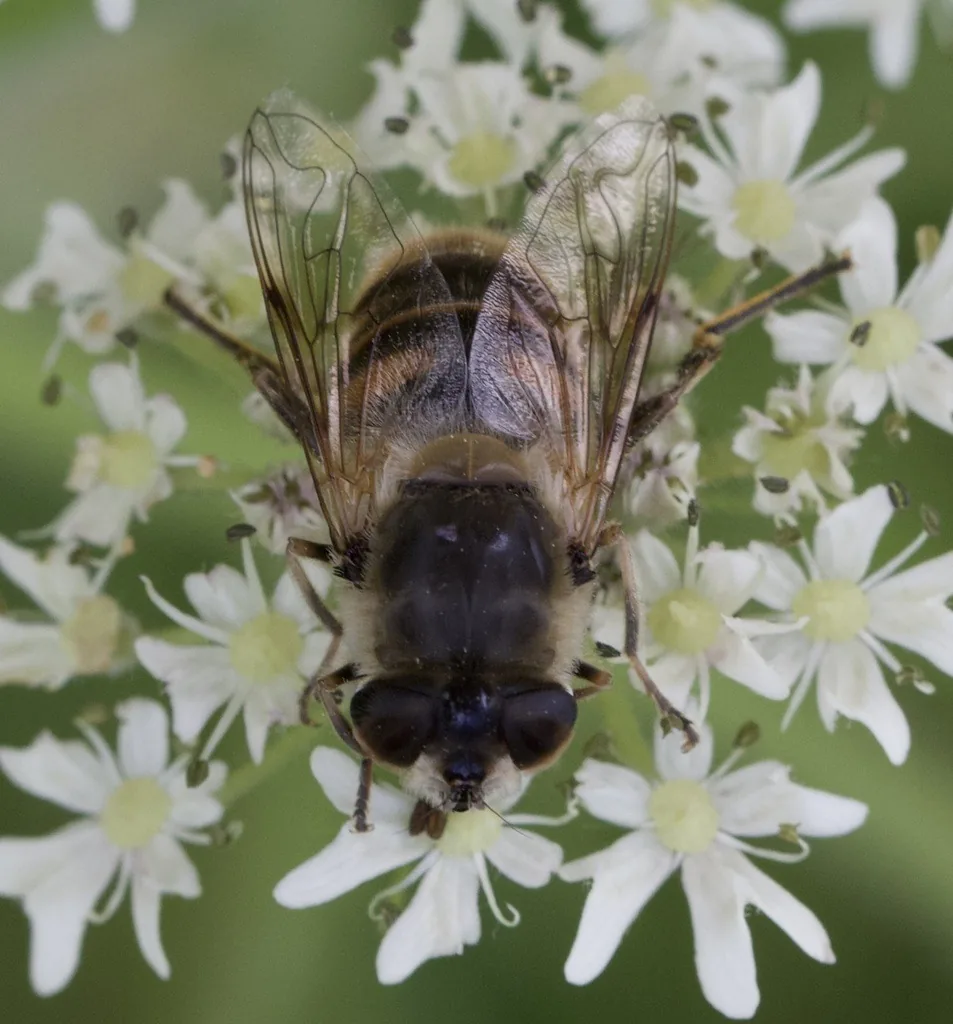
How to identify it
- Adults are 1/8 to 1 inch long; many are black with orange, yellow or white bands or stripes, like bees or wasps.[1]
- They have one pair of wings, while bees and wasps have two pairs.[1][2]
- Large eyes and a broad head about as wide as the abdomen; they hover in place and dart suddenly in new directions.[1][3]
- The drone fly is hairy, stout and black and brown, and is named for its resemblance to male honey bees.[1]
- Predatory larvae are legless, maggot- or sluglike, tapered toward the head, and green, yellow, brown or whitish.[1][2]
Look-alikes
Where it lives
Hover flies are common in gardens, crops and landscapes; species live in habitats from freshwater to forests and deserts.[3][1]
Biology and life cycle
Females lay small white eggs, often singly, near aphid colonies or other food for the larvae.[1][2]
Aphid-feeding species develop from egg to adult in about 2 to 4 weeks in summer and can have 5 to 7 generations a year.[1]
Most overwinter as larvae or pupae in leaf litter, soil or brush, though some overwinter as adults.[1][2][3]
Adults feed on nectar, pollen and honeydew, and some species carry pollen on specialized hairs like bees.[2][3]
Drone fly larvae live in water or wet decaying matter and are called rat-tailed maggots for their long breathing tube.[1]
Damage and signs
Health risk
Hover flies don't bite or sting. Those that land on people outdoors are just seeking moisture or salts from skin.[3][2]
Control
Prevention
No control is needed; hover flies are beneficial pollinators and aphid predators.[3][2]
Hover flies avoid flying in wind, so windbreaks give them shelter near the garden.[2]
Biological control
Plant flowers that bloom through the season; small white compound flowers, sweet alyssum, dill, coriander and Queen Anne's lace attract adults.[2][4]
Tolerate some aphids in the garden, since larvae need prey; a single larva can eat hundreds of aphids as it develops.[2][3]
Limit insecticides. Hover fly larvae are highly susceptible, so skip sprays when aphids are below damaging levels and syrphid larvae are feeding on them.[3][2]
Common questions
- Why is a bee-like fly hovering around me while I work outside?
- It is probably a hover fly seeking moisture or salt from your skin. It can't sting or bite.[3]
- How can I tell a hover fly from a bee?
- Look at the wings: flies have a single pair, while bees and wasps have two. Hover flies also hover in place and change direction abruptly.[1][2][3]
- What are the sluglike green larvae among my aphids?
- They are likely hover fly larvae hunting the aphids. Leave them be; each can eat 100 to 400 aphids.[2][4]
Sources
- University of California Statewide IPM Program, “Syrphids (Flower Flies, or Hover Flies) (Natural Enemies Gallery).” ipm.ucanr.edu/natural-enemies/syrphids/ (accessed 2026-10-06)
- University of Minnesota Extension, “Syrphid Flies (reviewed 2026).” extension.umn.edu/beneficial-insects/syrphid-flies (accessed 2026-10-06)
- University of Kentucky Entomology Extension, “Syrphid Flies: Overlooked Pollinating Insects, ENTFACT-710 (May 2023).” entomology.ca.uky.edu/files/ef710.pdf (accessed 2026-10-06)
- University of Wisconsin-Madison Extension, “Hover, Flower or Syrphid Flies, Syrphidae (revised February 2025).” hort.extension.wisc.edu/articles/hover-flower-or-syrphid-flies-syrphidae/ (accessed 2026-10-06)
- iNaturalist, “Eristalis tenax taxon page (order and family).” www.inaturalist.org/taxa/55719 (accessed 2026-10-06)