How to identify it
- Adults are delicate, mosquito-like flies about 2 to 3 mm long, with long legs and long antennae curled back over the body at rest.[1][2]
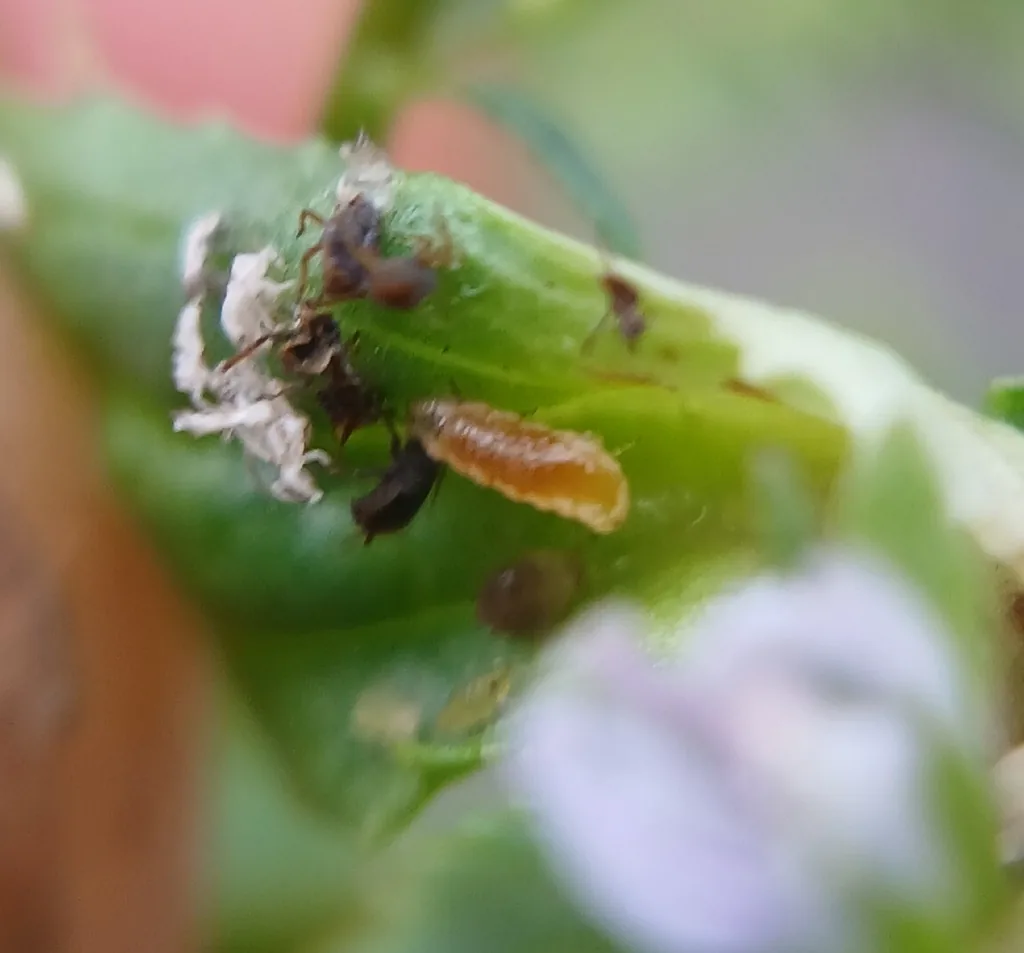
- Larvae are orange, red or yellowish maggots up to about 1/8 inch long that taper toward the head.[1][2]
- Eggs are tiny, oval and orange, laid among aphids.[1][2]
- Aphids killed by the larvae shrivel into blackened, collapsed skins left attached to the leaf.[2][1]
Look-alikes
| Look-alike | How to tell them apart |
|---|---|
| Fungus gnats | Fungus gnat adults have a distinct Y-shaped vein near each wing tip; aphid midges have only a faint forked vein.[1] |
Where it lives
Native to much of North America and common on apple, pear, vegetables and ornamental shrubs, as well as in greenhouses.[2][1]
Biology and life cycle
Each female lays about 70 eggs during a life of one to two weeks, and eggs hatch in two to four days.[1][2]
Each larva eats about 3 to 50 aphids a day for roughly a week, then usually drops to the ground to pupate.[1]
Egg to adult takes about three weeks at 72°F, with up to six generations a year outdoors.[1]
They stop reproducing when days fall below about 16 hours and overwinter as larvae in cocoons in the soil.[1][2]
Adults are active from dusk to dawn, are rarely seen, and feed on honeydew.[1][2]
Damage and signs
- They don't feed on plants. A larva needs at least 7 aphids to finish developing but may eat 80, and it kills more than it eats.[2]
Health risk
Aphid midge adults take only liquids such as honeydew, and the larvae feed on aphids; neither UC IPM nor Cornell notes any health concern for people.[1][2]
Control
Prevention
Most sprays are toxic to aphid midges, and adults may be more susceptible than larvae.[2]
Biological control
Larvae need slightly moist soil to pupate, and adults do best with humidity and shelter from heat and strong wind.[2]
Aphidoletes aphidimyza is sold commercially, and mass releases adequately controlled aphids in small backyard garden trials.[1][2]
Common questions
- What are the tiny orange maggots among my aphids?
- They're likely aphid midge larvae. They grip an aphid's leg joint, paralyze it and suck out its contents.[1][2]
- Why do aphid midges fade out in late summer?
- Shortening days trigger a resting stage; they stop reproducing when daylength drops below about 16 hours.[1][2]
Sources
- University of California Statewide IPM Program, “Aphid Midge (Natural Enemies Gallery).” ipm.ucanr.edu/natural-enemies/aphid-midge/ (accessed 2026-10-06)
- Cornell University College of Agriculture and Life Sciences, “Biological Control: A Guide to Natural Enemies in North America: Aphidoletes aphidimyza (Aphid Midge).” biocontrol.entomology.cornell.edu/predators/Aphidoletes.php (accessed 2026-10-06)
- iNaturalist, “Aphidoletes aphidimyza taxon page (order and family).” www.inaturalist.org/taxa/410619 (accessed 2026-10-06)