How to identify it
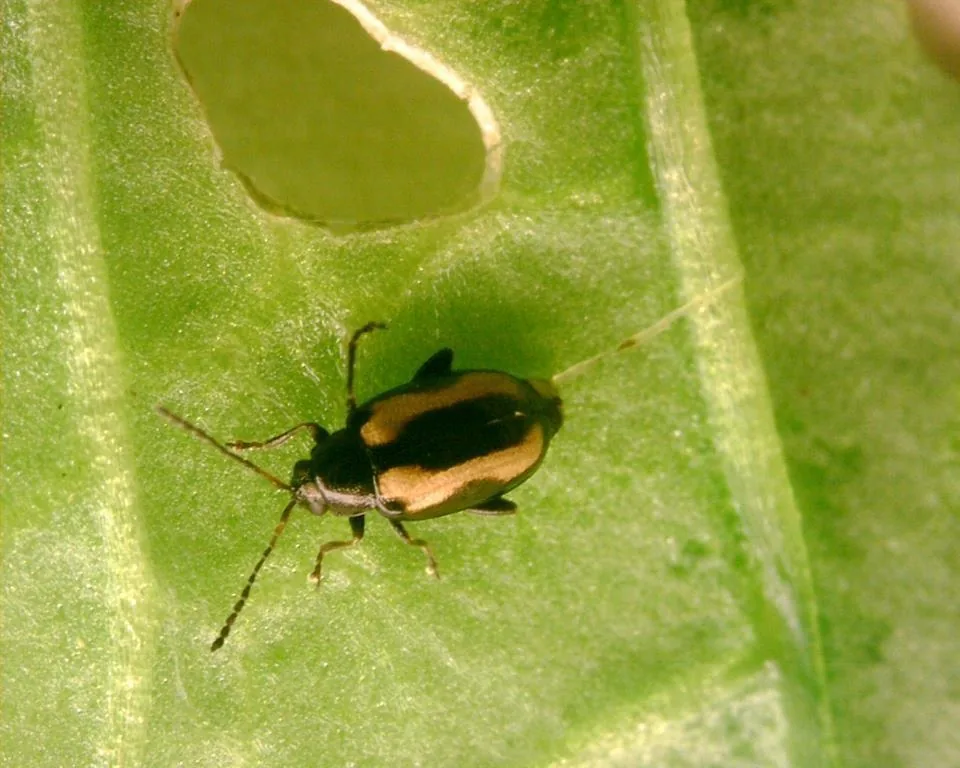
- Most adults are 1/16 to 1/8 inch long, colored black, bronze, bluish, brown or metallic gray, and some are striped.[2]
- Enlarged hind legs let them jump like fleas when disturbed.[1][2]
- Their feeding leaves small rounded holes, usually under 1/8 inch, and shallow pits, a pattern unique to flea beetles.[2]
- The striped flea beetle shown here is one of several common garden species; all flea beetles cause similar damage.[2]
Look-alikes
| Look-alike | How to tell them apart |
|---|---|
| Cucumber beetles | Much larger, about 1/4 inch, and yellowish with black spots or stripes, while most flea beetles are 1/8 inch or smaller.[3][2] |
Where it lives
Flea beetles are widespread; different species dominate in different regions, such as the crucifer and striped flea beetles in Minnesota and the tobacco and western potato flea beetles in the western United States.[2][1]
Biology and life cycle
Adults spend winter in leaf litter, weeds, hedgerows, windbreaks and woods, becoming active in early spring.[2][1]
Females lay eggs in soil, roots or leaves; the small white larvae feed mostly on roots, then pupate in the soil.[2][1]
There are usually one or two generations a year.[2][1]
Most species feed on a narrow range of plants, but the pale-striped flea beetle eats squash, beans, corn, lettuce, potatoes and many weeds.[2]
Damage and signs
- Adults do most of the harm by chewing leaves and stems; heavy feeding can wilt or stunt plants.[2]
- Seedlings started from seed tolerate damage less well than transplants; damage is rarely serious past the seedling stage.[2][1]
- Larvae seldom cause much damage, except potato flea beetle larvae, which tunnel into potato tubers and open them to rot.[2][1]
Health risk
Flea beetles are plant feeders; the harm they do is chewed seedling leaves and, for some species, tunnels in potato tubers.[2][1]
Control
Prevention
Watch seedlings as soon as they emerge; yellow or white sticky traps help detect adults.[2][1]
Plant a little later so seedlings grow quickly in warm weather, or plant an early trap crop such as radish to draw beetles away.[2]
Keep them out
Cover seedlings with row covers until about the sixth leaf stage; remove covers on crops that need bees before they flower.[1][2]
Sanitation
Control weeds and clear away crop debris in fall so fewer beetles find winter shelter.[2][1]
Pesticides
Treat seedlings when there are more than five beetles per plant; insecticides usually aren't needed by summer, once plants reach the 4- or 5-leaf stage.[2]
Garden insecticides with pyrethrins, spinosad, carbaryl, malathion or permethrin are labeled for flea beetles; check that your vegetable is on the label and observe the harvest interval.[2][1]
Common questions
- What is making tiny holes all over my seedlings?
- Many small, round holes and pits in young leaves, under 1/8 inch, are the classic sign of flea beetles.[2][1]
- Do I need to spray flea beetles all summer?
- Generally not. Flea beetles are most damaging in spring, and by summer plants are strong enough to outgrow the feeding.[2]
Sources
- University of California Statewide IPM Program, “Flea Beetles (Pest Notes, Home and Landscape).” ipm.ucanr.edu/home-and-landscape/flea-beetles/ (accessed 2026-10-06)
- University of Minnesota Extension, “Flea beetles (reviewed 2022).” extension.umn.edu/yard-and-garden-insects/flea-beetles (accessed 2026-10-06)
- University of California Statewide IPM Program, “Cucumber Beetles (Pest Notes, Home and Landscape).” ipm.ucanr.edu/home-and-landscape/cucumber-beetles/ (accessed 2026-10-06)
- iNaturalist, “Phyllotreta striolata taxon page (order and family).” www.inaturalist.org/taxa/228009 (accessed 2026-10-06)