On this page
How to identify it
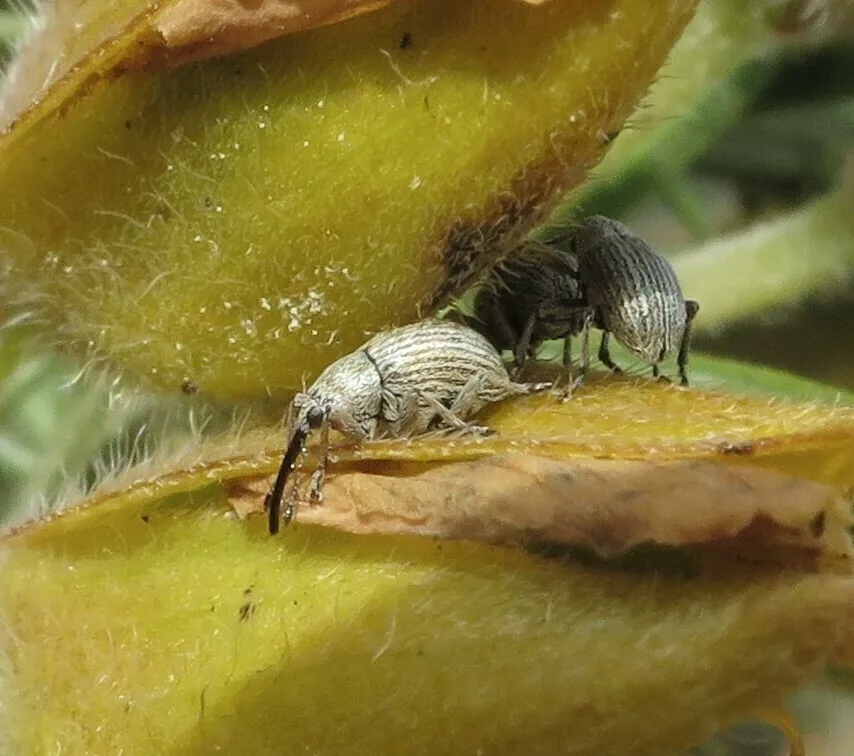
- Adults are gray, 2 to 3 mm long, with a very long, slightly curved snout and brownish gray legs; faint stripes sometimes show on the wing covers. Overwintered adults are easy to spot on gorse stems and flowers in early spring, and they are quick for their size, scurrying around the flowers on warm days.[1]
- Adult feeding leaves shot holes in the petals. The eggs are laid into young pods and cannot be seen in the field, but a brown pod opened before it splits shows the cream, brown-headed, C-shaped larvae, up to 3 mm, feeding partly inside and partly outside a seed.[1]
- Pupae are about 3 mm, cream turning dark gray with age, inside the pod.[1]
Look-alikes
| Look-alike | How to tell them apart |
|---|---|
| Scotch broom seed weevil (Exapion fuscirostre) | A sibling species released against Scotch broom, with the same long snout but brown bodies and silver side bands; look at which shrub the pod came from.[1] |
| Gorse spider mite (Tetranychus lintearius) | The other gorse agent approved in Oregon, a mite that feeds on the foliage and kills branches but rarely the whole shrub.[2] |
Where it lives
Native to Western Europe. A French population was released in California in 1953 and Oregon in 1956 and redistributed to Washington, establishing in all three states, where the weevil is now widespread and abundant on gorse. In Hawaii, releases from England in 1926 and 1949 failed, but stock from southern France in 1955 and England in 1956 established on Maui and Hawaii Island. It is not known to be present in Canada. It does best in open, sunny sites with dense gorse and is limited by cold winters, shade and scattered host plants.[1]
Biology and life cycle
On the mainland the overwintered adults emerge in late winter or early spring and feed on gorse flowers and foliage. Eggs go into the young pods, the larvae hatch from early to late spring and eat the developing seeds through three stages, and pupation is in the pod. New adults emerge in late summer but cannot chew their way out; they wait for the pod to dry and burst, then feed on spines and stems and overwinter among the gorse foliage. One generation a year.[1]
In Hawaii, where gorse grows on a different calendar, every stage comes earlier in the year and some adults are active year-round.[1]
Parasitism may limit weevil populations in some regions. In Hawaii, aggressive spraying and burning that destroyed the gorse also collapsed the weevil populations, which recovered only slowly.[1]
Damage and signs
- Adult feeding on flowers and foliage destroys some stem tissue without significantly harming the plant. Larval feeding reduces seed output, which does not kill any existing gorse but can slow the rate of spread.[1]
- Attack rates run from 30 to 95 percent of pods in the western United States, with a 2019 study at three Oregon sites finding 51 percent of seeds attacked, and in Hawaii up to 95 percent of pods in a year. Even so, the seed loss likely does not reduce established stand densities, the weevil cannot touch seed that matures in autumn or winter, and the overall efficacy of the agent is questionable because gorse produces so much seed and keeps it viable in the soil so long. Oregon State notes seed stays viable for 30 years and that neither the weevil nor the spider mite has been effective. In Hawaii the weevil's feeding may make plants more susceptible to a Colletotrichum fungus. No nontarget effects have been reported.[1][2]
Health risk
A seed-feeding weevil of gorse; neither source describes any risk to people.[1][2]
Control
Prevention
Oregon State treats gorse as a shrub that is very difficult to eradicate once established: it resprouts when cut, disturbance such as clearing, logging or fire triggers the buried seed, and the most effective control combines chemical, mechanical and biological methods, with equipment cleaned of seed before it moves to another site.[2]
Biological control
The weevil needs no control and no help; it is already widespread and abundant on western gorse and does best in open, sunny, dense infestations. Expect little from it in shade, cold-winter regions or scattered plants.[1]
Pesticides
Herbicides are part of Oregon State's recommended combination for gorse; on Oregon forest land a notification of operations must be filed before applying them.[2]
Common questions
- The weevils are all over my gorse. Will it die back?
- No. The sources say adult feeding does not significantly harm the plant and that seed loss, even at 95 percent of pods, has not reduced established stands; at best it slows the spread. Oregon State's judgment is that the weevil has not been effective for controlling gorse.[1][2]
- How do I check whether the weevil is in my gorse?
- Watch the flowers on a warm early-spring day for the fast little gray long-snouted weevils, then later in the season open pods that have turned brown but not yet split and look for the C-shaped larvae feeding half in and half out of a seed.[1]
- Can I collect them for Canada or another state?
- The weevil is not known to be present in Canada and is listed as approved in the USA only; it already occurs across the three western states where it was released.[1]
Sources
- North American Invasive Species Management Association (PDF hosted on Bugwood), “Andreas (Washington State University Extension), Price and Grevstad. Common Gorse Biocontrol Agents: History and Ecology in North America. In: Winston, ed., Biological Control of Weeds in North America, NAISMA-BCW-2022-12-GORSE-A (2022).” bugwoodcloud.org/resource/files/25362.pdf (accessed 2026-11-10)
- Oregon State University Extension Service, “Invasive Weeds in Forest Land: Gorse (Ulex europaeus). EC 1593-E (September 2008).” extension.oregonstate.edu/sites/default/files/documents/ec1593.pdf (accessed 2026-11-10)
- iNaturalist, “Exapion ulicis taxon page (order and family).” www.inaturalist.org/taxa/410464 (accessed 2026-11-10)