On this page
How to identify it
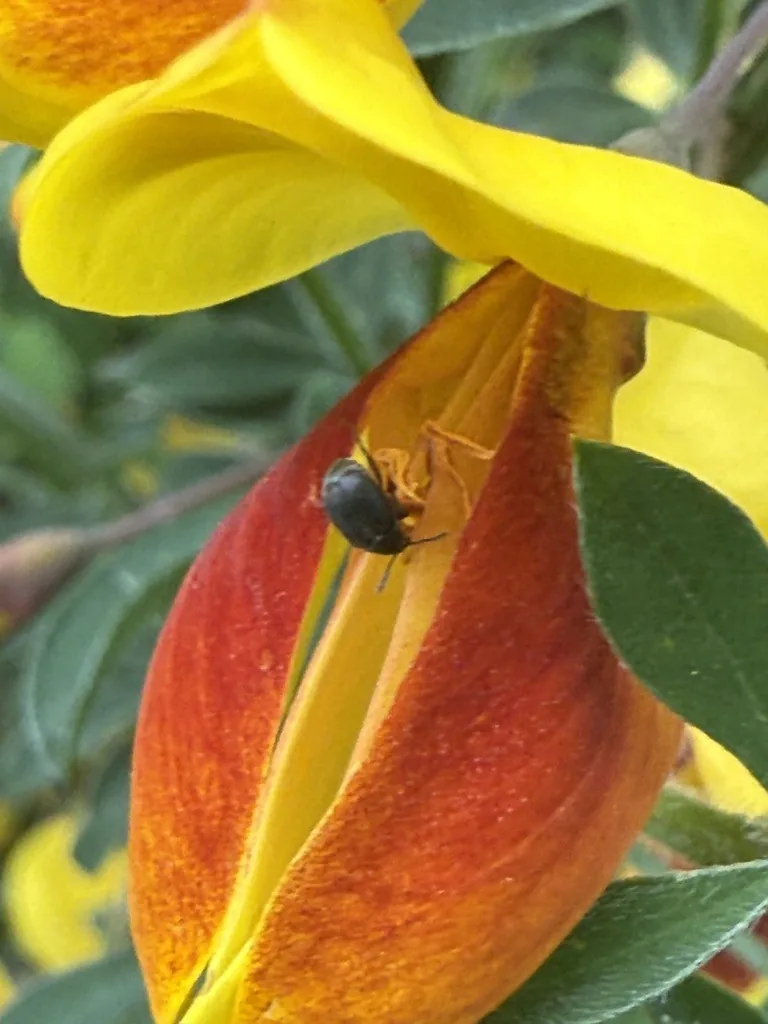
- Broom seed beetle adults are completely gray-black, oval to round, up to 2 mm (about 1/16 inch), with segmented antennae and a short snout and short wing covers. In spring they crowd onto broom flowers to feed on pollen, and their tiny, clear-to-white oval eggs are glued to the outside of the developing seed pods where they are easy to see.[1][2]
- Scotch broom seed weevil adults are narrow, brown-gray weevils of 1/16 to 3/32 inch with a long curved snout, light brown legs and two long, broken silver or tan bands running down the sides of the back. The long snout, color and shape separate them from the seed beetle at a glance. Their eggs are laid inside the pod and are not visible in the field.[1][2]
- Split a full-size pod that has turned brown but not yet opened. Seed weevil larvae feed half in and half out of the seed, so the damaged seed and the larva or pupa are obvious. Seed beetle larvae feed entirely inside the seed, which just looks mottled; press a fingernail through the seed and an attacked one gives way and exudes a milky juice as the larva is crushed. Both species are often in the same pod. Seeds the beetle has left show round emergence holes.[1][2]
- In spring, shaking flowering plants over a white sheet dislodges the adults, along with many other insects that live on broom.[2]
Look-alikes
| Look-alike | How to tell them apart |
|---|---|
| Scotch broom twig miner (Leucoptera spartifoliella) | A third approved Scotch broom agent, a 3 to 5 mm white moth seldom seen as an adult, whose translucent green-brown larvae tunnel in young shoots rather than seeds.[1] |
| Gorse seed weevil (Exapion ulicis) | A close relative released against gorse; the Scotch broom seed weevil is the one on broom pods.[1] |
Where it lives
The seed beetle, native to Europe, reached North America unintentionally, was first reported on Scotch broom in Massachusetts in 1918 and spread along the east coast; from 1998 it was moved from North Carolina to Oregon and Washington, spread to French broom in Oregon by 2001 and California by 2014, and was found in British Columbia in 2000 and Nova Scotia in 2003. It is now widespread on Scotch broom in the southeastern United States and western North America. The seed weevil, also European, was released in California in 1964, redistributed to Oregon from 1983, Washington from 1989 and Idaho in 2007, and spread into British Columbia by 2006; it is moderately abundant in the western United States and less so in Canada. Neither is officially approved in Canada.[1]
Biology and life cycle
The seed beetle's overwintered adults emerge as broom begins to flower and feed on pollen, which helps their ovaries mature. Eggs go singly on the outside of the pod; the newly hatched larva bores through the pod wall, sometimes leaving a visible tunnel, and into a seed, where the last three larval stages and the pupa are spent entirely inside the seed coat. New adults emerge in late summer but cannot chew out of the pod; they wait for it to dry and burst open, then overwinter away from the plant. One generation a year.[1]
The seed weevil's adults emerge in early spring and feed on stems and flowers, and the females must feed on broom flowers to produce eggs. The eggs are laid inside the pod, the larvae eat the developing seeds, and late-stage feeding breaks the seed coat and can spread to the neighbouring seed, so one larva sometimes destroys two. New adults are released when the pods split, overwinter in soil litter, and often stay active year-round, so generations can overlap.[1]
Both do best in meadows and on south-facing hillsides and poorly at heavily shaded, cold, high-elevation sites; the beetle also struggles on the coast and the weevil where ocean spray keeps things damp. Parasitism is usually low, and the beetle is less affected by it than the weevil.[1]
Damage and signs
- One larva typically kills one seed, and a seed with a larva in it usually will not germinate. Neither insect kills an existing broom plant; the seed weevil's adults cause some terminal shoot dieback, and the Washington Noxious Weed Control Board calls their adult damage insignificant. The point is the seed bank: fewer viable seeds slow the spread, and as old plants die the lack of recruits can reduce broom in the long run.[1][2][3]
- The numbers are getting large. Across 75 western sites surveyed from 2014, the seed beetle alone attacked an average of 59 percent of seeds in British Columbia, 44 percent in Washington and 41 percent in Oregon but under 1 percent in California, and attack rose by 10 to 37 points where the weevil was also present. In 2019 ten inland western Washington populations averaged 79 percent seed attack, and since 2012 seed reduction has exceeded 70 percent at 26 Washington sites, many above 80. The weevil alone attacks 10 to 37 percent across the West and often more than half in California, but it is out-competed wherever the beetle is present and is unlikely on its own to reduce broom density. Whether even the combined attack will reduce stands remains to be seen.[1]
- No nontarget effects have been reported for either, though studies continue on whether the seed beetle attacks the native tree lupine (Lupinus arboreus).[1]
Health risk
Seed-feeding beetles of broom; none of these sources describes any risk to people.[1][2]
Control
Prevention
Site matters: expect the best attack rates in open meadows and on south-facing slopes, and little from cold, shaded, high or coastal sites. Both insects are already widespread in the Northwest; the beetle is the dominant one at most Washington sites.[1]
Biological control
These beetles are the control, and WSU says they belong in a long-term program on large sites where mowing, pulling and herbicides are not being used on the same plants at the same time, since they do nothing to the stand already growing. Interstate movement of biocontrol agents goes through a USDA APHIS PPQ 526 permit.[2]
Pesticides
Where the standing shrubs must go, the Washington Noxious Weed Control Board lists foliar sprays, basal bark treatment and cutting stems and painting the fresh cut with herbicide as effective; it refers readers to the PNW Weed Management Handbook for products.[3]
Common questions
- How do I know if the seed beetles are in my broom?
- In spring shake flowering plants over a white sheet and look for the 2 mm gray-black beetles and the slender banded weevils, or find the beetle's clear eggs glued to the pods. When the pods have turned brown, split them: weevil damage is obvious, and a seed that crushes under a fingernail with a milky ooze holds a seed beetle larva.[2][1]
- Will they get rid of my Scotch broom?
- Not the plants you have now; neither insect harms an established shrub. They cut the seed that would replace those plants, by more than 70 percent at many Washington sites, so the payoff comes as old plants die and the seed bank runs down.[2][1]
- Why are the beetles doing so little in California?
- The 2014 survey found the seed beetle attacking under 1 percent of seeds in California against 40 to 60 percent further north, though it is increasing on French broom there; the weevil, released in California in 1964, often attacks more than half the seeds at California sites.[1]
Sources
- North American Invasive Species Management Association (PDF hosted on Bugwood), “Andreas (Washington State University Extension), Pitcairn (California Department of Food and Agriculture) and Pratt (USDA ARS). Scotch Broom Biocontrol Agents: History and Ecology in North America. In: Winston, ed., Biological Control of Weeds in North America, NAISMA-BCW-2022-7-SCOTCH BROOM-A (2022).” bugwoodcloud.org/resource/files/25363.pdf (accessed 2026-11-10)
- Washington State University Extension, “Andreas. Biological Control of Scotch Broom. Pest Watch FS203E (2016).” wpcdn.web.wsu.edu/wp-ecommerce/uploads/sites/2/product-3970-sku-FS203E.pdf (accessed 2026-11-10)
- Washington State Noxious Weed Control Board, “Scotch broom (Cytisus scoparius).” www.nwcb.wa.gov/weeds/scotch-broom (accessed 2026-11-10)
- iNaturalist, “Bruchidius villosus taxon page (order and family).” www.inaturalist.org/taxa/386880 (accessed 2026-11-10)