On this page
How to identify it
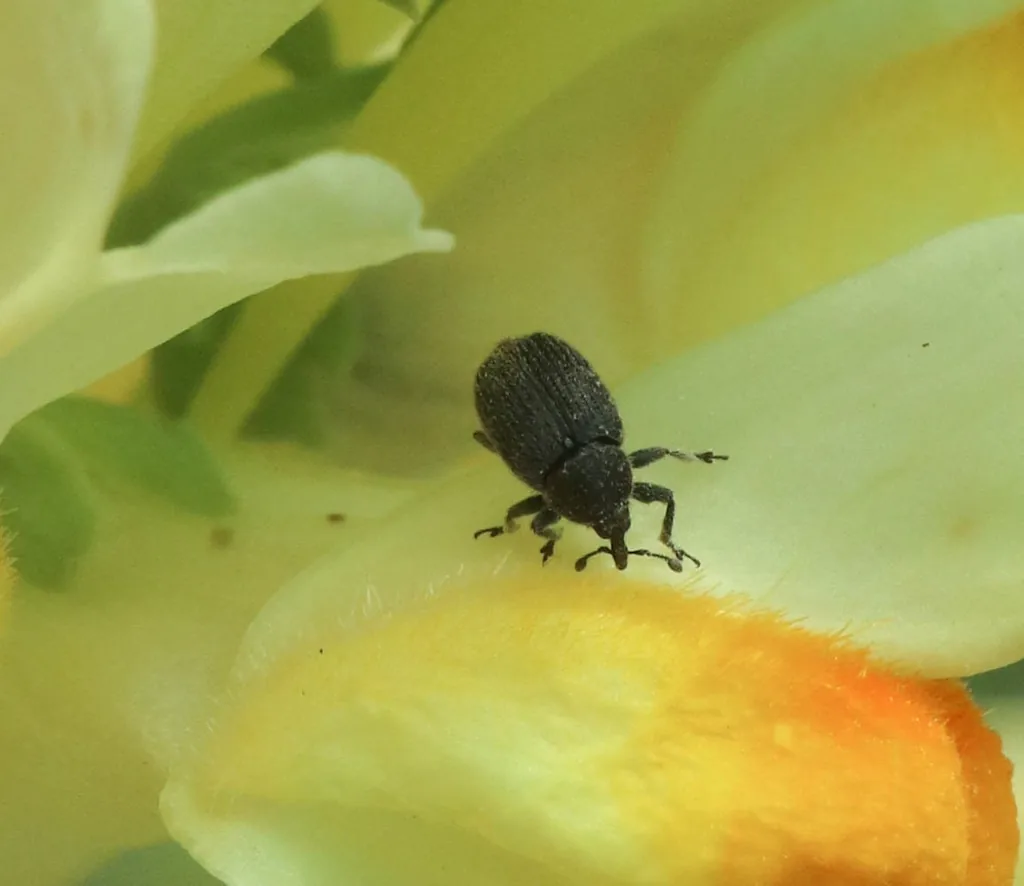
- All four are small, wide-bodied, hairy weevils with a long, distinctly curved and pointed snout and elbowed antennae. The seed-galling pair are gray to black with dense short hairs; adults taken from yellow toadflax (most likely R. antirrhini) are 2.5 to 3 mm long, while those from Dalmatian toadflax (most likely R. dieckmanni) reach 5 mm. R. linariae is black, up to 2.5 mm, with the same short dense hair. R. pilosa is black with longer upright hairs and a curved, hook-nosed profile; the NAISMA review gives 4.3 to 5.5 mm and the APHIS assessment 3.2 to 4.3 mm.[1][2]
- The galls identify the species better than the adults do. Seed-gallers leave large, swollen capsules in which the 8 to 17 seeds nearest the egg have grown up to ten times normal size and turned watery pale yellow. R. linariae leaves galls on the roots and root crown, 20 to 100 per plant in European studies, with neighbouring galls fusing into complexes of up to 40. R. pilosa makes a conspicuous green, globular to oblong gall between the middle and tip of a yellow toadflax stem, on average about 9 mm wide and 19 mm long, usually holding several larvae.[1][2]
- Larvae are C-shaped, creamy white to creamy yellow grubs with brown heads, up to 4 mm long, and live entirely inside the gall, so a capsule, root or stem must be cut open to see them. Pupae of the seed-gallers are dark gray, about 2.5 mm, with two tiny horns on top of the thorax.[1]
- A fifth species, R. neta, reached North America unintentionally, is not approved for release in the United States, and also feeds in toadflax seeds. Its adults are lighter gray to brown with a blunter, only slightly curved snout, 3 mm or less, and its pupae carry small bumps rather than pronounced horns.[1]
Look-alikes
| Look-alike | How to tell them apart |
|---|---|
| Toadflax stem weevils (Mecinus janthiniformis and M. janthinus) | Elongated bluish-black weevils that mine the stems rather than galling them; Mecinus adults have more elongated bodies than the rounder Rhinusa species.[1] |
| Toadflax flower-feeding beetle (Brachypterolus pulicarius) | Another beetle established on toadflaxes in North America, but it has no snout at all, unlike the long-snouted Mecinus and Rhinusa weevils. Where it competes with the seed-galling weevils, the two do not add up to greater seed loss.[1] |
Where it lives
R. antirrhini is native to Europe, Asia and the Mediterranean, was first documented on yellow toadflax in the eastern United States in 1909 and in eastern Canada by 1917, and has since spread naturally and by redistribution across the United States and Canada on both toadflaxes; it is most abundant on yellow toadflax and occurs in most yellow toadflax infestations. A strain from the former Yugoslavia released on Dalmatian toadflax in western Canada in 1993 and the western United States in 1996 is the likely source of R. dieckmanni, recently confirmed in southwestern Montana. R. linariae releases from German stock in the western United States failed; populations from central and southern Europe and southern Russia established on yellow toadflax in western Canada from 1996, and British Columbia weevils moved to the western United States in 2008 and 2015 have not been confirmed established. R. pilosa, from Serbia, was released in Canada from 2014, Montana from 2019, Oregon and South Dakota in 2021 and Idaho and Wyoming in late 2022.[1]
Biology and life cycle
The seed-gallers overwinter as adults in plant litter and emerge in late spring to feed on shoot tips, leaf buds and young leaves, switching to pollen and flower tissue as the toadflax blooms. A female lays 40 to 50 eggs singly inside flower ovaries. Egg laying raises a spur on the capsule that pushes the egg into the developing seeds and triggers the gall; the larva feeds on the enlarged seed tissue through three stages and pupates inside the capsule, and new adults emerge in late summer or early fall. There is one generation a year. R. antirrhini prefers yellow toadflax and R. dieckmanni Dalmatian toadflax; the two are so alike that R. dieckmanni was only recently confirmed as a separate species in North America and its life cycle has not been worked out.[1]
European R. antirrhini is not one uniform population. Sequencing of a mitochondrial and a nuclear gene, together with mating trials, found substantial genetic variation within the species that is best explained by specialisation on different Linaria host plants, with the host forms estimated to have begun separating in the mid-Pliocene, roughly 3.8 million years ago.[3]
R. linariae adults emerge in spring and feed on new shoots, then the females chew pockets into the roots and root crowns and lay single eggs that trigger root galls. Larvae feed on the galled tissue through three stages and pupate in the gall; new adults appear in mid to late summer, feed briefly on stems and overwinter in soil or litter, though some stay inside the root galls until the following spring. One generation a year.[1]
R. pilosa overwinters as an adult and emerges in early spring, from March to May, with the burst of new shoots. Adults feed for three to five days before mating and begin laying about ten days later, in April and May, dispersing among toadflax patches as they go. Each egg goes into an actively growing stem tip, and the gall is complete 8 to 10 days later, when the first larva hatches. Larvae feed through three stages and pupate inside the gall; new adults stay in it another 10 to 15 days eating the remaining gall tissue before chewing out. Egg to emerging adult takes 55 to 65 days. The new adults feed on stems for about ten days, then hide in litter or soil cracks through the summer, feeding occasionally in the evening and at night, feed again on autumn regrowth and enter winter diapause in the soil or leaf litter.[2][1]
Galls are the plant's doing, provoked by the weevil. A week after R. pilosa egg laying, galls on yellow toadflax weighed three times as much as untreated stem tissue and had accumulated fructose, glucose, turanose and insoluble carbohydrates, evidence that the weevil reprograms the plant to stock the gall with food for its larvae. Because the galling is triggered by the fluid deposited at egg laying, a gall can form even when no egg was inserted, so not every gall contains a larva. Serbian studies averaged 2.4 adults per gall, with a record of 17.[4][1][2]
Damage and signs
- Adult feeding on foliage and flowers by the seed-gallers is insignificant. The larvae destroy seeds: galled seeds are not viable and the larva eats more within the capsule. On yellow toadflax, seed reductions of 85 to 90 percent have been reported in Washington, but reductions are usually much lower, and 30 to 40 percent attack rates in Oregon had minimal effect on plant density. Lower seed output does not kill established plants, though it can slow the rate of spread and reduce the genetic diversity of a stand. Widespread R. antirrhini has not given satisfactory control of yellow toadflax in Canada, and its impact on Dalmatian and hybrid toadflax has largely not been studied.[1]
- R. linariae root galls disrupt the movement of water and nutrients to and from the roots and may act as a sink that diverts root reserves to the larvae. Where the weevil is established in British Columbia its populations are high and its local impact heavy, but populations build slowly and are redistributed every two to four years.[1]
- R. pilosa stem galls divert the water and nutrients the plant needs for growth and reproduction, stunting the shoots and reducing seed output. It is too early after release to judge its overall abundance and impact; in 2022 it had overwintered and produced abundant galls at several Montana sites and early South Dakota results were encouraging.[1]
- No nontarget effects have been reported for any of the four. Before R. pilosa was permitted, APHIS reviewed European field surveys of 20 Linaria species from 290 populations that found it reared only from yellow toadflax stem galls, and quarantine tests on 63 native North American plants in which only four accepted eggs and only one, Sairocarpus virga, produced any adults, three in total. No threatened or endangered North American plant belongs to the tribe the weevil could attack.[1][2]
Health risk
These are plant-feeding weevils and weed biological control agents; none of these sources describes any risk to people.[1][2]
Control
Prevention
Do not count on the seed-gallers alone: reduced seed set slows spread but leaves the plants alive, and where the flower-feeding beetle Brachypterolus pulicarius shares the stand the two insects do not add to each other's impact.[1]
Traps and physical control
To confirm the weevils, look for swollen, pale, watery seed capsules, root galls on dug plants or green stem galls near the shoot tips, and split them open to find the C-shaped grubs. Adults can be seen on shoots, leaves and flowers through the growing season.[1]
Biological control
No control is wanted; the weevils are working on your behalf. R. antirrhini is already in most yellow toadflax stands and spreads on its own. Field releases of R. pilosa in the United States are made under USDA APHIS permits, which is how the stem-galling weevil reached Montana, Oregon, South Dakota, Idaho and Wyoming.[1][2]
Common questions
- Why are the seed pods on my yellow toadflax swollen and pale?
- That is the seed-galling weevil R. antirrhini (or R. dieckmanni on Dalmatian toadflax). Its egg makes the nearest 8 to 17 seeds swell to ten times normal size and turn watery yellow, and none of those seeds will germinate.[1]
- Can I get the stem-galling weevil for my property?
- R. pilosa is approved for yellow toadflax in North America and has been released in Montana since 2019 and in Oregon, South Dakota, Idaho and Wyoming since 2021 and 2022 under USDA APHIS permits. Ask your state weed biocontrol program; it is still too soon after release to know how abundant it will become.[1][2]
- Do these weevils harm snapdragons or native plants?
- No nontarget effects have been reported. In the APHIS host tests only four of 63 native North American plants accepted R. pilosa eggs and only one produced any adults, and the native plants that formed galls raised no adults at all.[2][1]
Sources
- North American Invasive Species Management Association (PDF hosted on Bugwood), “Toadflax Biocontrol Agents: History and Ecology in North America. In: Winston, ed., Biological Control of Weeds in North America, NAISMA-BCW-2022-29-TOADFLAXES-A (2022).” bugwoodcloud.org/resource/files/27419.pdf (accessed 2026-11-10)
- USDA Animal and Plant Health Inspection Service, Plant Protection and Quarantine, “Field release of the stem gall weevil Rhinusa pilosa (Coleoptera: Curculionidae) for classical biological control of yellow toadflax (Linaria vulgaris) (Plantaginaceae) in the contiguous United States. Environmental Assessment, December 2017.” www.aphis.usda.gov/plant_health/ea/downloads/2017/rhinusa-pilosa-yellow-toadflax-biocontorl-ea-fonsi.pdf (accessed 2026-11-10)
- Molecular Ecology (Wiley), “Hernandez-Vera, Mitrovic, Jovic, Tosevski, Caldara, Gassmann and Emerson. Host-associated genetic differentiation in a seed parasitic weevil Rhinusa antirrhini (Coleoptera: Curculionidae) revealed by mitochondrial and nuclear sequence data. Molecular Ecology 19: 2286-2300 (2010), doi:10.1111/j.1365-294X.2010.04639.x.” doi.org/10.1111/j.1365-294X.2010.04639.x (accessed 2026-11-10)
- Plant Physiology and Biochemistry (Elsevier), “Zoric, Morina, Tosevski, Tosti, Jovic, Krstic and Veljovic-Jovanovic. Resource allocation in response to herbivory and gall formation in Linaria vulgaris. Plant Physiology and Biochemistry 135: 224-232 (2019), doi:10.1016/j.plaphy.2018.11.032.” doi.org/10.1016/j.plaphy.2018.11.032 (accessed 2026-11-10)
- iNaturalist, “Rhinusa antirrhini taxon page (order and family).” www.inaturalist.org/taxa/456055 (accessed 2026-11-10)