On this page
How to identify it
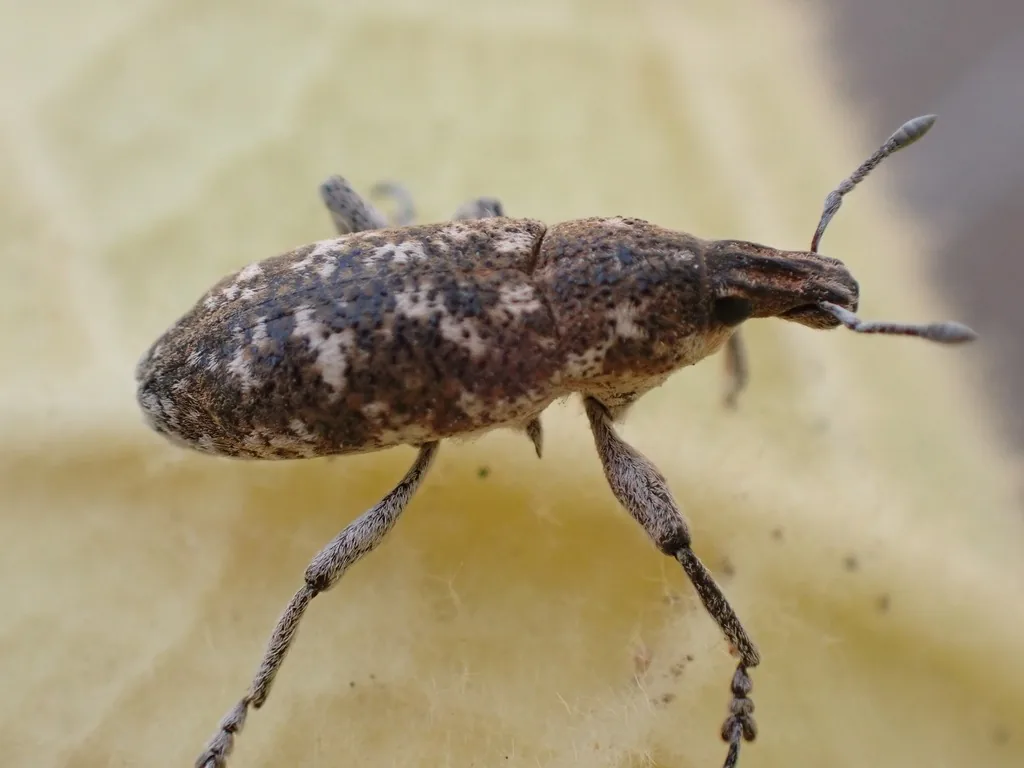
- Adults are large for a weevil, 13 to 15 mm long, mottled gray-brown and white, with a short, thick snout. Females have a rounded abdomen and males a flattened one.[1]
- Larvae are plump, C-shaped, creamy white or yellowish grubs with a large light brown head, up to 13 mm long, found only by digging up and cutting open knapweed roots. Older larvae often swell the root into a gall-like enlargement.[1]
- Eggs are under 2 mm, white or pale yellow and darkening as they develop, laid in notches chewed into the root crown just below the soil surface, where they are hard to find.[1]
- Look for adults on the tops of knapweed plants on hot, sunny days in late summer and early fall, when they climb up in search of mates; otherwise they stay on the root crown just below the surface.[1]
Look-alikes
| Look-alike | How to tell them apart |
|---|---|
| Other knapweed root feeders | The larvae of four other introduced agents feed in knapweed roots: the buprestid beetle Sphenoptera jugoslavica and the moths Agapeta zoegana, Pelochrista medullana and Pterolonche inspersa. Their adults look nothing like this stout, mottled weevil.[1] |
| Knapweed flower weevils (Larinus minutus and L. obtusus) | Much smaller, 4 to 5 mm, mottled brown weevils with a long bent snout that develop in the seed heads rather than the roots.[1] |
Where it lives
Native to Europe and the Mediterranean, the weevil was released on diffuse and spotted knapweed in western Canada from 1987 and the western United States from 1988, using stock from Austria, Hungary and Romania, and was later moved to spotted knapweed across other parts of the country. It is believed established on squarrose knapweed in Utah; a 1998 attempt on meadow knapweed failed. In Minnesota it is one of the two predominant knapweed biocontrol agents and is collected from established sites for release at new ones.[1][2]
Biology and life cycle
Adults emerge from late summer into early fall, chewing out of the root and crawling to the surface. They live 8 to 15 weeks, do not overwinter, and spend most of their lives on the root crown just below the ground, climbing the plants on hot sunny days to find mates.[1]
A female typically lays more than 100 eggs, each in a notch she cuts in the root crown. Larvae hatch in 10 to 12 days and mine toward the center of the root, passing through four stages; the third and fourth stages often cause the root to swell into a gall.[1]
Larvae overwinter in the roots. In western Montana almost all (94 percent) overwintered as first-stage larvae and a few as eggs, a less advanced stage than in their native range. Pupation takes about two weeks in the root in early summer. There is one generation a year.[1][4]
The weevil walks rather than flies to disperse, so it spreads best through continuous stands of knapweed. It prefers hot, dry sites with loose, well-drained, coarse soil and bare ground where grasses do not crowd the knapweed.[1]
Damage and signs
- Larval tunneling can kill small plants. Most damage comes when several larvae share a root, which cuts plant biomass and the density of knapweed stands; the tunnels also open the root to bacterial and fungal infection. Minnesota's program rates the root weevils highly effective because they weaken or kill existing plants.[1][2]
- Results vary by site. In some regions the weevil is credited with reducing knapweed longevity, seed output and density, while at other sites seed production did not change after heavy attack, and where mature plants thinned out, more seedlings came up and the population stayed the same.[1]
- A three-year Montana experiment found the weevil cut survival of adult spotted knapweed by about 9 percent, more so with normal rainfall and alongside bluebunch wheatgrass, but had no effect on seed production per plant or on seedling recruitment, and the extra deaths were offset by new adults so final densities did not differ.[3]
- No nontarget effects have been reported.[1]
Health risk
A plant-feeding weevil and a weed biological control agent; none of these sources describes any risk to people.[1][2]
Control
Prevention
Expect a long program: Minnesota considers many sites controlled, but large sites have taken up to a decade. Dense grass crowding the knapweed, and scattered patches the walking weevil cannot reach, work against it.[2][1]
Biological control
The weevil is the control. It works best in combination with the Larinus seedhead weevils, at sites with strong competing vegetation, under hot and dry conditions and in loose soil. Minnesota collects root weevils and seedhead weevils from established sites and releases them together at new ones.[1][2]
Common questions
- When can I see knapweed root weevils?
- On hot, sunny days in late summer and early fall, on the tops of the plants. The rest of the time the adults sit on the root crown just under the soil and the larvae are inside the roots.[1]
- Why hasn't the root weevil wiped out the knapweed?
- Knapweed compensates. Where the weevil kills mature plants, more seedlings recruit, so stand density often holds steady; the weevil works best paired with seedhead weevils that cut seed production, and at hot, dry, loose-soil sites with competing plants.[1][3]
- Does it attack other plants?
- Its hosts are spotted and diffuse knapweed and occasionally squarrose knapweed, and no nontarget effects have been reported.[1]
Sources
- North American Invasive Species Management Association (PDF hosted on Bugwood), “Knapweed Biocontrol Agents: History and Ecology in North America. In: Winston, ed., Biological Control of Weeds in North America, NAISMA-BCW-2023-34-KNAPWEEDS-A (2023).” bugwoodcloud.org/resource/files/27451.pdf (accessed 2026-11-10)
- Minnesota Department of Agriculture and Minnesota Department of Natural Resources, “Biological Control of Invasive Plants in Minnesota (Chandler, Skinner and Van Riper).” files.dnr.state.mn.us/natural_resources/invasives/biocontrolofplants.pdf (accessed 2026-11-10)
- Ecology (Ecological Society of America), “Ortega, Pearson, Waller, Sturdevant and Maron (USDA Forest Service Rocky Mountain Research Station). Population-level compensation impedes biological control of an invasive forb and indirect release of a native grass. Ecology (2012), doi:10.1890/11-0750.1.” doi.org/10.1890/11-0750.1 (accessed 2026-11-10)
- Environmental Entomology (Entomological Society of America), “Corn, Story and White (Montana State University). Comparison of larval development and overwintering stages of the spotted knapweed biological control agents Agapeta zoegana (Lepidoptera: Tortricidae) and Cyphocleonus achates (Coleoptera: Curculionidae) in Montana versus Eastern Europe. Environmental Entomology (2009), PMID 19689874.” pubmed.ncbi.nlm.nih.gov/19689874/ (accessed 2026-11-10)
- iNaturalist, “Cyphocleonus achates taxon page (order and family).” www.inaturalist.org/taxa/371992 (accessed 2026-11-10)