On this page
How to identify it
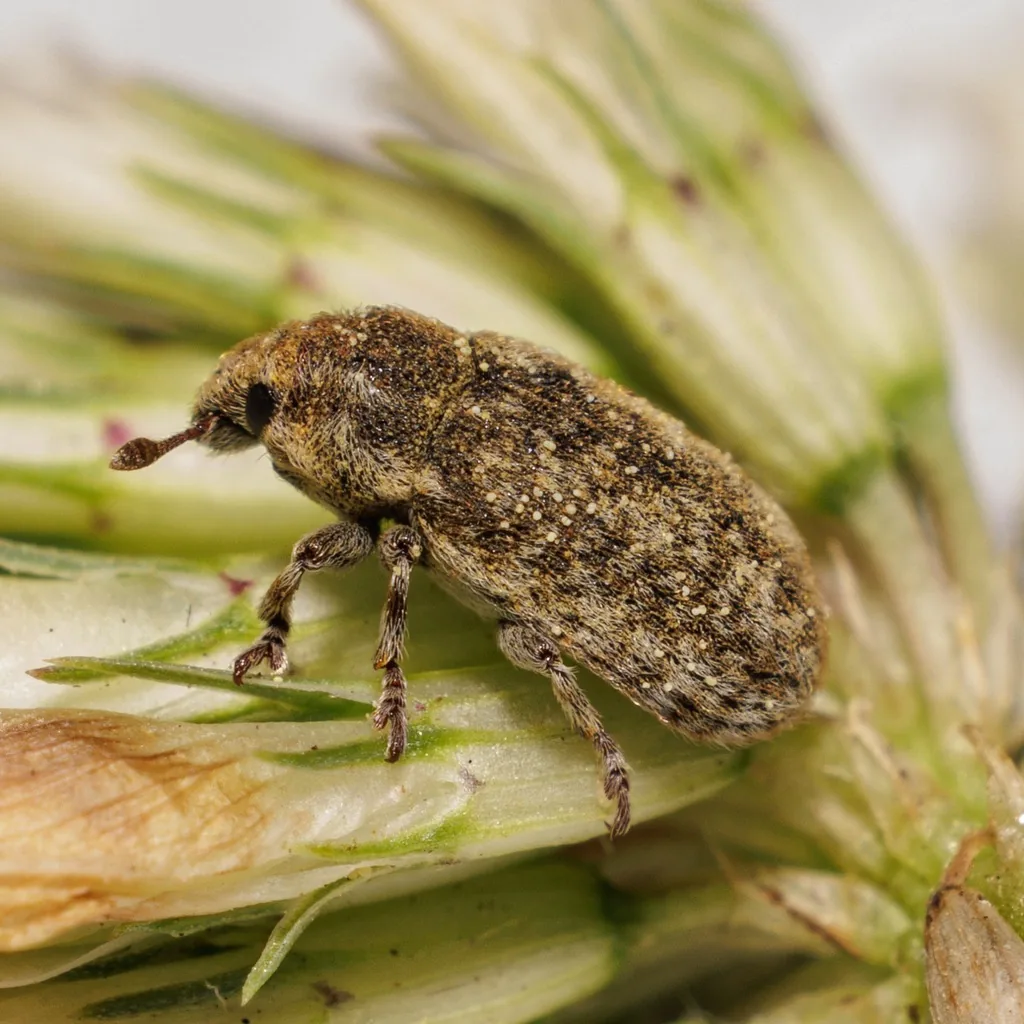
- Adults are small, 4 mm or less, mottled gray and brown, covered in short hairs, with a short snout. They are smaller than the Larinus knapweed weevils and the snout is much shorter and blunter. Look for them around knapweed flower buds in spring and early summer.[1][2]
- Eggs are yellow ovals laid singly on the underside of a leaflet or on the stem below a developing head, each covered with chewed plant tissue that forms a black cap; UC IPM describes the covering as a black excretion. The covered eggs are easy to see with the naked eye.[1][2]
- Larvae are white, brown-headed and C-shaped, up to 8 mm, and the pupae are white and up to 5 mm. Neither shows unless a seed head is pulled apart, and the larvae are not easily told from Larinus larvae in the same heads.[1]
Look-alikes
| Look-alike | How to tell them apart |
|---|---|
| Knapweed flower weevils (Larinus minutus and L. obtusus) | Larger seedhead weevils with much longer snouts whose larvae also eat knapweed seed; the two Larinus species are very hard to tell apart from each other.[1][2] |
| Knapweed root weevil (Cyphocleonus achates) | A much larger knapweed weevil whose larvae feed in the root, not the seed head.[1] |
| Knapweed seed head flies (Urophora spp.) and Terellia virens | Flies whose larvae feed in the heads and overwinter there as larvae, unlike the weevils, which leave the plant to overwinter as adults.[1][2] |
Where it lives
Native to southern Europe and the Mediterranean. Populations from Greece were released on diffuse knapweed in the western United States in 1990, then redistributed to spotted knapweed across the country from 1992 and to squarrose knapweed in the West from 1993; attempts to move it onto meadow knapweed in 1998 and purple starthistle in 1999 failed. It is approved only in the United States, has not been intentionally released in Canada and is not established there. It prefers hot, dry areas and does poorly where rain is prolonged or at high elevations.[1]
Biology and life cycle
Overwintered adults come up out of the soil and litter in spring and feed on knapweed foliage before laying. From late spring through summer the female lays eggs one at a time under leaflets or on stems below the developing heads, caps each with chewed plant tissue, and the eggs hatch in 8 to 12 days. Depending on where the egg sat, the larva mines into the leaflet midrib or the stem before tunneling into the flower head, where it feeds on developing seed tissue through four larval stages all summer.[1][2]
Pupation is inside the head in a chamber of frass and fused seeds. Adults emerge in late summer or early fall as the knapweed dies back and drop to the ground to overwinter; exactly where they spend the winter is not known, probably sheltered spots such as tree bark, under rocks or in leaf litter. One generation a year.[1][2]
Damage and signs
- Larvae eat the seed head tissue and the developing seeds. Eating seed does not kill a knapweed plant, but it lowers seed production, which may slow the spread of a stand and in some habitats may shrink it. At high weevil densities adult feeding can defoliate and stunt plants.[1]
- Results depend on the knapweed. The weevil does best on plants with small seed heads: on diffuse knapweed in Oregon and Washington populations are high, control is reported to be good, adult feeding stunts plants and the larvae can destroy up to 100 percent of the seed in an attacked head, while elsewhere its numbers and effect are limited for reasons not well understood. On spotted knapweed it is less effective because some seed in the large heads escapes. In California, where it and Larinus minutus attack up to 85 percent of diffuse knapweed heads and knapweed density fell to about a third over eight years, the two weevils also infest more than 90 percent of squarrose knapweed heads, cut its seed production by 99 percent and stopped recruitment; the adult plants later died of other causes and squarrose knapweed is no longer considered an economic weed there. In Utah its numbers on squarrose knapweed stay limited. The weevil tends to displace L. minutus at most California sites over about six years. No nontarget effects have been reported.[1][2]
Health risk
A seed-feeding weevil of knapweeds; neither source describes any risk to people.[1][2]
Control
Prevention
Plan other knapweed work around it. The weevil leaves the plant in late summer and winters as an adult away from the stand, while the seed head flies winter inside the heads as larvae, so fall grazing of knapweed heads by goats kills most of the flies but does not affect the weevil.[2]
Biological control
The weevil is a weed-control agent and needs no control. Adults can be collected by sweep net or aspirator for moving to new knapweed stands, their presence can be checked by opening mature heads for larvae and damage, and insects may be available from the county Agricultural Commissioner in California. It will not establish in Canada, where it is not approved.[1][2]
Common questions
- How do I tell this weevil from the Larinus weevils on the same knapweed?
- By the snout: the broad-nosed weevil is smaller, 4 mm or less, with a much shorter, blunter snout. The grubs inside the heads cannot easily be told apart.[1][2]
- Will it control my spotted knapweed?
- Expect less there. The weevil is most effective on species with small seed heads such as diffuse and squarrose knapweed; in large spotted knapweed heads a share of the seed escapes attack.[1]
- What are the black dots on my knapweed stems?
- Capped eggs. The female lays a yellow egg on a leaflet underside or on the stem below a bud and covers it with chewed plant material that forms a black cap, visible without a lens.[1][2]
Sources
- North American Invasive Species Management Association (PDF hosted on Bugwood), “Knapweed Biocontrol Agents: History and Ecology in North America. In: Winston, ed., Biological Control of Weeds in North America, NAISMA-BCW-2023-34-KNAPWEEDS-A (2023).” bugwoodcloud.org/resource/files/27451.pdf (accessed 2026-11-10)
- University of California Statewide IPM Program, “Weed Control User Tool (WeedCUT): Biological Control of Knapweed.” weedcut.ipm.ucanr.edu/biological-control/knapweed/ (accessed 2026-11-10)
- iNaturalist, “Bangasternus fausti taxon page (order and family).” www.inaturalist.org/taxa/905863 (accessed 2026-11-10)