On this page
How to identify it
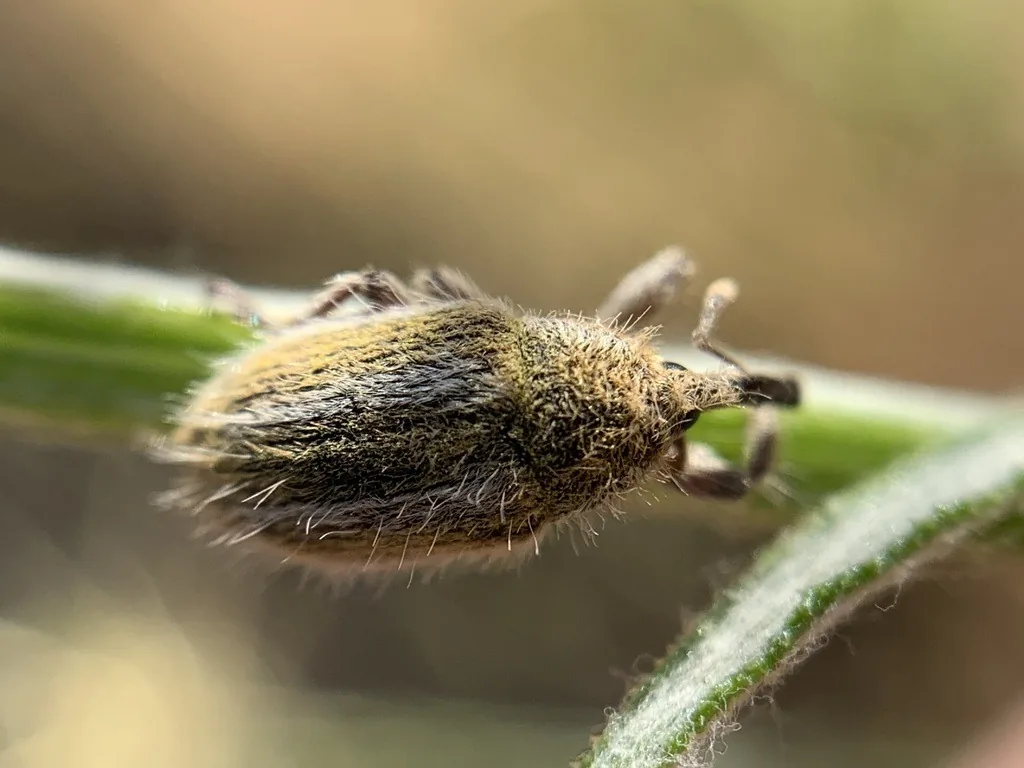
- Hairy weevil (Eustenopus villosus): 4 to 6 mm, oblong and cylindrical, brown with lighter lengthwise stripes, covered in long hairs, with a very long, slender snout. Look for it on seed heads and stems from early to midsummer and again in early fall; the holes it chews in the side of closed buds to lay eggs are capped with a dark substance and easy to see.[1]
- Bud weevil (Bangasternus orientalis): also 4 to 6 mm but somewhat flattened and cylinder-shaped with a short snout, brown with yellow-white hairs that make it look mottled. Its eggs, laid on leaflets or the stem just below the buds and covered with a dark protective material, are visible to the naked eye.[1]
- Flower weevil (Larinus curtus): 5 to 6 mm, oval-bodied with a medium-length snout, brown with white hairs, often dusted yellow with starthistle pollen. Through summer it is frequently found upside down, burrowed head-first into the florets of open flower heads.[1]
- Rosette weevil (Ceratapion basicorne): only 2 to 2.5 mm, teardrop-shaped, black with blue-green metallic wing covers, black to reddish legs and a long curved snout; males have an enlargement on the front shin. It rests on the undersides of rosette leaves in early spring and on bolting plants in early summer, and its adult feeding leaves characteristic windows in the leaf blade.[1]
- Larvae of the three seed-head weevils are all white, C-shaped grubs with brown heads up to 6 mm long, hidden inside the heads; the rosette weevil's larvae are under 3 mm and mine the leaf midrib down into the root crown. Dissect a head or a root crown to find them.[1]
Look-alikes
| Look-alike | How to tell them apart |
|---|---|
| Yellow starthistle seed-head flies (Chaetorellia australis, C. succinea, Urophora sirunaseva) | Three introduced flies whose larvae also feed in the seed heads, the gall fly Urophora making galls there. Adults are tan or black flies with banded clear wings and metallic eyes, not snouted beetles; C. succinea, never officially released, is widespread and with the hairy weevil is the most effective agent.[1][2] |
| Knapweed flower weevils (Larinus minutus and L. obtusus) | Related Larinus weevils released against spotted and diffuse knapweed, close relatives of yellow starthistle in the same genus Centaurea.[1] |
Where it lives
All four are native to Europe, western Asia and the Mediterranean, and all the North American stock came from Greece. The bud weevil was released in California from 1985 and is established in five western states; the hairy weevil went into California, Idaho, Oregon and Washington from 1990 and is established and widespread in seven western states; the flower weevil followed in the same four states from 1992, with later attempts in Arizona and New Mexico, and is established in four. The rosette weevil was released in California in 2020 to 2022 and Idaho in 2023, too recently to confirm establishment. UC IPM counts six insects and one rust fungus established on yellow starthistle in California, with the bud weevil, hairy weevil and gall fly widespread.[1][2]
Biology and life cycle
The hairy weevil overwinters as an adult in soil litter and emerges in spring as the weed bolts, feeding heavily on the early immature buds. In early to midsummer the female chews a hole in the side of a mature, still-closed bud, lays an egg inside and caps the hole. The larvae hatch through the summer, feed on the developing seeds through three stages and pupate in the head in a chamber of chewed seed and receptacle tissue; adults emerge in late summer. One generation a year.[1]
In eastern Washington, overwintered hairy and flower weevil adults appeared on the weed from May, built up and then declined by mid-August. The hairy weevil's rise tracked warming temperatures most closely, the flower weevil's tracked increasing starthistle cover one year and warming, drying soil the next, and both faded as the plants ran out of the buds and flowers they feed and breed in.[4]
The bud weevil lays up to 470 eggs in a lifetime, singly on leaflets or the stem just below the buds. The larva hatches in late spring and tunnels through the stem into the developing head, where it feeds on bracts, receptacle and seeds; the first stage mines the stem and bracts and stages two to four feed inside the head. Pupation is in the head, adults emerge in late summer and overwinter in litter, with one generation a year.[1]
The flower weevil is the late one: its overwintered adults do not emerge until summer, when the weed is in bud and flower, and they feed on florets and pollen. Eggs go singly into open flower heads at the base of the florets, the larvae eat developing seeds through three stages and pupate in the head, and the new adults overwinter in soil litter. One generation.[1]
The rosette weevil works the other end of the plant. Adults emerge in early spring and feed on rosette leaves, eggs are laid singly inside the midrib or blade, and the larva tunnels down the midrib into the root crown, feeding through three stages before pupating there in late spring or early summer. New adults emerge in early summer, feed for about two weeks and leave to overwinter in sheltered places. Several larvae can share one plant. One generation a year.[1]
Damage and signs
- Adult feeding by the hairy weevil kills a high proportion of young flower buds and delays mature flowering by two to three weeks, and its larvae can destroy every seed in an attacked head; it has the largest effect on the weed's reproductive output of any yellow starthistle agent and attacks up to 80 percent of heads in California. In an early California study its adult feeding stopped 60 to 70 percent of early buds from developing, 69 to 92 percent of heads were punctured, larvae occupied 27 to 49 percent of them, and larval feeding cost 34 to 47 percent of total seed.[1][3]
- Together with the fly Chaetorellia succinea the hairy weevil can cut seed production by more than 70 percent overall, which is thought to have driven significant declines of yellow starthistle at undisturbed sites where grasses and other plants compete with it. On disturbed ground such as roadsides no declines have been seen, and at many sites the plants compensate for lower density by growing larger and producing more heads and seeds. Parasites and predators may blunt the weevil's effect locally.[1]
- The bud weevil's larvae destroy about 60 percent of the seeds in the heads they attack, but after peaking a few years post-release its numbers have declined and it now attacks usually fewer than 15 percent of heads, held down by predation, parasitism and displacement by the other agents. The flower weevil also destroys about 60 percent of seed in attacked heads, but attack rates are typically low; it is common in parts of Oregon, moderate in Washington and scarce in Idaho and California. Adult feeding by both is superficial and does not harm the plant. Seed feeding never kills an existing plant; it reduces seed output and may slow spread.[1]
- Heavy larval mining by the rosette weevil can stunt growth and reduce seed production; its adult feeding windows on the leaves do no appreciable harm. UC IPM's summary of the whole program is that the hairy weevil and false peacock fly are the most effective agents, reducing seed production by about 50 percent, but that seed counts per plant remain high even so. All the agents are host-specific and no nontarget effects have been reported in North America.[1][2]
Health risk
These weevils are weed biocontrol agents and feed only on starthistle; none of these sources describes any risk to people. The weed itself is another matter: UC IPM warns that yellow starthistle is toxic to horses, causing a fatal neurological 'chewing disease' with no known treatment.[1][2]
Control
Prevention
Do not expect the insects to finish the job. UC IPM recommends combining biological control with other methods because even a 50 percent seed reduction leaves high seed numbers, and NAISMA notes the weevils work best where undisturbed grasses and forbs compete with the weed and poorly on disturbed roadsides, where the plants grow larger and out-produce the seed loss.[2][1]
Traps and physical control
To check for the weevils, look for capped egg holes in the sides of closed buds (hairy weevil), dark-covered eggs on the stem below the buds (bud weevil), weevils burrowed upside down in open flowers (flower weevil) or feeding windows on rosette leaves (rosette weevil), and dissect seed heads or root crowns for the grubs.[1]
Biological control
The weevils need no control; let them be. If you want them, the USDA and CDFA run the California program and the hairy weevil is already widespread and abundant across seven western states; the rosette weevil is the new agent, approved in 2019 and released from 2020.[2][1]
Common questions
- Which yellow starthistle weevil am I looking at?
- Size and snout settle most cases: a 4 to 6 mm hairy, striped weevil with a very long slender snout is the hairy weevil; a flattened mottled one with a short snout is the bud weevil; a 5 to 6 mm oval one burrowed into an open flower, often yellow with pollen, is the flower weevil; and a 2 mm black weevil with metallic wing covers on a rosette leaf is the rosette weevil.[1]
- Why is there still so much yellow starthistle if the weevils are everywhere?
- Seed feeding does not kill plants, the best agents cut seed by only about half, and on disturbed sites the plants compensate by growing bigger and making more heads. Declines have come where the weed also faces competition from grasses and other plants at undisturbed sites.[2][1]
- Can the weevils move to my pasture grasses or native plants?
- No. All the yellow starthistle agents are host-specific and do not harm crops or native plants, and no nontarget effects have been reported in North America.[2][1]
Sources
- North American Invasive Species Management Association (PDF hosted on Bugwood), “Randall, Smith and Milan. Yellow Starthistle Biocontrol Agents: History and Ecology in North America. In: Winston, ed., Biological Control of Weeds in North America, NAISMA-BCW-2023-14-YELLOW STARTHISTLE-A (2023).” bugwoodcloud.org/resource/files/27955.pdf (accessed 2026-11-10)
- University of California Statewide IPM Program, “Yellow Starthistle (Home and Landscape).” ipm.ucanr.edu/home-and-landscape/yellow-starthistle/ (accessed 2026-11-10)
- Insects (MDPI), “Pitcairn, Woods, Joley and Turner (California Department of Food and Agriculture, USDA-ARS). Evaluation of the impact of Eustenopus villosus on Centaurea solstitialis seed production in California. Insects 12: 606 (2021), doi:10.3390/insects12070606.” doi.org/10.3390/insects12070606 (accessed 2026-11-10)
- Environmental Entomology (Entomological Society of America), “Woodley, Zamora and Coffey (Washington State University). Environmental variables influence the association of Eustenopus villosus and Larinus curtus (Coleoptera: Curculionidae) adults with different growth stages of the invasive thistle Centaurea solstitialis in Washington State. Environmental Entomology 46: 319-327 (2017), doi:10.1093/ee/nvx011.” doi.org/10.1093/ee/nvx011 (accessed 2026-11-10)
- iNaturalist, “Eustenopus villosus taxon page (order and family).” www.inaturalist.org/taxa/466052 (accessed 2026-11-10)