On this page
How to identify it
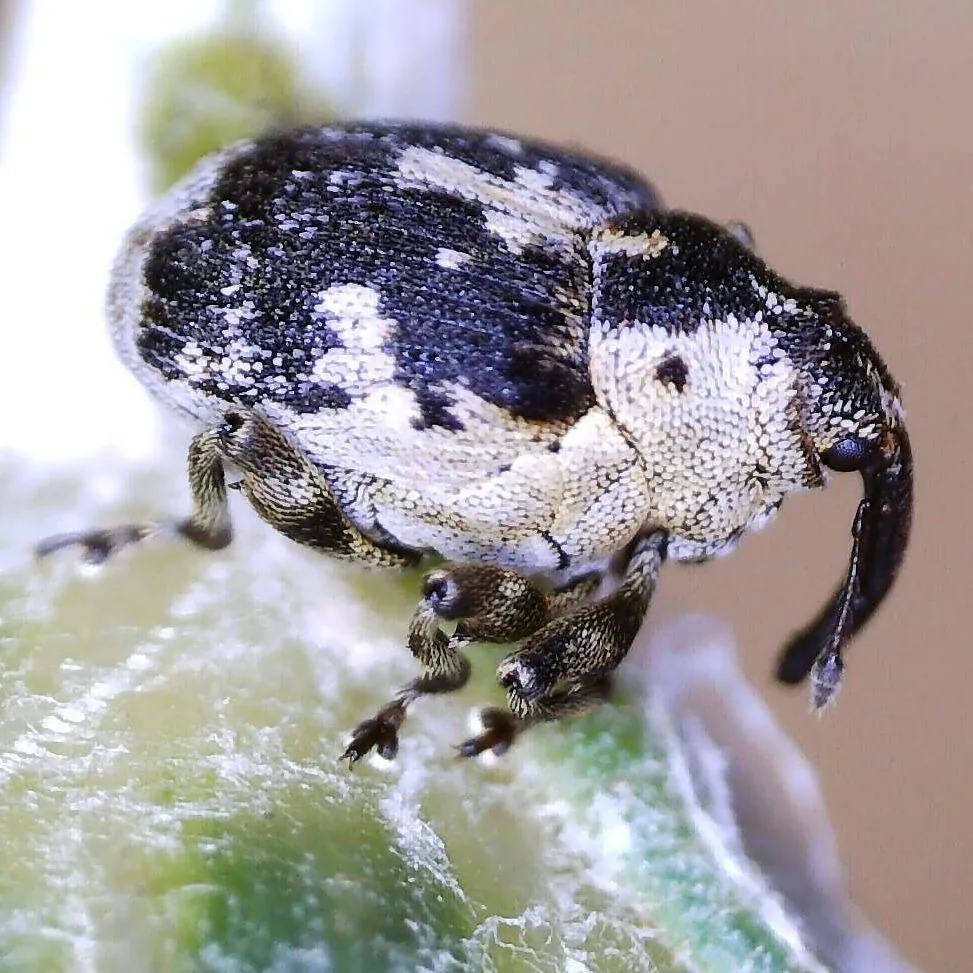
- Adults are thick-bodied weevils up to 4 mm long, mottled black and white, with a pale T-shaped mark on the back and a very long, curved snout.[1]
- Larvae are white, C-shaped grubs up to 3 mm long with a brown head, sometimes looking pointed at the front end. They live inside Canada thistle leaf veins, stems and root crowns and show only if a stem is split.[1]
- The mines are frass-filled and discolored and stay clearly visible in the dead stalks in late fall; each larva mines only 2 to 3 cm of stem.[2]
- Adults can be seen around Canada thistle rosette leaves and shoots in spring and early summer. The eggs, laid in the midvein on the underside of new rosette leaves, are hard to find.[1]
Look-alikes
| Look-alike | How to tell them apart |
|---|---|
| Musk thistle crown weevil (Trichosirocalus horridus) | About the same size with a long snout, but brown with white mottling and spines on the thorax, and its larvae feed at the root-stem junction of musk, plumeless and bull thistle rather than mining Canada thistle stems.[1] |
| Canada thistle bud weevil (Larinus carlinae) | A larger (up to 8 mm) black weevil with tan-yellow hairs whose larvae develop in the seed heads, not the stems.[1] |
Where it lives
Native to Europe. Populations from France, Germany, Italy and Switzerland were released in Ontario beginning in 1965 and redistributed through much of southern Canada; a German population was released across the United States from 1971. It prefers moist, disturbed ground where Canada thistle grows densely and the plants are not stressed by drought, grazing or other control. In Oregon it was well established in the lower, warmer west of the state by 1995, and a cold-adapted strain from Montana's Gallatin Valley was used to establish it in the east. Researchers have also studied it in Canada thistle stems in eastern North Dakota.[1][2][3]
Biology and life cycle
Overwintered adults leave the plant litter early in spring and feed on Canada thistle leaves and stems. Eggs are laid in spring in the midvein on the underside of new rosette leaves.[1]
The larvae mine the leaf veins, then the stems and root crowns, through spring and summer, passing through three stages; in North Dakota, eggs and larvae were found in stems from May through July. They pupate in the soil, and the new adults overwinter in litter. There is one generation a year.[1][3]
Canada thistle is its only host in North America. It has low reproductive and dispersal ability, so populations are usually small, though it is established at most Canadian release sites. On the Oregon refuge, by contrast, it spread to all parts of 1,800 hectares within seven years of release.[1][2]
Damage and signs
- Larval mining and adult feeding do little direct harm to Canada thistle populations, because the larvae typically eat only non-essential tissue and leave the vascular tissue alone. Over several years the mining does reduce root biomass when combined with other stresses, but even with other agents its overall impact appears limited.[1]
- Its exit holes let pathogens and other organisms into the stems; the Canada thistle rust fungus may get in this way, though that has not been studied directly.[1]
- Where larval populations are high the mines can outrun the growing shoot and kill its tip, and the plant then sprouts several shorter shoots from buds below. At the Oregon refuge 70 to 80 percent of plants were attacked each year from 2003 on, and by 2007 a third of the total stem length was mined, an unusually heavy infestation given how little stem each larva uses.[2]
- At that refuge, with the stem gall fly and the Canada thistle bud weevil also at work, Canada thistle fell from about 50 plants per square metre to about 8 between 1999 and 2007, plants grew shorter, and the refuge stopped spraying herbicide for thistle after 2004. The authors credit the combined stress from all three insects, which let the grasses outcompete the weakened thistle.[2]
Health risk
A plant-feeding weevil; none of these sources describes any risk to people.[1][2]
Control
Prevention
No control is needed. The stem weevil is an approved biological control agent of Canada thistle, and its only North American host is Canada thistle.[1]
Biological control
It does best in moist, disturbed ground with dense Canada thistle that is not being stressed by drought, grazing or other control methods, and its effect is largest alongside other agents and competing vegetation. In the Oregon program it was released as newly emerged adults in May and redistributed from the established colonies in the following years.[1][2]
Common questions
- What are the dark, frass-filled tunnels inside my dead Canada thistle stems?
- Larval mines of the Canada thistle stem weevil. The grubs mine the leaf veins, stems and root crown in spring and summer, and the discolored, frass-packed mines stay visible in the dead stalks in late fall.[1][2]
- Will the stem weevil get rid of Canada thistle?
- Not by itself. The larvae eat mostly non-essential tissue, and most studies find little direct impact. It helped most where it worked for years together with the stem gall fly and a seedhead weevil, as on an Oregon refuge where thistle density fell from about 50 to about 8 plants per square metre over a decade.[1][2]
- When are the adults out?
- Early spring to early summer, around the rosette leaves and shoots; the new generation emerges from the soil later and overwinters in plant litter.[1]
Sources
- North American Invasive Species Management Association (PDF hosted on Bugwood), “Introduced Thistle Biocontrol Agents: History and Ecology in North America. In: Winston, ed., Biological Control of Weeds in North America, NAISMA-BCW-2024-8-INTRODUCED THISTLES-A (2024).” bugwoodcloud.org/resource/files/29169.pdf (accessed 2026-11-10)
- USDA Forest Service (Treesearch 44760), “Markin (USDA Forest Service, Rocky Mountain Research Station) and Larson (Ladd Marsh Wildlife Refuge). Effective landscape scale management of Cirsium arvense (Canada thistle) utilizing biological control. In: Proceedings of the XIII International Symposium on Biological Control of Weeds, Session 9, pp. 423-428. USDA Forest Service, Forest Health Technology Enterprise Team (2013).” research.fs.usda.gov/treesearch/44760 (accessed 2026-11-10)
- Environmental Entomology (Entomological Society of America), “Gramig, Burns and Prischmann-Voldseth (North Dakota State University and Montana State University). Predicting developmental timing for immature Canada thistle stem-mining weevils, Hadroplontus litura (Coleoptera: Curculionidae). Environmental Entomology 44: 1085-1094 (2015), doi:10.1093/ee/nvv089.” doi.org/10.1093/ee/nvv089 (accessed 2026-11-10)
- iNaturalist, “Hadroplontus litura taxon page (order and family).” www.inaturalist.org/taxa/178013 (accessed 2026-11-10)