On this page
How to identify it
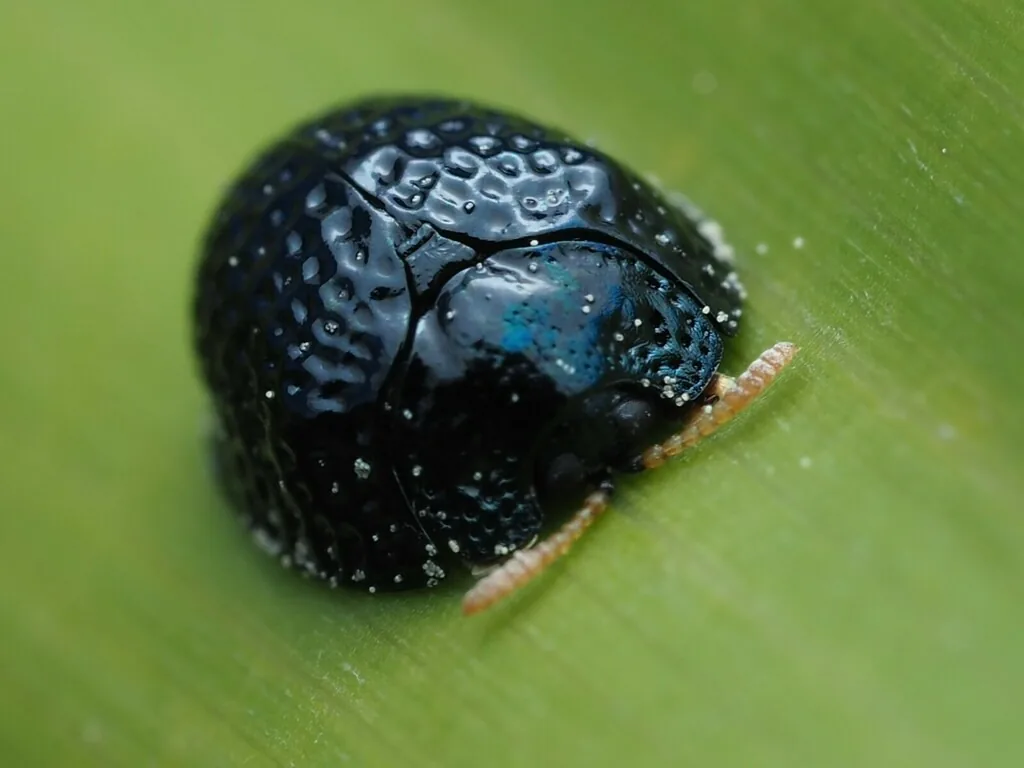
- Adults are about 1/4 inch, dark blue to purple and dome-shaped like a tortoise shell, with rows of pits and ridges on the wing covers.[1][2]
- The feet are greatly enlarged; when attacked or in high winds the beetle presses thousands of bristles to the frond and releases oil to hold on.[1][2]
- Larvae carry a dense, thatch-like shield of coiled dry frass on their backs.[1]
Where it lives
Recorded from Florida, Georgia, Alabama and Texas, probably Louisiana and Mississippi, and South Carolina, wherever its palms grow.[1][2]
Biology and life cycle
Eggs are cemented to leaves and covered with fecal pellets; larvae and pupae are found in mid to late summer, and adults all year.[1]
Larvae pupate under their frass shield on the leaf.[1]
Damage and signs
Health risk
Control
Prevention
Control is rarely needed; the beetles occasionally scar fronds but seldom harm the palm.[1][2]
Common questions
Sources
- University of Florida IFAS Extension (EDIS, Featured Creatures), “Palmetto Tortoise Beetle, Florida Tortoise Beetle, Hemisphaerota cyanea (EENY-232).” ask.ifas.ufl.edu/publication/IN388 (accessed 2026-10-16)
- Clemson Cooperative Extension Home & Garden Information Center, “Palmetto Tortoise Beetles: Masters of Camouflage.” hgic.clemson.edu/palmetto-tortoise-beetles-masters-of-camouflage/ (accessed 2026-10-16)
- iNaturalist, “Hemisphaerota cyanea taxon page (order and family).” www.inaturalist.org/taxa/126416 (accessed 2026-10-06)