On this page
How to identify it
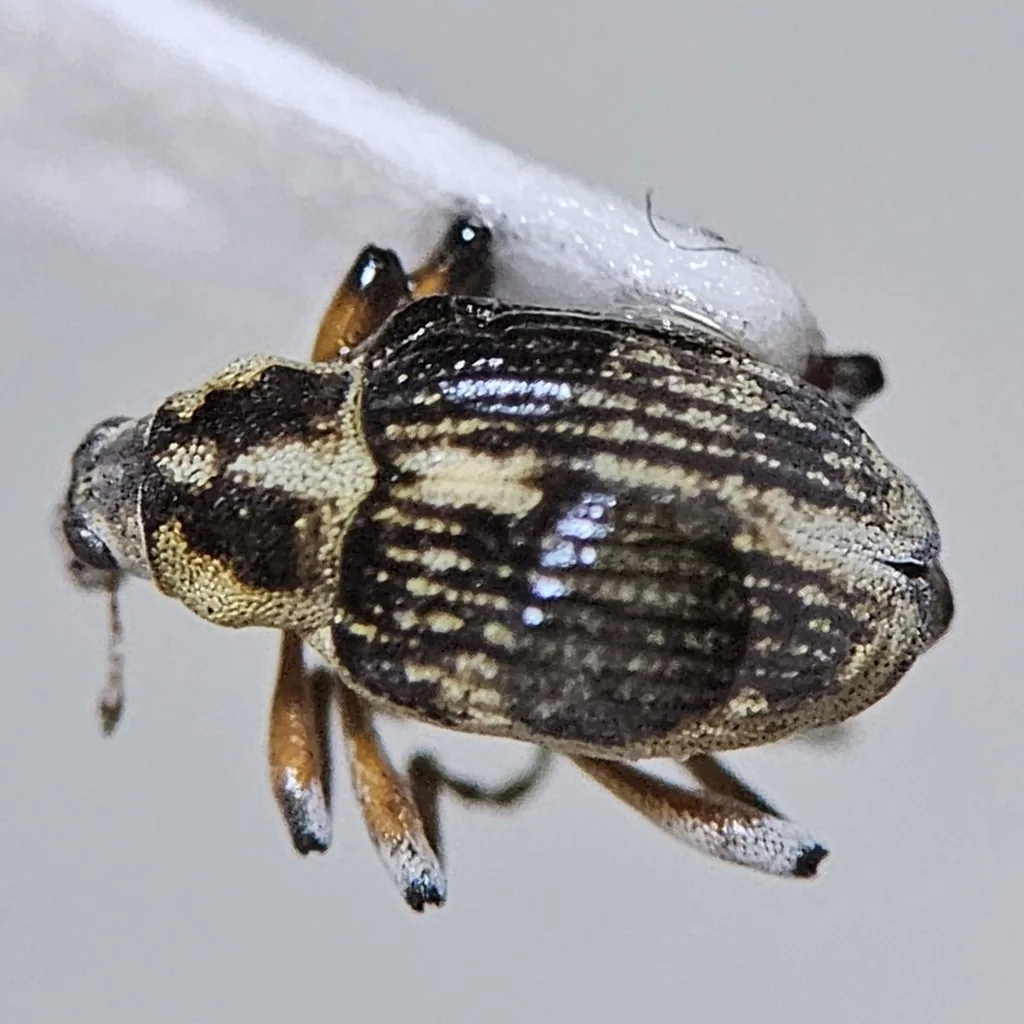
- Adults are 3 mm long, dark, with black and yellowish mottled stripes, and are found under water on the leaves and stems of watermilfoil, where they feed; the feeding scars show on the leaflets.[1]
- Larvae are whitish-tan when young and turn purplish-gray as they grow. They feed on the stem tips and then mine down inside the stems, and the pupa sits in a chamber inside the stem.[1]
- Eggs are yellow and laid singly on the plant tips through the growing season.[1]
Look-alikes
| Look-alike | How to tell them apart |
|---|---|
| Milfoil moth (Acentria ephemerella) | A European aquatic moth whose greenish, transparent larvae up to 12 mm mine milfoil leaflets and later feed on stem tips from shelters of plant material; it is widespread but feeds on many native aquatic plants and is not approved for redistribution in the United States.[1] |
Where it lives
Native to North America and widely distributed, occurring naturally on northern watermilfoil (Myriophyllum sibiricum) throughout northern North America and in Canada. It has been redistributed to Eurasian watermilfoil in multiple US states, and declines of the weed have been associated with it in some lakes in the Northeast, the Midwest and Washington State. In Canada it has not been redistributed for Eurasian watermilfoil control.[1]
Biology and life cycle
The weevil is fully aquatic through the growing season. Females lay yellow eggs singly on plant tips, the larvae feed on the tips and mine the stems, and pupation takes place in chambers inside the stems. Up to five generations are possible in a year, though three is more usual in the field. In late summer the adults move to shore and overwinter in leaf litter.[1]
Its original host is the native northern watermilfoil, but it does best on Eurasian watermilfoil. In University of Minnesota rearing trials, weevils raised on Eurasian milfoil developed faster and grew into larger adults than on any other milfoil, while the natives northern milfoil and M. verticillatum produced the smallest, slowest weevils. The weevils laid eggs on all four milfoils offered and completed development on three, but could not get past the larval stage on parrotfeather (M. aquaticum).[5]
It is a watermilfoil specialist. Offered seven aquatic plants, only three of 207 egg-laying females put an egg on anything other than a watermilfoil. Weevils reared on Eurasian watermilfoil preferred it, whereas weevils reared on northern watermilfoil showed no preference between the two, and two weeks of adult exposure to Eurasian milfoil was enough to shift preference toward it.[4][5]
The weevil finds its host by smell, or the underwater equivalent: it is attracted to glycerol and uracil released by Eurasian watermilfoil, and uracil is released in greater amounts by that species than by other milfoils. This was the first freshwater specialist insect shown to home in on chemicals released by its host plant.[6]
Damage and signs
- Larval mining of the stems and adult feeding on leaves and stems can suppress Eurasian watermilfoil where weevil densities are high, but most populations are too low for measurable, consistent control. Predation, water depth and temperature, plant quality, a lack of competing native plants and a shortage of suitable overwintering habitat on shore all limit the weevil and its impact.[1]
- At very high densities the weevil may also feed on other native Myriophyllum species, which is why NAISMA does not recommend moving it into water bodies that hold native milfoils.[1]
Health risk
A plant-feeding aquatic weevil; none of these sources describes any risk to people.[1][2]
Control
Prevention
Do not move weevils into lakes that hold native milfoil species. Interstate transport requires a USDA APHIS 526 permit, and collecting must be done with extreme care so that snails, mussels and other insects are not carried to a new lake along with the weevils. Minnesota describes weevil biocontrol as still under research, and requires a DNR permit for mechanical or herbicide control of invasive plants in public waters.[1][3]
Traps and physical control
Where the weed itself must go, Wisconsin notes that mechanical harvesting gives temporary relief for boating and swimming, and that hand harvesting by snorkelers or divers, though laborious and practical only for small infestations, removes the roots and lasts longer. An aquatic plant management plan can weigh these options together with herbicides and weevils in an integrated program.[2]
Biological control
Stocking weevils is a gamble. Augmentation with larvae or eggs has proven ineffective; adding adults may sometimes raise weevil numbers the following year. Open-field studies give mixed results, and none shows that weevil stocking achieves significant long-term control. A model built from 133 published studies and reports found that shallower lakes, more frequent weevil additions and more overwintering habitat on shore were the strongest predictors of success, and warned that augmentation, which is costly because the weevils are hard to find and rear, may not work in every lake.[1][2][7]
Common questions
- Can I buy milfoil weevils for my lake?
- They were at one point sold commercially, but results are mixed, stocking larvae or eggs does not work, and no field study shows long-term control from stocking. Moving weevils across state lines needs a USDA APHIS permit.[1][2]
- Will the weevils hurt native plants in the lake?
- They are watermilfoil specialists and lay almost no eggs on other plants, but at very high densities they may feed on native milfoils, so NAISMA advises against adding them where native milfoil species grow.[4][1]
- Why did the weevils disappear from my lake over winter?
- Adults leave the water in late summer to overwinter in shoreline leaf litter. The availability of suitable overwintering habitat is one of the factors that limits weevil populations, and the size of that habitat was among the strongest predictors of success in a review of 133 augmentation studies.[1][7]
Sources
- North American Invasive Species Management Association (PDF hosted on Bugwood), “Andreas (Washington State University Extension), Glisson and Parsons (Washington State Department of Ecology) and Muffley (Ada County Noxious Weed Control). Eurasian Watermilfoil Biocontrol Agents: History and Ecology in North America. In: Winston, ed., Biological Control of Weeds in North America, NAISMA-BCW-2024-3-EURASIAN WATERMILFOIL-A (2024).” bugwoodcloud.org/resource/files/33589.pdf (accessed 2026-11-10)
- Wisconsin Department of Natural Resources, “Eurasian watermilfoil (Myriophyllum spicatum).” dnr.wisconsin.gov/topic/Invasives/fact/EurasianWaterMilfoil.html (accessed 2026-11-10)
- Minnesota Department of Natural Resources, “Eurasian watermilfoil (Myriophyllum spicatum).” www.dnr.state.mn.us/invasives/aquaticplants/milfoil/index.html (accessed 2026-11-10)
- Oecologia (Springer), “Solarz and Newman (University of Minnesota). Oviposition specificity and behavior of the watermilfoil specialist Euhrychiopsis lecontei. Oecologia 106: 337-344 (1996), doi:10.1007/BF00334561.” doi.org/10.1007/BF00334561 (accessed 2026-11-10)
- Oecologia (Springer), “Solarz and Newman (University of Minnesota). Variation in hostplant preference and performance by the milfoil weevil, Euhrychiopsis lecontei Dietz, exposed to native and exotic watermilfoils. Oecologia 126: 66-75 (2001), doi:10.1007/s004420000484.” doi.org/10.1007/s004420000484 (accessed 2026-11-10)
- Journal of Chemical Ecology (Springer), “Marko, Newman and Gleason (University of Minnesota). Chemically mediated host-plant selection by the milfoil weevil: a freshwater insect-plant interaction. Journal of Chemical Ecology 31: 2857-2876 (2005), doi:10.1007/s10886-005-8399-7.” doi.org/10.1007/s10886-005-8399-7 (accessed 2026-11-10)
- Ecological Applications (Ecological Society of America), “White, Antoniou, Martin, Kmetz and Twiss. A machine-learning approach to predict success of a biocontrol for invasive Eurasian watermilfoil reduction. Ecological Applications 32: e2625 (2022), doi:10.1002/eap.2625.” doi.org/10.1002/eap.2625 (accessed 2026-11-10)
- iNaturalist, “Euhrychiopsis lecontei taxon page (order and family).” www.inaturalist.org/taxa/455883 (accessed 2026-11-10)