The short answer
- Identify the beetle first. Weevils (long snout) breed inside whole kernels and seeds, so check rice, popcorn, whole grains, dried beans, bird seed and decorative corn. Flour beetles and sawtoothed grain beetles can't attack whole, undamaged grain and live in flour, mixes, cereal and other processed foods. Drugstore and cigarette beetles eat almost anything dry, including spices and pet food.[2][3][1][5]
- Find every infested item, including ones outside the kitchen: bird seed, dry pet food, dried flower arrangements, decorations made of grain or beans, and old rodent bait. Throw them out in a sealed bag in an outdoor trash can.[5][3][4][8]
- Vacuum the shelves, cracks and corners, look under cans and jars, and empty the vacuum afterward.[2][4][3]
- Grain, beans or decorations you want to keep can be frozen or heated. Iowa State says 0°F for 3 days or 140°F for 15 minutes kills all weevil stages; other sources give longer times, listed below.[3][4][5][2]
- Store dry food in glass, metal or heavy plastic containers with tight lids. Insecticides aren't recommended in food cupboards; a spray kills a few adults but won't fix the problem.[3][4][1][5]
Pantry beetle and weevil profiles
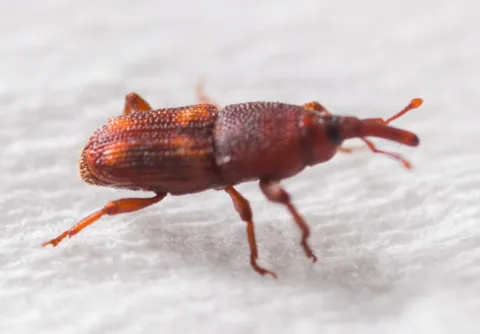 Rice Weevil
Sitophilus oryzae
Rice and granary weevils develop inside whole grains and seeds. Weevils in the house usually mean an infested package of whole grain or seed somewhere, such as popcorn, dried beans, saved seeds or decorative corn.
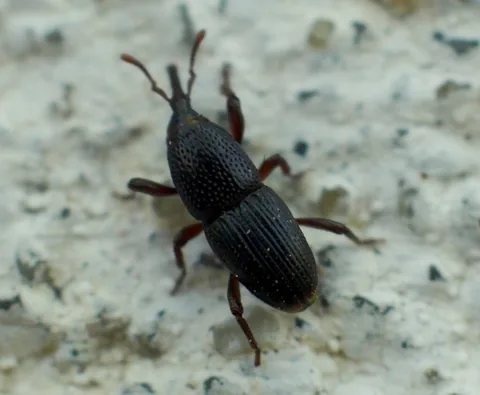 Granary Weevil
Sitophilus granarius
The granary weevil is a pest of stored grain and seeds. Its young develop hidden inside whole kernels, so the first sign in a home is usually small dark weevils near seeds, popcorn or decorative corn.
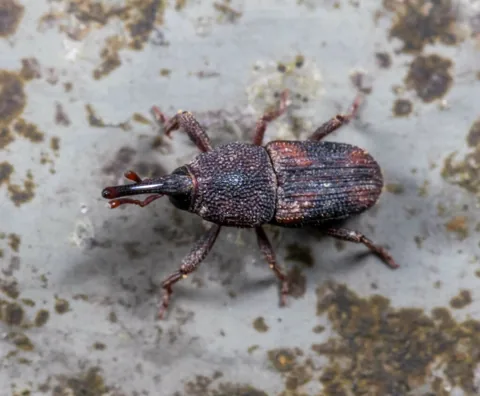 Maize Weevil
Sitophilus zeamais
The maize weevil is one of the most destructive pests of stored grain worldwide. Its larvae feed and grow hidden inside individual kernels, so the first thing most people notice is small, dark snout beetles near stored corn, grain or pasta.
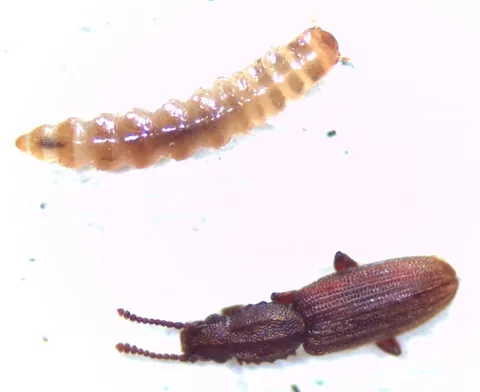 Sawtoothed Grain Beetle
Oryzaephilus surinamensis
The sawtoothed grain beetle is one of the most common beetles in home pantries; Georgia Extension rates it nearly as common as the Indianmeal moth. Both adults and larvae feed in dry foods of plant origin, and the first thing most people notice is small beetles crawling over shelves and counters.
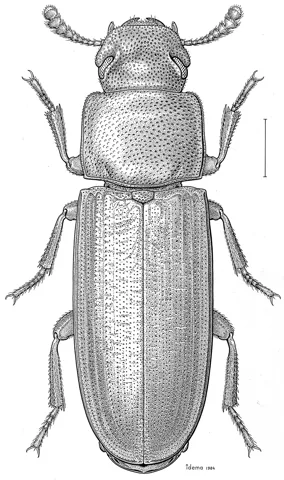 Confused Flour Beetle
Tribolium confusum
The confused flour beetle is a common pantry pest that feeds on flour, cereals, broken grain, nuts, dried fruit and many other dry foods.
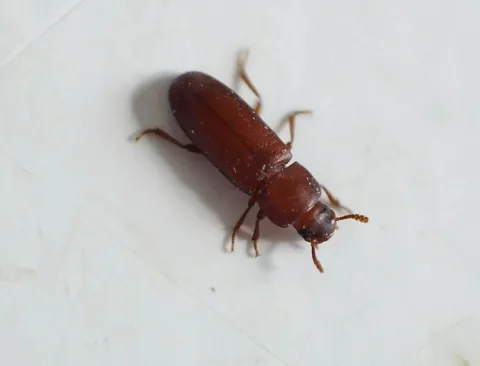 Red Flour Beetle
Tribolium castaneum
The red flour beetle is a shiny reddish-brown beetle that lives in flour, mixes and other processed or broken grain products; it can't chew into whole, sound kernels. Researchers call it a major storage pest.
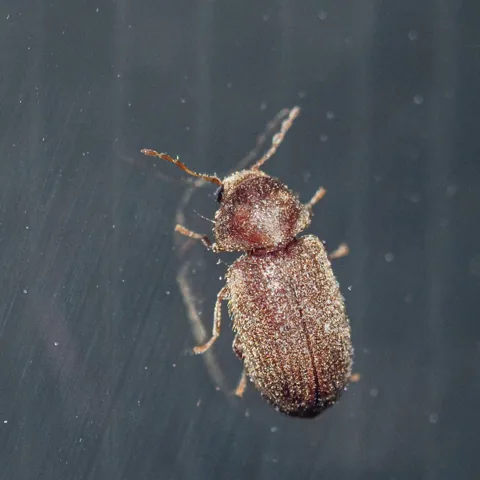 Drugstore Beetle
Stegobium paniceum
The drugstore beetle is a very general feeder said to "eat anything except cast iron"; in homes it most often infests pet food, drugs, cereals and spices.
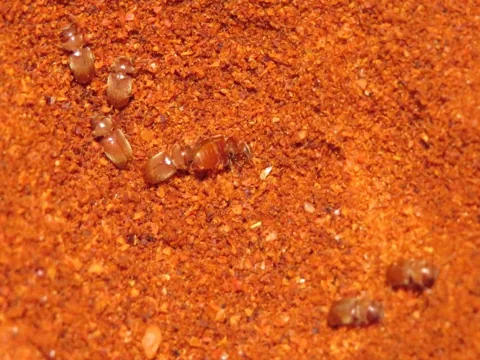 Cigarette Beetle
Lasioderma serricorne
The cigarette beetle is the most important insect pest of stored tobacco, and Texas A&M calls it the most common pantry pest in Texas. In homes its larvae feed in spices, pet food, flour, cereals and dried plant decorations.
Which pantry beetle do you have?
Most of these beetles are about 1/8 inch long and reddish brown, so a hand lens helps. The kind matters because it tells you which foods to search. Kentucky's point is that identifying the pest gives clues on where to look, though some of them live on a wide range of materials.[2][4][5]
Larvae you find in food can tell you whether you have beetles or moths. UC IPM says beetle larvae are either legless grubs or have only three pairs of legs, all close to the head. Moth larvae have three pairs of true legs plus extra leglike structures farther down the body, and they leave silk webbing. Moths have their own guide.[1]
- Rice and granary weevils: about 1/8 inch, slender and hard-shelled, with a long snout and a body pitted with tiny holes. Kentucky puts rice weevils at 1/8 to 1/4 inch. The rice weevil has four faint yellowish or pale spots on its wing covers (Georgia says wetting them slightly makes the spots show); the granary weevil is uniformly colored with no spots.[3][2][4][5]
- Maize weevil: Mississippi State says it looks so much like the rice and granary weevils that you need a microscope to tell them apart, and since control is the same for all three, you don't need to. Adults are 1/10 to 1/5 inch, larger when they grew up in corn.[10]
- Sawtoothed and merchant grain beetles: slender, flat and brown, about 1/10 inch, with six sawlike teeth along each side of the thorax behind the head. UC IPM says the two are managed the same way, so there's no need to separate them.[1][4][5]
- Confused and red flour beetles: shiny reddish brown, flattened and oval, about 1/8 to 1/7 inch (Georgia gives up to 3/16). UC IPM says the red flour beetle's antennae end abruptly in a three-segmented club, while the confused flour beetle's enlarge gradually.[1][4][5]
- Drugstore and cigarette beetles: about 1/8 inch, light brown and humpbacked, with the head tucked down so it can't be seen from above. The drugstore beetle has rows of grooves or pits on its wing covers and antennae ending in three enlarged segments; the cigarette beetle's wing covers are smooth and its antennae are saw-like and the same thickness from base to tip.[1][4][5][6][7][9]
- Other kernel and seed feeders: UC IPM lists the lesser grain borer and the bean weevil, and Georgia describes the cowpea weevil, whose larvae live inside dried beans and peas and leave round exit holes. UC IPM says they're managed like the other pantry beetles.[1][5]
- A hairy larva with a tail of long hairs in food is likely the warehouse beetle, whose shed hairs can irritate the mouth and gut. UC IPM says to throw out any food it infests; the pantry pests overview covers it, along with larder beetles and grain mites.[1]
Inside the kernel or outside: why it changes where you look
Pantry beetles split into two groups. Weevils lay eggs inside whole kernels and seeds. Georgia says the female chews a small pit in the kernel, lays an egg in it and seals it with a plug. The larva eats and pupates inside that one kernel, and Iowa State says there is generally no outside sign of it for about a month, until the adult chews its way out. That leaves a small round exit hole, which is what to look for in rice, corn, beans and nuts.[5][3][10]
Weevils need something hard to develop in. Georgia says weevil larvae need a food with a hard or semi-hard coating, such as corn, wheat, rice, dried peas, beans, nuts or bird seed. Mississippi State says maize weevils don't usually develop in flour, but will attack processed grain formed into shapes adults can chew into, such as macaroni, cereal and dog treats.[5][10]
The other beetles feed from the outside. Kentucky says flour beetles and sawtoothed grain beetles can't attack whole or undamaged grain, and Georgia says the grain has to be damaged or milled. They live in flour, meal, mixes, cereal, dried fruit, nuts, candy and the like. Drugstore and cigarette beetles are the least choosy: UC IPM quotes the old line that the drugstore beetle will "eat anything except cast iron."[2][5][1]
Where each beetle breeds
Start your search nearest to where most of the adults are, then widen it. Georgia suggests lightly shaking each open food container, because shaking brings small beetles to the surface. Kentucky says beetles are often found beneath cans and other items on the shelf. If the kitchen comes up clean, look elsewhere in the house; Clemson says infestations sometimes start in the garage, for example in a bag of dog food, and move into the kitchen as numbers grow.[5][2][8]
- Weevils: whole grains, rice, popcorn, dried beans and peas, nuts, bird seed, saved garden seeds, decorative Indian corn, seed decorations, bean bags and old grain-based mouse bait. Mississippi State adds macaroni, cereal and dog treats.[3][4][5][10]
- Sawtoothed grain beetles: almost any plant food, especially flour, meal, breakfast cereal, oatmeal, dried fruit, nuts, candy and chocolate, and also pet food, bird seed and rodent bait. Georgia says infested bird seed brought into the home is the origin of many sawtoothed grain beetle problems.[1][4][5]
- Flour beetles: flour above all, plus cracked grain, cake mixes, cereal, dried beans and peas, dried fruit, nuts, chocolate and spices.[4][1]
- Cigarette beetles: Kentucky finds them most often in dried dog food and paprika. UC IPM and Clemson add chili powder and other spices, pet food, cereal, nuts, candy, dried pepper arrangements, wreaths and dried flowers. Penn State adds old rodent baits and the flax tow stuffing in upholstered furniture, and Clemson notes infestations can start in bird seed or pet food that mice have stashed in an attic or wall.[2][1][9][7]
- Drugstore beetles: Kentucky finds them in bread, flour, meal, breakfast foods and red pepper. Georgia lists dried herbs and spices, dry pet food, dog bones, rodent bait, dried flowers, books and taxidermy mounts, often with round exit holes in dog treats and dried peppers. UC IPM says pet foods, drugs and cereals are the most common sources in homes.[2][5][1]
Why you find them on windowsills and far from the pantry
Several pantry beetles fly, and some head for light, which is why they end up on windowsills, counters and floors away from the infested food. Georgia says the adults are the stage that spreads an infestation and the one you see most, while larvae mostly stay in the food.[5][2][4][10]
Sources disagree on which flour beetle flies. Kentucky says the confused flour beetle flies and comes to lights while the red flour beetle crawls toward light but apparently doesn't fly. Illinois says the opposite, that the red flour beetle can fly and the confused flour beetle cannot, and Georgia also says red flour beetles can fly and are sometimes attracted to light.[2][4][5]
- Drugstore and cigarette beetles: both fly and are attracted to light, so they turn up away from the food they're breeding in.[2][4][5]
- Rice and maize weevils: fly, and Mississippi State says roaming adults keep turning up on cabinets and windowsills while infested food is still around. Illinois says the granary weevil does not fly. Georgia notes rice weevils sometimes play dead when disturbed.[4][10][5]
- Sawtoothed grain beetles: Kentucky says they neither fly nor are attracted to light, and Georgia says they don't commonly fly, so they're usually in or near the infested food.[2][5]
How beetles get into packages
Some pantry beetles are better at getting into food than moths are, so how you store food matters more. Georgia says drugstore beetles can chew through paperboard boxes, bags and aluminum foil. Sawtoothed grain beetles don't chew through packaging; they squeeze through tiny cracks and creases and sometimes hide in the outer layers until a package is opened. In a Kansas State and USDA study, sawtoothed grain beetles infested packages with 0.4 mm holes far more than intact ones, because females laid eggs at the holes and newly hatched larvae crawled in.[5][11]
Clemson says newly hatched cigarette beetle larvae are very active and enter small holes looking for food, and that a factory seal that isn't tight enough can let insects into unopened containers. Penn State says unopened items such as cake mixes can be infested with no outward sign.[9][8][7]
- Move dry food into glass, metal or heavy plastic containers that seal tightly. Illinois says that keeps beetles from getting in and keeps any that are already in a package from getting out. Penn State recommends airtight hard plastic containers, even for unopened mixes.[4][3][7]
- Don't buy broken or damaged packages; UC IPM says they are more likely to be infested.[1][4]
Long-lived adults mean a longer cleanup
Indian meal moth adults don't feed, but UC IPM says pantry beetles feed as both larvae and adults, and many live a long time, so a few survivors can restart the problem. Georgia says species whose adults feed can keep infesting food for several months to a year. UC IPM says some pantry pests can live for many weeks without food, so keep susceptible food in airtight containers, the refrigerator or the freezer for at least several months after the cleanup.[5][1]
Published adult life spans vary by source:[1]
- Sawtoothed grain beetle: UC IPM says an average of 6 to 10 months, with some living as long as 3 years. Georgia says 6 to 8 months or more.[1][5]
- Flour beetles: UC IPM says about one year on average, with some living almost four years. Kentucky says adult females live several months to more than a year.[1][2]
- Rice weevil: Kentucky says 6 to 8 months; Georgia says 3 to 6 months.[2][5]
- Cigarette beetle: Penn State says adults live 2 to 4 weeks, but a female can lay as many as 100 eggs, and the life cycle from egg to adult typically takes 6 to 8 weeks.[7]
Cleaning out a beetle infestation
The steps are the same as for any pantry pest: find and throw out infested food, vacuum, and store the rest sealed. The pantry moth guide walks through them in detail. A few points matter more with beetles.[2][8][1]
- Throw out heavily infested items outdoors in a tightly sealed bag. Iowa State says larger quantities of infested grain may need to be thrown out or professionally fumigated.[4][8][3]
- Vacuum shelves top and bottom with a crevice tool, paying attention to cracks and corners, then empty the canister or discard the bag so the beetles don't come back out.[2][3][4]
- Look under cans, jars and other items on the shelf, where Kentucky says beetles are often found.[2][1]
- Cleaning solutions don't kill them: Iowa State says washing shelves with detergent, bleach, ammonia or disinfectants has no effect on the insects. UC IPM still suggests soap and water for flat surfaces, while Clemson's cigarette beetle sheet says not to clean cabinets with water because it can leave a pasty residue the beetles like. Vacuuming is the step all three agree on.[3][1][9]
- Wash containers that held infested food before refilling them, and don't mix old and new food.[1][8]
Saving grain, beans and decorations with heat or cold
Freezing or heating kills beetles inside things you want to keep, such as a sack of grain, dried beans, or decorations made of corn, beans or dried flowers. Iowa State says it can save small amounts of weevil-infested grain. Sources give different times and temperatures; Illinois says the colder and the longer, the better. Georgia notes that results depend on the temperature actually reached inside the item, how long it's held there, the insect, and how well the item insulates it. The freezer guide covers bagging and thawing.[3][5]
- Iowa State: 0°F for 3 days or 140°F for 15 minutes kills all stages of rice and granary weevils in grain.[3]
- Illinois: 27°F or colder for at least 3 to 7 days, longer being better, or a 140°F oven for an hour.[4]
- Kentucky, for decorations such as Indian corn and dried flowers: 155°F for about 20 minutes with the oven door propped open, or 0°F for 4 days in a freezer that isn't self-defrosting.[2]
- Georgia, for items you can't throw out: 0°F to -2°F for six days in a household freezer, and longer for warehouse beetle.[5]
- Clemson suggests freezing grain products at 0°F for 3 days after you buy them as a habit.[9]
Do pantry beetle traps work?
Traps tell you whether beetles are still around; they don't get rid of them. Georgia says traps are for detecting pests and checking whether control worked, not for reducing numbers. Pick the right lure: UC IPM says traps made for the Indian meal moth won't attract beetles, but some traps carry lures for several pantry pests, including red and confused flour beetles, warehouse beetle and cigarette beetle. The flour beetle lures are aggregation pheromones that draw both sexes, and some traps also contain food oil.[5][1]
UC IPM says to set traps where the infestation was, check them weekly, and inspect food again whenever a new batch of beetles shows up. Most traps work for about three months. Georgia adds that traps lose their pull when they're dirty or crowded with insects.[1][5]
Should you spray for pantry beetles?
Mostly no, though sources differ in degree. UC IPM, Iowa State and Illinois don't recommend insecticides for pantry pests; Illinois says any control is temporary unless the infestation is removed. Clemson calls spraying a last resort. Georgia says an insecticide can knock down visible adults but won't solve the problem if that's all you do. Penn State's cigarette beetle sheet is the exception: after cleaning, it suggests an insecticide registered for indoor use applied into cracks and crevices.[1][3][4][8][5][7]
If you do use one, read the label first, never apply it to food, and treat only cracks and crevices. Illinois says any food an insecticide touches must be thrown out, and cupboards, containers and dishes washed and dried before use. Clemson says to remove all food first, skip surfaces used for food storage or preparation, and let the treatment dry before food goes back.[5][4][9][8]
Are pantry beetles and weevils harmful?
Not to people directly. Iowa State says rice and granary weevils can't bite or sting, don't carry disease and won't damage furniture, clothing or the house; the harm is to the food they infest. Clemson says no diseases have been associated with pantry pests but their presence makes food unfit to eat.[3][8]
Infested food is contaminated, though. UC IPM says some beetle larvae give food a disagreeable odor and taste, and that pantry pests can bring in microbes that produce mycotoxins, especially in warm, humid storage. The one beetle UC IPM singles out for direct harm is the warehouse beetle, whose shed hairs can irritate the mouth, throat and stomach.[1]
Keeping beetles out
Georgia says sanitation plays a very important role in denying these beetles food, and UC IPM notes that most home infestations keep going on spills in cupboard crevices and on opened packages kept for a long time.[5][1]
- Store open packages in sealed containers or in the refrigerator or freezer. UC IPM suggests keeping rarely used flour, grains and spices in the freezer.[5][1]
- Write the purchase date on packages and use older ones first. Buy amounts you'll use in a short time; Clemson's cigarette beetle sheet says 2 to 4 months.[5][4][9]
- Keep bird seed and dry pet food in tightly sealed containers, and Georgia suggests storing bird seed away from the kitchen.[5][1]
- Inspect grains and seeds when you buy them and buy only sealed, undamaged packages.[8][4][1]
- Keep the pantry dry and ventilated; UC IPM says moisture favors pantry pests and dryness discourages them.[1][9][8]
- Don't leave rodent baits out for long, and get rid of rodent nests near the house; UC IPM says some pantry insects breed in them and move indoors.[8][1]
When to call a professional
Georgia suggests a pest management professional if an infestation keeps going after you've searched and cleaned, and says a good technician's inspection should lead to the likely infested item, since finding it is still the key. Iowa State and Penn State point to professionals for fumigating large amounts of grain; Penn State calls fumigation a last resort because registered fumigants are highly toxic.[5][3][6]
Next steps
These pages pick up where this one stops.[1]
Common questions
- Why do I keep finding weevils even after I threw out the rice?
- Something else in the house is probably infested. Weevils also breed in popcorn, dried beans, bird seed, nuts, saved seeds, decorative corn, bean bags, old mouse bait, and shaped products like macaroni and dog treats. Adults also live for months, and rice and maize weevils fly, so stragglers keep turning up for a while.[3][4][10][2][5]
- Is it safe to eat food with weevils in it?
- The weevils themselves don't carry disease, but infested food is contaminated with insects and their by-products, and Clemson says their presence makes food unfit to eat. Sources recommend throwing infested food out.[3][8][1]
- How did beetles get into a sealed package?
- Either they were in it when you bought it or they got in through a tiny flaw. Drugstore beetles can chew through paperboard, bags and foil, sawtoothed grain beetle larvae crawl through holes as small as 0.4 mm, and a factory seal that isn't tight can let insects in.[5][11][8]
- What are the tiny beetles on my windowsill?
- Often drugstore or cigarette beetles, which fly and are attracted to light, or rice or maize weevils, which also fly. They're breeding in food or dried material somewhere nearby, sometimes spices, pet food or decorations rather than the pantry.[2][4][5][10]
- Will freezing kill weevils and beetles?
- Yes, if it's cold enough for long enough. Iowa State says 0°F for 3 days kills all weevil stages; Illinois gives 27°F or colder for 3 to 7 days and Georgia six days at 0°F to -2°F.[3][4][5]
- Can flour beetles get into whole rice or grain?
- Not into whole, undamaged kernels. Kentucky says flour beetles and sawtoothed grain beetles can't attack them, and Georgia says the grain has to be damaged or milled. Beetles in whole rice or popcorn are more likely weevils, which develop inside the kernel.[2][5][3]
Photo credits
- Rice Weevil: (c) portioid, some rights reserved (CC BY) — via iNaturalist, CC BY 4.0
- Granary Weevil: (c) Roman, some rights reserved (CC BY) — via iNaturalist, CC BY 4.0
- Maize Weevil: (c) portioid, some rights reserved (CC BY) — via iNaturalist, CC BY 4.0
- Sawtoothed Grain Beetle: (c) aubrey_moore, some rights reserved (CC BY) — via iNaturalist, CC BY 4.0
- Confused Flour Beetle: Bousquet et al. 2018, Catalogue of Tenebrionidae of North America, ZooKeys 728, Figure 30 (CC BY 4.0) — via Wikimedia Commons, CC BY 4.0
- Red Flour Beetle: (c) Roman, some rights reserved (CC BY) — via iNaturalist, CC BY 4.0
- Drugstore Beetle: (c) Arsen Vorobei, some rights reserved (CC BY) — via iNaturalist, CC BY 4.0
- Cigarette Beetle: (c) Ezequiel Vera, some rights reserved (CC BY) — via iNaturalist, CC BY 4.0
Sources
- University of California Statewide IPM Program, “Pest Notes: Pantry Pests (Home and Landscape).” ipm.ucanr.edu/home-and-landscape/pantry-pests/ (accessed 2026-11-10)
- University of Kentucky Entomology, “ENTFACT-612: Stored Product Pests in the Pantry (L. Townsend).” entomology.mgcafe.uky.edu/ef612 (accessed 2026-11-10)
- Iowa State University Extension and Outreach, Yard and Garden, “Rice Weevil and Granary Weevil.” yardandgarden.extension.iastate.edu/encyclopedia/rice-weevil-and-granary-weevil (accessed 2026-11-10)
- University of Illinois Extension, “Common Pantry Pests.” extension.illinois.edu/sites/default/files/common_pantry_pests.pdf (accessed 2026-11-10)
- University of Georgia Cooperative Extension, “Bulletin 1378: Stored Product Pests in the Home (Suiter, Toews and Ames).” fieldreport.caes.uga.edu/publications/B1378/ (accessed 2026-11-10)
- Penn State Extension, “Drugstore Beetle (D. Calvin).” extension.psu.edu/drugstore-beetle (accessed 2026-11-10)
- Penn State Extension, “Cigarette Beetle (S. Jacobs).” extension.psu.edu/cigarette-beetle (accessed 2026-11-10)
- Clemson Cooperative Extension, Home & Garden Information Center, “HGIC 2439: Pantry Pests.” hgic.clemson.edu/factsheet/pantry-pests/ (accessed 2026-11-10)
- Clemson Cooperative Extension, Home & Garden Information Center, “HGIC 2413: Cigarette Beetles.” hgic.clemson.edu/factsheet/cigarette-beetles/ (accessed 2026-11-10)
- Mississippi State University Extension Service, “Bug's Eye View: Maize Weevils, Vol. 7, No. 1 (B. Layton).” extension.msstate.edu/taxonomy/term/4171/2021/maize-weevils-vol-7-no-1 (accessed 2026-11-10)
- Journal of Economic Entomology, abstract via PubMed, “Mowery and others 2002, Mechanisms underlying sawtoothed grain beetle infestation of consumer food packaging materials.” pubmed.ncbi.nlm.nih.gov/12539851/ (accessed 2026-11-10)