The short answer
- Find the source. Check every package of grain products, flour, cereal, dried fruit, nuts, chocolate, spices, dry pet food and bird seed, especially opened ones. Webbing inside a package or tiny holes in it are the signs to look for.[1][4][3]
- Throw out anything infested. Kentucky calls disposal the best way to eliminate the problem; Clemson says to bag it and put it in an outdoor trash can with a tight lid.[3][5]
- Clean the shelves. Vacuum shelves, corners and cracks with a crevice attachment, both upper and lower surfaces.[3][1]
- Hunt down wandering larvae and cocoons on walls and ceilings, because full-grown caterpillars leave the food to pupate and become the next moths.[1][6][5]
- Freeze what you want to keep: Kentucky suggests 0°F for 4 days in a freezer that isn't self-defrosting.[3]
- Store dry food in containers with tight-fitting lids. Plastic bags aren't adequate.[1][4]
- Use a pantry-moth pheromone trap to tell whether moths are still around after the cleanout. It catches males only, so it's a warning light, not the cure.[1][6]
- Skip the bug spray. UC IPM says insecticides aren't recommended for any pantry pests, and spraying near food may do you more harm than the moths.[1][4]
Pantry moth profiles
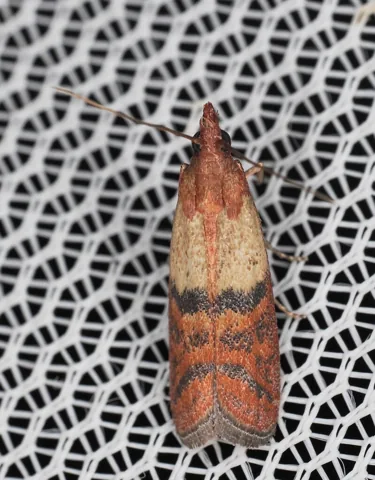 Indianmeal Moth
Plodia interpunctella
The Indianmeal moth is the most common moth infesting stored food in the home; all damage is done by the larvae, which feed in cereals, flour, nuts, dried fruit, chocolate and pet food.
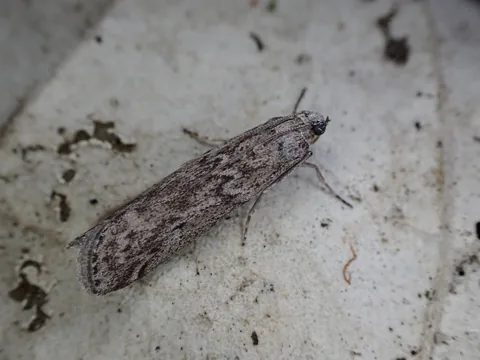 Mediterranean Flour Moth
Ephestia kuehniella (also listed as Anagasta kuehniella)
The Mediterranean flour moth is a gray pantry moth whose caterpillars line flour and other dry foods with silk webbing. Washington State University calls it a frequent food-infesting moth in homes, though less common than the Indian meal moth.
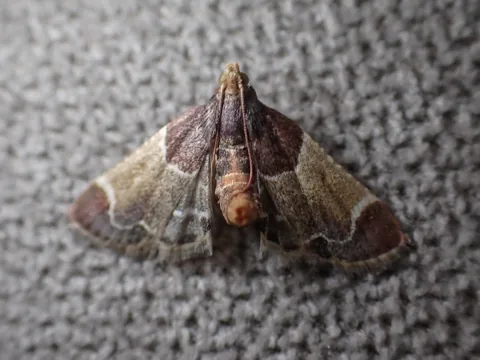 Meal Moth
Pyralis farinalis
The meal moth is a stored-food moth whose caterpillars feed on cereals, flour, meal, seeds and similar material, especially when it is damp or spoiled. It turns up in grain warehouses and in damp spots such as moist basements, and it is mostly a minor pest.
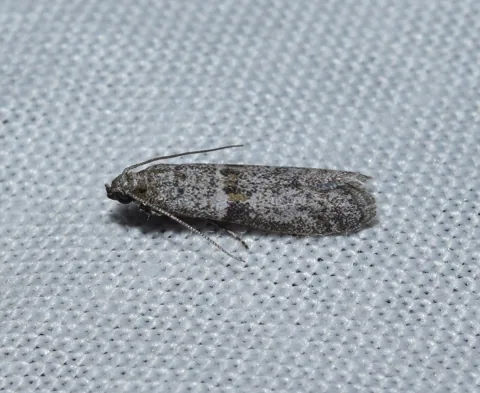 Almond Moth
Cadra cautella
The almond moth, also called the tropical warehouse moth, is a pantry moth whose caterpillars infest dried fruit, nuts, grain, seeds and candy. Despite the name, the University of Florida says its preferred foods are dried figs and dates.
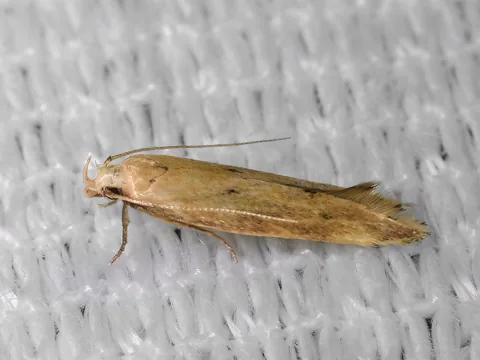 Angoumois Grain Moth
Sitotroga cerealella
The Angoumois grain moth is a primary pest of stored grain: its caterpillars develop entirely inside single kernels, so infested corn or wheat can look normal until moths appear. USDA's stored-grain handbook calls it the moth most commonly found in infested grain in the United States.
Is it a pantry moth?
The moth that turns up in kitchens most often is the Indian meal moth (Plodia interpunctella); UC IPM calls it the most common moth found on food products in the home. A less common one is the Mediterranean flour moth (Ephestia kuehniella). Both have caterpillars that spin webbing in and around the food they eat.[1][6][7]
- Indian meal moth adult: forewings reddish brown with a coppery luster on the outer two-thirds and whitish gray on the inner part. UC IPM gives the body as 1/3 to 2/5 inch long with a wingspan of about 3/5 inch; Kentucky says 1/2 inch long; Clemson gives a wingspan of about 1/2 inch and Washington State 1/2 to 3/4 inch.[1][3][4][6]
- Indian meal moth larva: dirty white, often with a pink, greenish or brownish tint depending on its food. UC IPM and Washington State put a full-grown larva at about 1/2 inch; Clemson gives 1/4 to 3/4 inch.[1][6][4]
- Mediterranean flour moth adult: about one inch across the wings, with grayish forewings crossed by dark zigzag lines and off-white hindwings. Washington State says the easiest clue is the resting pose: it raises the front of its body so the wings slope down, with the tip of the abdomen poking up between them.[7]
- Mediterranean flour moth larva: white to whitish pink and about 1/2 inch when mature. It prefers flour and meal but also infests grain and other foods, and its loose webbing is characteristic.[7][8]
- Clothes moth instead? Clothes moths are about 1/4 inch long at rest, roughly half the length of most food moths. They flutter close to the infested fabric, while food moths fly steadily around the house, often toward lights.[2][5]
- When you'll see them: Clemson notes that the first sign is often pinkish white caterpillars crawling over countertops or up the wall or ceiling, or a few brownish moths flying in an irregular pattern in the kitchen a few hours after sunset.[4]
Why the moths keep coming back
All the damage is done by the larvae. A female Indian meal moth lays her eggs on or near food, and Clemson says she starts about 3 days after becoming an adult and lays 200-300 eggs over 1-18 days. The caterpillars feed inside a tunnel of silk and droppings, then leave the food to pupate.[1][4]
- Larvae travel: when an infestation is heavy, UC IPM says mature larvae turn up in parts of the house far from the food. Washington State and Clemson say they often pupate on walls, countertops and ceilings, which is why you find cocoons where there's no food at all.[1][6][5]
- How long a generation takes: sources give different numbers. Kentucky says the life cycle can be as short as 25 days. UC IPM says six to eight weeks for egg, larva and pupa in warm weather. Clemson's figures are longer: eggs hatch in 7-8 days, larvae feed for 6-8 weeks and the pupal stage lasts 15-20 days.[3][1][4]
- Packages aren't a wall. Clemson says the larvae can get through packaging materials and even polythene film. In a Kansas State and USDA lab study, older larvae chewed into all three types of polypropylene energy-bar wrapper tested; the thickest film held up best.[4][11]
- It outlasts the cleanup. Pantry pests can live for weeks without food, so UC IPM says the threat of reinfestation lasts until the remaining insects die off or are killed.[1]
Step 1: find every infested item
By the time moths are flying, the larvae have usually spread beyond the first package. Kentucky's fact sheet says the source is often a partly used box or bag forgotten at the back of a shelf, and the more insects you see, the older the infestation. Go through everything once, carefully: a hasty search means doing it again.[1][3]
- Foods to check: cereal and grain products, flour and cornmeal, rice, dried fruit and vegetables, nuts, chocolate and candy, powdered milk, crackers, dried peppers, herbs and spices. Kentucky says Indian meal moths prefer coarse flours and corn meal; the Mediterranean flour moth favors flour.[1][3][4][8]
- Pet food and bird seed: Clemson says household infestations are often traced to these, because both sit in large amounts in places nobody watches. Check the garage and the shed too; Clemson notes infestations can start in a bag of dog food in the garage and spread to the kitchen.[4][5]
- Non-food items: if the pantry comes up clean, Kentucky says to look at decorative items such as Indian corn, dried flower arrangements and bird seed.[3]
- What a bad package looks like: silk webbing in the tight corners of a box or bag, tiny holes, larvae or cocoons. Destroy any package that shows the slightest sign.[1][5]
- Rodent bait counts too: Clemson says old rat baits and dead rodents can serve as infestation sites, so don't leave baits out for long periods.[5]
Step 2: throw out, then clean
Infested food can be contaminated with insect hairs, droppings, webbing and secretions, so throw it out. Clemson says to bag it and dispose of it only in an outdoor trash can with a tight lid. Then clean the empty shelves before anything goes back.[1][5]
- Vacuum first: go over shelves, both upper and lower surfaces, with a crevice attachment in the cracks and corners, then vacuum the pantry floor. UC IPM says that removes eggs and pupae hiding in the crevices.[3][1][5]
- Water or not: sources disagree. UC IPM says to wash shelves with soap and water. Clemson's Indian meal moth sheet says not to clean cabinets with water because it can leave a pasty residue the moths like; it relies on vacuuming. Whichever you do, let shelves dry fully before restocking.[1][4]
- Containers: wash reusable containers that held infested food before refilling them.[5][1]
- Seal the gaps: Clemson suggests caulking cracks and crevices where spilled food collects and making sure shelf paper lies flat.[5]
- Larvae and cocoons on walls and ceilings: Washington State recommends physically destroying the larvae and pupae before they become adults. For Mediterranean flour moths it adds that adults can be swatted.[6][7]
Step 3: freeze or heat what you keep
Freezing or heating kills the insects in items worth saving, but sources give different times and temperatures. For infested food itself, Kentucky's first choice is still to throw it out. The freezing guide has the general method for other household items.[3][4]
- Freezer: Kentucky says 0°F for 4 days in a freezer that isn't self-defrosting. Clemson says to freeze at 0°F and calls freezing grain products for 3 days after purchase a good habit. Clemson's pantry pest sheet suggests a few days in the freezer for items not meant to be eaten.[3][4][5]
- Why not just a day: the Indian meal moth is one of the most cold-tolerant stored-product pests. In a University of Minnesota lab study, adults didn't survive at -20°C, but larvae and pupae responded differently depending on stage and cold acclimation, so give the freezer its full time.[9]
- Oven: for decorative items such as Indian corn, dried flowers or bird seed, Kentucky gives 155°F for about 20 minutes with the oven door propped open.[3]
- What the research shows on heat: in a Kansas State lab study, wandering larvae were the most heat-tolerant stage, and killing 99% of them took at least 34 minutes at 50°C. Heat treatments that kill those larvae should kill the other stages too.[10]
Pheromone traps: what they can and can't do
Pantry-moth traps use a sex pheromone that pulls male moths onto a sticky surface. They don't attract females at all. If they catch males before mating, UC IPM says they may cut down on egg-laying, but the main job is detecting moths, not ending an infestation. The pheromone trap guide covers trap types in detail.[1][6]
- Match the lure: a trap made for the Indian meal moth won't attract pantry beetles. Some traps carry lures for several pantry pests at once.[1]
- Placement and checks: put traps where the infestation was and check them weekly. UC IPM says each new batch of moths in a trap means it's time to inspect food packages again.[1]
- Keep one out afterward, since pantry pests can live for weeks without food.[1]
- Mass trapping evidence: research on pheromone suppression comes from commercial buildings, not homes. In replicated pet food and grocery stores, Campos and Phillips found mass trapping, attract-and-kill and mating disruption suppressed Indian meal moths in most weeks compared with untreated buildings, but mass trapping's adult catch was statistically similar to untreated stores in most weeks.[12]
- Kentucky's point applies here: seeing adults tells you there's an infestation, but killing adults doesn't solve it.[3]
What about insecticides?
UC IPM doesn't recommend insecticides for any pantry pests and warns that spraying on or near food may harm your family more than the moths would. Clemson treats sprays as a last resort and not strongly recommended.[1][5]
- If you do spray: Clemson says to use a household insecticide labeled for pantry pests, remove all food and clean the cabinets first, and aim only at cracks and crevices.[4][5]
- Never spray food, or surfaces used for food storage or preparation, or where appliances and utensils are kept. Let the treatment dry before food goes back, and Clemson suggests covering shelves with clean shelf paper.[4][5]
Keeping pantry moths out
Clemson calls good sanitation the best prevention and control, and says that following a few rules usually clears the problem quickly. UC IPM recommends that for at least several months after a cleanout you keep susceptible food in airtight containers, the refrigerator or the freezer.[4][1]
- Containers: move products out of cardboard, paper or plastic into jars or other containers that seal tightly. UC IPM says plastic bags aren't adequate, and Clemson notes factory seals can fail too.[3][1][5]
- Buy smaller amounts: Clemson's Indian meal moth sheet says to buy only what you'll use in 2 to 4 months; its pantry pest sheet says no more than you'll use in two months.[4][5]
- Check at the store: buy only sealed packages without insect damage, and inspect grains and seed when you bring them home.[4][5]
- Use the freezer: UC IPM suggests keeping rarely used flours, spices and grains in the freezer if you can.[1]
- Pet food and bird seed: store bulk supplies in containers with tight-fitting lids too.[1]
- Keep it dry and clean: wipe up spills, pay attention to corners and crevices, and fix moisture problems in the pantry.[5][4]
Common questions
- Where do pantry moths come from?
- Usually from an infested food package, often an old opened one at the back of a shelf, or from bulk pet food or bird seed. Clemson says infestations can also start at the store when a factory seal doesn't keep insects out.[3][4][5]
- Why are there worms on my ceiling?
- Those are full-grown Indian meal moth larvae leaving the food to find a place to pupate. They commonly crawl up walls and onto ceilings. Destroy them and their cocoons, then find the food they came from.[6][5][4]
- Can I eat food that had pantry moths in it?
- The insects aren't known to carry disease, but Clemson says their presence makes food unfit to eat, and UC IPM notes infested food is contaminated with hairs, droppings, webbing and secretions. Throw it out.[5][1]
- Do pheromone traps get rid of pantry moths?
- Not on their own. They catch only males and are mainly for finding moths and confirming the cleanout worked. Removing infested food is what ends the problem.[1][3]
- How long does it take to get rid of pantry moths?
- It depends on finding every infested item. UC IPM says it takes persistent effort, and because pantry pests can live for weeks without food, keep a trap out and check it weekly for a while after the cleanout.[1]
- Are pantry moths the same as clothes moths?
- No. Clothes moths are smaller and flutter near the infested fabric. Food moths are about twice as long and fly steadily around the house.[2]
Photo credits
- Indianmeal Moth: (c) Rosario Douglas, some rights reserved (CC BY) — via iNaturalist, CC BY 4.0
- Mediterranean Flour Moth: (c) dr_robert, some rights reserved (CC BY) — via iNaturalist, CC BY 4.0
- Meal Moth: Joshua S. Martin, public domain (CC0), via iNaturalist
- Almond Moth: (c) Sunčana Bradley, some rights reserved (CC BY) — via iNaturalist, CC BY 4.0
- Angoumois Grain Moth: Boza48, public domain (CC0), via iNaturalist
Sources
- University of California Statewide IPM Program, “Pest Notes: Pantry Pests (Home and Landscape).” ipm.ucanr.edu/home-and-landscape/pantry-pests/ (accessed 2026-11-10)
- University of California Statewide IPM Program, “Pest Notes: Clothes Moths (Home and Landscape).” ipm.ucanr.edu/home-and-landscape/clothes-moths/ (accessed 2026-11-10)
- University of Kentucky Entomology, “Stored Product Pests in the Pantry (Entfact 612).” entomology.mgcafe.uky.edu/ef612 (accessed 2026-11-10)
- Clemson Cooperative Extension, Home & Garden Information Center, “Indian Meal Moth.” hgic.clemson.edu/factsheet/indian-meal-moth/ (accessed 2026-11-10)
- Clemson Cooperative Extension, Home & Garden Information Center, “Pantry Pests.” hgic.clemson.edu/factsheet/pantry-pests/ (accessed 2026-11-10)
- Washington State University Extension, “Indian meal moth (Pestsense).” pestsense.cahnrs.wsu.edu/fact-sheet/indian-meal-moth/ (accessed 2026-11-10)
- Washington State University Extension, “Mediterranean flour moth (Pestsense).” pestsense.cahnrs.wsu.edu/fact-sheet/mediterranean-flour-moth/ (accessed 2026-11-10)
- University of Minnesota, “Mediterranean Flour Moth (Radcliffe's IPM World Textbook).” ipmworld.umn.edu/mediterranean-flour-moth (accessed 2026-11-10)
- Journal of Economic Entomology, abstract via PubMed (PMID 15889756), “Carrillo et al. 2005, Relationship between supercooling point and mortality at low temperatures in Indianmeal moth.” pubmed.ncbi.nlm.nih.gov/15889756/ (accessed 2026-11-10)
- Bulletin of Entomological Research, abstract via PubMed (PMID 17201971), “Mahroof and Subramanyam 2006, Susceptibility of Plodia interpunctella developmental stages to high temperatures used during structural heat treatments.” pubmed.ncbi.nlm.nih.gov/17201971/ (accessed 2026-11-10)
- Insects, abstract via PubMed (PMID 29669990), “Scheff et al. 2018, Evaluating penetration ability of Plodia interpunctella larvae into multilayer polypropylene packages.” pubmed.ncbi.nlm.nih.gov/29669990/ (accessed 2026-11-10)
- Journal of Economic Entomology, abstract via PubMed (PMID 24665735), “Campos and Phillips 2014, Attract-and-kill and other pheromone-based methods to suppress populations of the Indianmeal moth.” pubmed.ncbi.nlm.nih.gov/24665735/ (accessed 2026-11-10)