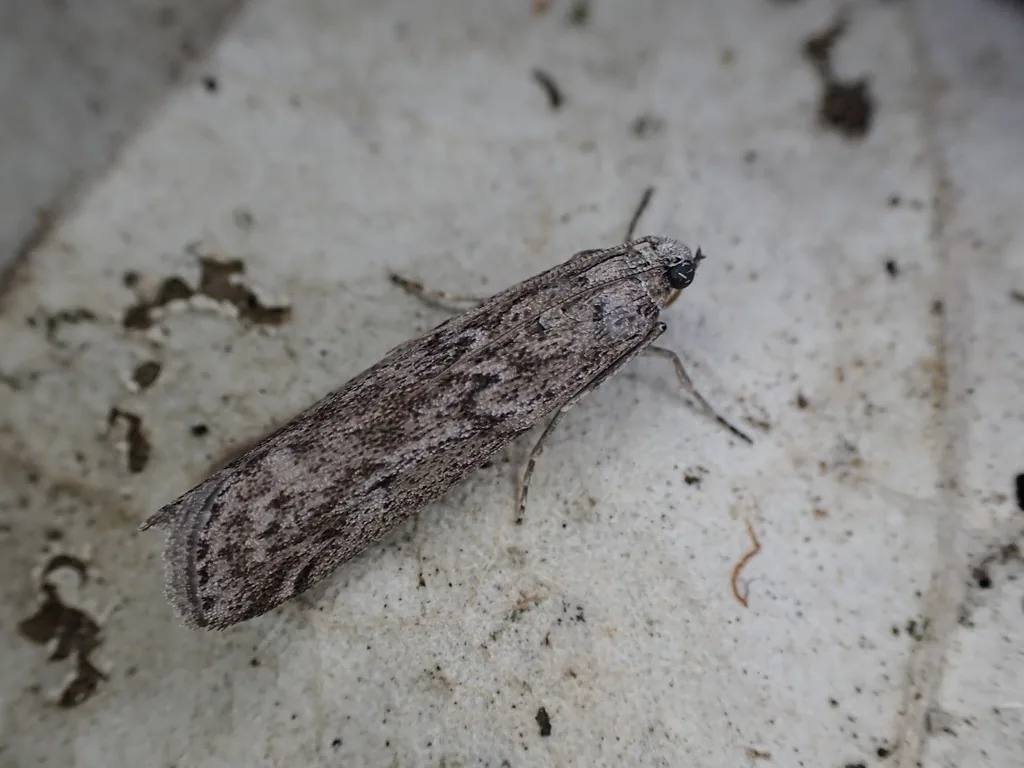
How to identify it
- The forewings are pale gray, crossed by two dark zigzag lines, and the hind wings are off-white.[2][3]
- Wingspan is about 1 inch or a little less.[2][3]
- At rest it raises the front of its body so the wings slope downward, with the tip of the abdomen poking up between them.[3]
- Caterpillars are white to whitish pink, reach about 1/2 inch, and live inside silk tubes they spin in the food.[3][2]
Look-alikes
| Look-alike | How to tell them apart |
|---|---|
| Indian meal moth | Its forewings are two-toned, whitish gray near the body and reddish brown with a coppery sheen on the outer two-thirds, not evenly gray with zigzag bands.[1] |
| Clothes moths | Smaller and hairier than pantry moths, and their larvae feed on wool and other animal fibers rather than stored food.[1] |
Where it lives
Found worldwide in temperate and subtropical climates, usually arriving in homes inside an infested food package.[2][4][1]
Biology and life cycle
A female can lay several hundred eggs on or near food, and the eggs hatch in three to five days.[2][4]
The full life cycle takes about nine to ten weeks, with four or five generations a year under favorable conditions.[2]
Adults don't feed and live only a short time; all the damage comes from the caterpillars.[4]
Larvae particularly favor flour, and heavy infestations produce enough webbing to clog mill machinery.[4][2]
Damage and signs
Health risk
The moths don't bite or sting. Infested food is spoiled by webbing and droppings, and pantry pests may bring in microbes that can form mycotoxins in warm, humid storage.[1]
Control
Prevention
Keep flour, cereal and pet food in tightly sealed containers, and store rarely used flours and grains in the freezer.[3][1]
Sanitation
Find the webbed package that started the problem and throw it out, sealed, outside the house.[3][1]
Check every opened package for webbing in folds and corners or tiny holes, then vacuum and wash shelves before restocking.[1]
Traps and physical control
Crush wandering caterpillars and pupae before they become breeding adults, and swat adult moths.[3]
Pesticides
Washington State University lists no recommended chemical controls, and UC IPM advises against insecticides for pantry pests.[3][1]
Common questions
- Why is my flour full of webbing and clumps?
- Mediterranean flour moth caterpillars spin silk tubes as they feed, which binds flour into webbed clumps; discard the flour.[2][3]
- Is this the same as the Indian meal moth?
- No. Both are pantry moths handled the same way, but the Indian meal moth has two-toned, coppery forewings while this moth is gray with zigzag lines.[1][2]
Sources
- University of California Statewide IPM Program, “Pest Notes: Pantry Pests, Publication 7452.” ipm.ucanr.edu/home-and-landscape/pantry-pests/ (accessed 2026-10-06)
- University of Florida, Entomology and Nematology Department, “Mediterranean flour moth, Anagasta kuehniella (stored product pests image gallery).” entnemdept.ufl.edu/projex/gallery/dl/stored_product_pests/text/mediterranean_flour_moth.htm (accessed 2026-10-06)
- Washington State University Extension, “Mediterranean flour moth (PestSense fact sheet, reviewed December 2025).” pestsense.cahnrs.wsu.edu/fact-sheet/mediterranean-flour-moth/ (accessed 2026-10-06)
- University of Minnesota, “Mediterranean Flour Moth (Radcliffe's IPM World Textbook).” ipmworld.umn.edu/mediterranean-flour-moth (accessed 2026-10-06)
- iNaturalist, “Ephestia kuehniella taxon page (order and family).” www.inaturalist.org/taxa/324640 (accessed 2026-10-06)